


Through billion-dollar investments, policy reforms, and infrastructure expansion, governments are racing to attract AI innovation, top talent, and data centres, betting that today’s investments will fuel tomorrow’s economic growth, technological leadership, and job creation.
Artificial intelligence has become one of the defining economic and geopolitical priorities of the decade. Governments are no longer competing only through regulations or research grants. Instead, they are investing billions of dollars in data centers, semiconductor manufacturing, cloud infrastructure, and AI ecosystems to attract technology companies, top talent, and long-term capital.
Among global leaders, French President Emmanuel Macron and Indian Prime Minister Narendra Modi have emerged as two of the most proactive advocates for AI investment. Both leaders have personally engaged with technology executives, promoted their countries as AI destinations, and backed policies designed to strengthen domestic AI capabilities.
Although France and India approach the opportunity from different starting points, both are pursuing the same objective: securing a meaningful position in the global AI economy.
AI Has Become a National Economic Priority
The race to lead in artificial intelligence extends far beyond developing advanced chatbots or large language models. Today, governments view AI as a strategic asset that can accelerate economic growth, boost productivity, strengthen national security, and create high-value jobs.
To build a globally competitive AI ecosystem, countries must invest heavily in hyperscale data centres, semiconductor supply chains, cloud infrastructure, and a highly skilled workforce. At the same time, they must create policies and business environments that encourage innovation and attract long-term private investment. Nations that succeed in securing these assets stand to gain a lasting competitive edge across industries ranging from healthcare and manufacturing to finance, defence, and scientific research.
Against this backdrop, France and India have stepped up their efforts to position themselves as preferred destinations for the world’s leading AI companies. Through investment incentives, infrastructure development, and supportive policy frameworks, both countries are competing to attract the capital, talent, and technology that will shape the next generation of AI innovation.
Macron Is Leveraging France’s Infrastructure Advantage
France has made AI a central pillar of its industrial strategy, with President Emmanuel Macron taking an unusually active role in attracting international technology investment.
One of the country’s biggest wins came in May 2026, when SoftBank announced plans to develop 3.1 gigawatts (GW) of AI data center capacity in France by 2031. The project forms part of a broader €75 billion national initiative aimed at deploying 5 GW of AI-focused data center infrastructure.
According to SoftBank founder Masayoshi Son, Macron personally reached out to discuss the investment, maintaining direct communication throughout the negotiations. Son later revealed that Macron highlighted France’s abundant nuclear-powered electricity supply and encouraged SoftBank to increase the project’s capacity from the originally proposed 2 GW to 3.1 GW.
Reliable low-carbon electricity has become one of France’s strongest competitive advantages as AI data centers require enormous amounts of continuous power. With roughly two-thirds of France’s electricity generated through nuclear energy, the country can offer both energy stability and lower carbon emissions compared with many competing locations.
Building an AI Ecosystem Beyond Infrastructure
Macron’s strategy extends beyond physical infrastructure.
During the G7 Summit hosted by France in June, he brought together several of the world’s leading AI executives for discussions with global political leaders. The gathering included executives from OpenAI, Anthropic, Google DeepMind, Mistral AI, Cohere, Synthesia, Domyn, and Black Forest Labs.
By facilitating direct engagement between policymakers and AI companies, France hopes to position itself not only as a location for data centers but also as a center for AI research, startup development, and commercial innovation.
The approach reflects Macron’s broader ambition to make France one of Europe’s leading AI hubs.
Modi Is Positioning India as an AI Growth Engine
India faces a different set of opportunities and challenges.
Unlike France, India does not yet manufacture advanced AI chips at scale and has not produced frontier AI foundation models comparable to those developed in the United States or China. However, it offers something equally attractive to technology companies: a vast digital economy, one of the world’s largest developer communities, rapidly expanding internet adoption, and a massive domestic market.
Prime Minister Narendra Modi has made attracting AI investment a national priority.
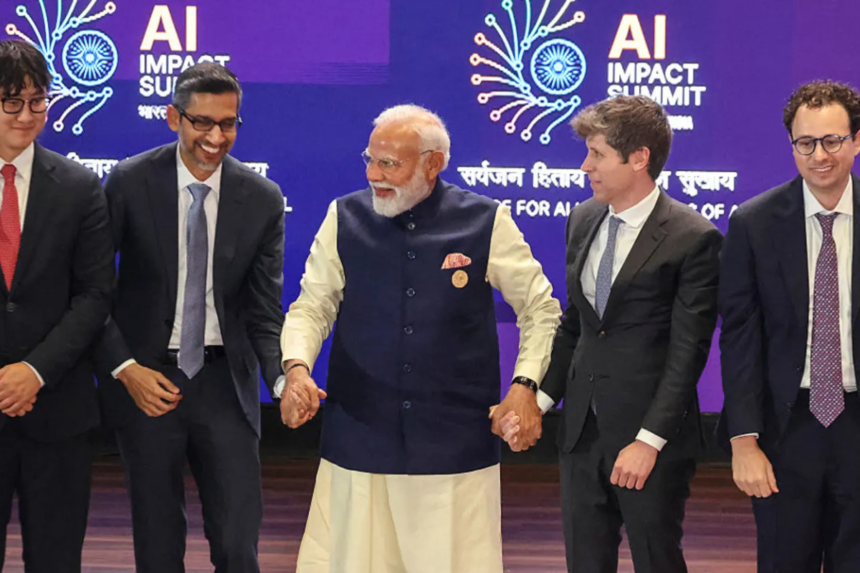
Speaking at the Global AI Summit in February, Modi emphasized India’s long-term ambitions, declaring:
“India does not see fear in AI. India sees fortune in AI. India sees the future in AI.”
He encouraged global companies to “Design and Develop in India,” positioning the country as both a development center and a future global AI market.
Securing Commitments From Global Technology Companies
Rather than attempting to build the entire AI ecosystem independently, India has focused on attracting global technology leaders through investment commitments and strategic partnerships.
In recent months, Modi has met executives from several of the world’s largest technology companies.
Last week, he met Amazon CEO Andy Jassy, welcoming the company’s planned $48 billion investment in India. According to government statements, approximately $21 billion of that investment will support AI and cloud infrastructure.
Earlier engagements with Microsoft CEO Satya Nadella, Google CEO Sundar Pichai, and Intel CEO Lip-Bu Tan have also resulted in significant commitments aimed at expanding India’s AI capabilities.
Microsoft announced what it described as its largest investment in Asia to strengthen India’s AI infrastructure. At the same time, Google committed $15 billion toward building what the company says will become its largest AI hub outside the United States.
Incentives for Data Centers and Semiconductor Manufacturing
Recognizing that AI leadership requires more than software development, India’s government has introduced policies to encourage long-term infrastructure investment.
The government has offered tax incentives to hyperscale cloud providers building AI data centers while simultaneously encouraging domestic semiconductor manufacturing.
During Modi’s visit to the Netherlands earlier this year, ASML, the world’s leading supplier of advanced semiconductor lithography equipment, agreed to provide technology for Tata Electronics’ 300-millimeter semiconductor fabrication facility.
Intel has also indicated interest in purchasing chips produced by Tata Electronics, providing additional confidence in India’s emerging semiconductor ecosystem.
These developments represent important steps toward reducing India’s dependence on imported computing hardware.
Different Strengths, Shared Ambitions
Although France and India share the same goal of attracting AI investment, each brings a distinct set of competitive advantages to the table.
France leverages its abundant nuclear energy, mature infrastructure, political stability, and close access to the European technology market. Together, these strengths make the country especially attractive for energy-intensive AI data centres and large-scale computing infrastructure.
India, by contrast, capitalizes on its scale. It combines a vast engineering talent pool with a rapidly expanding digital economy, a thriving startup ecosystem, and strong government backing. As a result, the country has become an increasingly compelling destination for AI development, software engineering, and cloud infrastructure.
Ultimately, both governments understand that the AI race is about far more than today’s technologies. Companies that establish data centres, research facilities, and semiconductor operations make long-term commitments that often span decades, creating lasting economic value, driving innovation, and strengthening national competitiveness.
Why the Competition Matters
The competition to attract AI investment has intensified because the technologies developed today will shape future economic competitiveness.
Countries that successfully build AI ecosystems are likely to benefit from higher productivity, greater technological independence, stronger innovation, and new employment opportunities. Those that fail to build sufficient infrastructure risk becoming dependent on foreign computing resources, cloud providers, and AI models.
India continues to face challenges, particularly its reliance on imported semiconductors and frontier AI models. France, despite its infrastructure strengths, must compete with larger investment programs emerging across the United States, the Middle East, and parts of Asia.
Nevertheless, both Macron and Modi have demonstrated that attracting AI investment now requires more than favorable regulations. It increasingly depends on direct engagement with technology leaders, long-term infrastructure planning, and national strategies capable of convincing global companies that their next generation of AI innovation should be built locally.
As artificial intelligence reshapes industries and economies worldwide, the countries that secure today’s investments are likely to influence tomorrow’s technological landscape.
Read more news, and follow us on Instagram
Source: CNBC
India’s Prime Minister Narendra Modi (C) takes a group photo with AI company leaders including OpenAI CEO Sam Altman (2nd R), Anthropic CEO Dario Amodei (R), Google CEO Sundar Pichai (2nd L), and Meta Chief AI Officer Alexandr Wang (L), at the AI Impact Summit in New Delhi on February 19, 2026.
Ludovic Marin | Afp | Getty Images