

Tim Cook Steps Aside, But Not Away
The announcement that Tim Cook will step down as CEO of Apple follows a familiar script. It highlights a 15-year tenure defined by scale, stability, and expansion. It also introduces John Ternus as a capable successor with deep product expertise.
Then, however, one line reframes the entire transition.
Cook will remain executive chairman, with a mandate that includes engaging with policymakers around the world.
This is not ceremonial language. Instead, it signals where real power will continue to sit.
The Real Job Apple Cannot Hand Over
“Engaging with policymakers” points to a precise and critical responsibility. Apple operates between two global powers, the United States and China, that increasingly pull in opposite directions.
On one side, Apple relies heavily on China for its supply chain. On the other hand, it faces intense regulatory scrutiny from Washington. Both sides demand compliance, and neither tolerates misalignment.
Against this backdrop, Cook has spent years managing this delicate balance. Now, he will focus on it full-time.
John Ternus Takes the Product Engine
Meanwhile, John Ternus steps into the CEO role with clear strengths. He has spent more than two decades within Apple’s hardware organization, shaping the company’s core products.
His track record includes leading major product transitions and overseeing critical hardware developments. He understands Apple’s engineering culture and execution model at a granular level.
In effect, he fits the role of an operator—he runs the machine.
However, he does not yet carry the external relationships that exist beyond it.
Diplomacy Becomes the Center of Power
Apple’s biggest risk is no longer product failure. It is geopolitical friction.
Tariff threats on China-based manufacturing have already shown how quickly margins can come under pressure. The company’s supply chain cannot shift overnight. Rebuilding it would take years, possibly longer.
Cook understood this early. He built direct relationships with political leaders, engaged consistently, and made strategic commitments when required.
Those actions protected Apple in ways balance sheets alone could not.
That capability is now formalized under his new title.
A Rare Division of Roles at the Top
Most leadership transitions aim for clean breaks. Apple has chosen overlap instead.
Ternus manages operations, product, and execution. Cook manages external pressure, policy risk, and political alignment.
This is not redundancy. It is a specialization.
The company separates what can be scaled from what must be handled personally.
Why the Transition Holds Together
Cook’s influence does not transfer through a memo or a meeting. It comes from years of accumulated trust, access, and negotiation.
Ternus will need time to build that layer. Until then, removing Cook from that position would create a gap Apple cannot afford.
The transition acknowledges that reality.
What This Signals About Apple’s Future
Apple’s structure now reflects its operating environment. Technology leadership alone is no longer sufficient at this scale. Political navigation is as important as product innovation.
Cook remains in the role that absorbs that pressure. Ternus inherits the role that drives growth.
One builds the future. The other protects it.
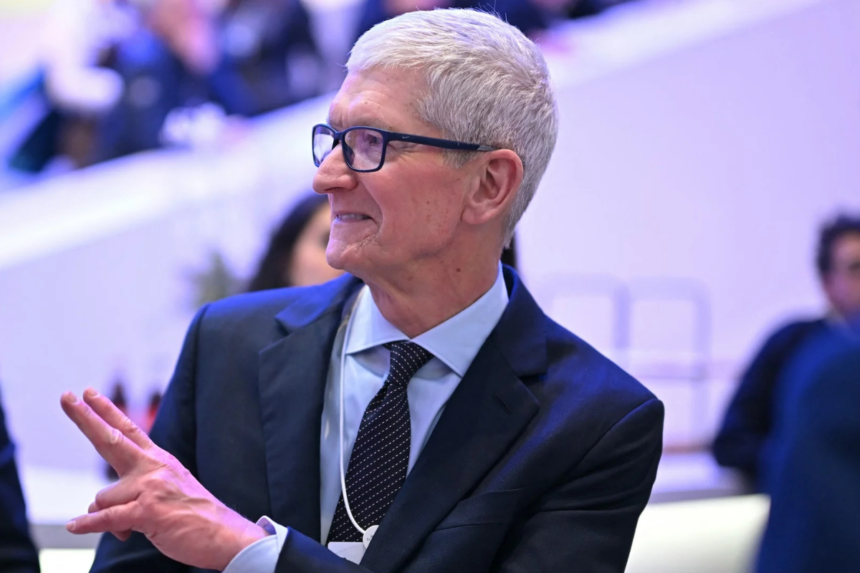
US businessman Tim Cook gestures as he departs after a business leaders’ reception with the US President on the sidelines of the World Economic Forum (WEF) annual meeting in Davos on January 21, 2026. The World Economic Forum takes place in Davos from January 19 to January 23, 2026. (Photo by Fabrice COFFRINI / AFP)
Source: INC