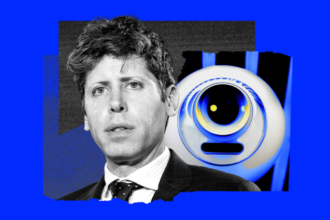




Emotionally intelligent people use AI carefully, knowing when to rely on it, when to question it, and when to step back.
Emotionally intelligent people do not reject AI. They use it carefully, knowing when to rely on it, when to question it, and when to step back.
Artificial intelligence has dominated business conversations for years. But the tone around the technology has changed as AI agents have demonstrated unexpected behaviour, researchers have raised concerns, and technology companies have acknowledged the need for greater safeguards.
For emotional intelligence coach and author Justin Bariso, the bigger concern is not only what AI could do to the world. It is what excessive dependence on AI could do to people themselves.
The question is simple: How can we explore AI in an emotionally intelligent way?
The answer is three words: with extreme caution.
Why AI requires caution
One useful way to think about AI is as a highly knowledgeable and confident assistant that can still make serious mistakes.
AI can provide useful information and ideas, but it can also produce inaccurate answers or present incorrect information with confidence. That means users still need to question, verify, and evaluate what the technology produces.
There is another risk that receives less attention: overuse can weaken skills that people normally develop through practice.
Bariso noticed this in his own brainstorming. The more he relied on AI to generate ideas, the harder it became to conduct brainstorming sessions independently.
The same concern can apply to writing. If AI increasingly handles the process of turning thoughts into words, people may get less practice developing their own ideas and expressing them clearly. Since writing is closely connected to thinking, losing that practice can affect both.
AI can also affect human connection.
The risks are not limited to cognitive skills.
Technology has already changed how people communicate, particularly among younger generations who increasingly rely on texting and direct messaging rather than face-to-face interaction.
Greater dependence on AI for communication could add another layer to that problem.
Human interaction requires reading tone, context, emotion, and subtle social signals. Those skills develop through practice with other people. Replacing too much of that interaction with machines could reduce opportunities to exercise them.
AI also faces a fundamental challenge when dealing with the enormous amount of information available to it. Having access to more information does not automatically mean knowing which information is accurate, relevant, or valuable.
That makes human judgment an important part of responsible AI use.
Ask whether AI should do the task.
The first question when considering AI should not always be, “Can AI help me with this?”
It should also be, “Should AI help me with this?”
That distinction encourages people to think about what they may lose by outsourcing a task.
Using AI to summarize information may save time. Using it to generate every idea, make every decision, or write every thought may deprive you of the practice needed to develop those abilities yourself.
The goal is not to avoid AI. It is to use it intentionally.
Give AI better information to work with
AI’s ability to process huge amounts of information also creates a responsibility for the user.
When using AI for research or as a thought partner, it can help to guide the system toward sources appropriate for the task.
For example, Reddit discussions can provide useful insight into how people experience a product or think about a topic. But if you are asking AI for guidance on giving constructive feedback, scientific research or expert sources may provide a stronger foundation.
The quality of the output depends partly on the quality and relevance of the information guiding the process.
AI is still evolving.g
There is another reason for caution. AI technology is developing rapidly, and some of its risks only become visible after people encounter them in real-world situations.
Early users of AI agents, for example, have experienced situations where automated systems took actions they did not expect, sometimes resulting in financial or other losses.
The technology is powerful, but its limitations are still being discovered.
That makes human oversight particularly important when AI can take actions rather than simply provide information.
The Sully Sullenberger lesson
A useful mental model for responsible AI use comes from Captain Chesley “Sully” Sullenberger.
After a bird strike disabled both engines of US Airways Flight 1549, Sullenberger and his crew successfully landed the aircraft in New York’s Hudson River, saving everyone aboard.
Sullenberger later described the event as the result of years of preparation and training. His experience had prepared him to make critical decisions when there was no time for hesitation.
The same principle applies to AI.
If people allow AI to handle every difficult cognitive task, they may get less practice making decisions, solving problems, writing, ng and communicating independently.
AI should therefore remain a tool, not a substitute for the abilities people need to develop themselves.
Emotionally intelligent AI use does not mean refusing new technology. It means knowing when technology helps, when human judgment matters more, and when stepping away from the machine is the smarter choice.
The three-word rule is simple:
With extreme caution.
Read more news and follow us on Instagram
Source: Inc.
Credit: Getty Images