


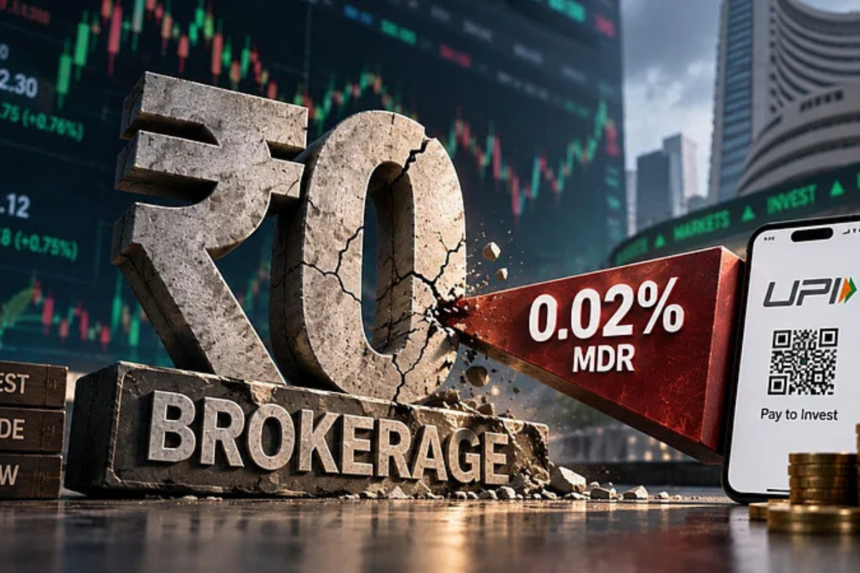
The 0.02% MDR will have a limited impact on most retail investors, but frequent UPI pay-ins and quarterly fund settlements could increase costs for discount brokers.
A 0.02% UPI Merchant Discount Rate (MDR) may look insignificant to an individual investor. But for India’s discount-broking platforms, the same charge could become a recurring operating cost.
From October 15, 2026, selected UPI payments above ₹2,000 will attract MDR. Capital-market transactions, including payments involving mutual funds, securities, stockbrokers and dealers, will have a lower rate of 0.02%, capped at ₹300 per transaction.
The charge is part of the payment ecosystem and is not intended to be passed directly to customers.
That means a ₹50,000 eligible capital-market payment would generate an MDR of ₹10, while a ₹1 lakh payment would generate ₹20.
For an investor making an occasional investment, that amount is relatively small.
For a broker processing millions of transfers, the calculation looks very different.
Why investors may barely notice the change
Retail investors’ immediate concern is whether UPI will become more expensive for investing.
Under the new framework, the MDR is payable within the merchant-payment ecosystem rather than being imposed as a direct customer charge. The government has said merchants should not pass the MDR on to consumers, and UPI providers cannot add separate platform or hidden charges under the new framework.
The framework also treats recurring payments differently.
Mutual fund SIPs routed through UPI AutoPay and mandates are outside the prescribed MDR structure, according to the current framework. One-time capital-market payments are subject to the lower 0.02% rate.
That distinction matters for investors who regularly contribute to mutual funds.
For example:
| Eligible payment | MDR at 0.02% |
|---|---|
| ₹50,000 | ₹10 |
| ₹1 lakh | ₹20 |
| ₹2 lakh | ₹40 |
| ₹5 lakh | ₹100 |
| ₹10 lakh | ₹200 |
| ₹15 lakh | ₹300 |
The ₹300 cap is reached at ₹15 lakh.
So the immediate cost is relatively modest for an investor making an occasional transaction. The bigger question is who absorbs that cost when the same payment infrastructure is used repeatedly.
The broker problem is about frequency
For a stockbroker, money transferred into a trading account does not necessarily result in a trade.
A customer may add ₹2 lakh to an account, decide not to invest immediately, and later withdraw the unused balance.
The payment still generated an MDR.
That creates a mismatch between payment activity and revenue activity.
Nithin Kamath, co-founder and CEO of Zerodha, has raised precisely this concern. He said there is no guarantee that money transferred to a broker will eventually result in a transaction that generates revenue for the platform.
This becomes more significant for brokers operating on a low-cost or zero-brokerage model.
Their economics depend heavily on scale. A small payment cost multiplied across a large customer base can become meaningful even when the cost of each transaction is tiny.
A ₹20 cost can become a large operating expense
Consider the difference between one investor and a brokerage platform.
An investor making a ₹1 lakh eligible transfer faces an MDR equivalent of ₹20 within the payment ecosystem.
A broker handling thousands or millions of similar transfers does not look at the ₹20 in isolation.
It has to consider how often customers add money, withdraw unused funds and move money back into their accounts.
That is why the 0.02% rate matters less than transaction frequency for the broking industry.
Rubina Singla, founder of Equitrust, described the issue as one of frequency rather than transaction size.
For brokers operating with thin servicing margins, she said repeated UPI transfers could create a structural cost even when those transfers do not lead to trades.
Quarterly settlements add another layer
There is another reason brokers are concerned.
Under securities-market settlement requirements, brokers periodically have to return unused client funds. Customers can then move money back into their brokerage accounts when they want to trade.
Kamath has argued that UPI could therefore be used repeatedly for money movements that are partly driven by regulatory requirements rather than actual trading activity.
The broker can incur a payment cost when the money comes in even though no brokerage revenue follows.
If the customer later moves unused funds back and subsequently redeposits them, the same cycle can generate additional payment costs.
For a zero-brokerage platform, absorbing every such cost indefinitely could put pressure on margins.
Kamath wants a lower cap for brokers
Kamath has said he does not oppose MDR in principle.
His concern is the size of the cap for broking transactions.
He has suggested retaining the 0.02% rate but reducing the maximum charge to around ₹5 or ₹10 per transaction, rather than the current ₹300 ceiling.
His argument is that a payment to a broker is fundamentally different from an ordinary retail purchase.
A customer can transfer a large amount into a brokerage account without actually buying or selling anything. The payment network receives its fee, while the broker may receive no corresponding trading revenue.
SEBI is now examining brokers’ concerns
The issue has moved beyond individual broker complaints.
SEBI Chairman Tuhin Kanta Pandey said on September 17 that the regulator would examine concerns raised by stockbrokers over the new UPI MDR framework.
The development leaves open the possibility of further discussion around how the MDR should apply to brokerage-related fund transfers.
For now, however, the framework remains scheduled to take effect on October 15.
Will brokers absorb the cost?
There are several ways brokers could respond.
They could absorb the MDR and treat it as another operating expense.
They could encourage customers to use alternative funding methods such as bank transfers.
They could adjust other parts of their pricing structure to recover some of the cost.
Or they could introduce charges for specific types of fund transfers while keeping headline brokerage rates unchanged.
That means investors may not necessarily see a new line item called a “UPI fee.”
The impact could appear elsewhere in the pricing structure.
NSE expects some short-term impact
The change could also affect payment behaviour and, potentially, market activity.
NSE Managing Director and CEO Ashishkumar Chauhan has said the new MDR could have an initial impact on transaction volumes, although he expects activity to normalise over time.
The distinction between occasional investing and repeated account funding could matter here.
A long-term investor making an occasional ₹1 lakh investment may have little reason to change behaviour.
An active trader who frequently moves money into and out of a brokerage account faces a different calculation.
The bigger question for zero-brokerage platforms
The 0.02% MDR tells two very different stories.
For an investor, ₹20 on a ₹1 lakh eligible payment is a relatively small amount, and the charge is not supposed to be passed directly to the customer.
For a broker, however, the relevant number is not ₹20.
It is ₹20 multiplied by the number of eligible transfers, including transfers that may never lead to a trade.
That is where the new UPI framework could put pressure on India’s zero-brokerage model.
The immediate impact on investors may remain limited. The more important question is whether brokers can continue absorbing payment costs while maintaining low or zero brokerage across a business built on enormous transaction volumes.
With SEBI now examining the concerns raised by brokers, the treatment of brokerage-related UPI payments could still evolve before the new MDR framework takes effect on October 15.
Read more news and follow us on Instagram
Outlook Business