



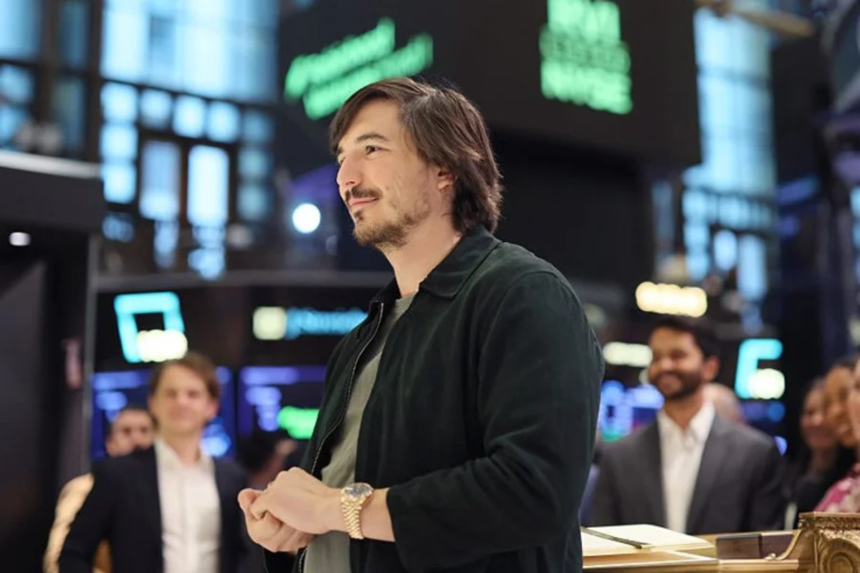
The company believes AI agents will help small investors invest with more confidence.
Artificial intelligence is rapidly reshaping the financial industry, from algorithmic trading to portfolio management and personalized financial advice. While large investment firms have relied on sophisticated automated systems for decades, retail investors have often lacked access to the same capabilities.
Robinhood wants to change that.
The company is betting that Robinhood AI trading will eventually allow individual investors to access intelligent trading tools once reserved for institutional firms. CEO Vlad Tenev believes AI agents could one day perform many of the same functions as professional traders, helping millions of users make more informed investment decisions while simplifying the investing process.
Robinhood’s Vision for Agentic AI
At the center of Robinhood’s strategy is the concept of agentic trading, where AI systems perform complex financial tasks on behalf of users instead of simply offering recommendations.
According to Tenev, the long-term goal is to build AI agents capable of handling nearly every task a human trader can perform. These systems would analyze markets, process financial information, evaluate investment opportunities, and execute trades based on a user’s preferences and risk profile.
Rather than replacing investors, Robinhood believes AI will function as a highly capable financial assistant that helps users invest with greater confidence.
Bringing Institutional Technology to Retail Investors
Professional investment firms have relied on automated trading systems for years. High-frequency trading firms, hedge funds, and institutional investors use advanced algorithms to monitor markets, identify opportunities, and execute trades within fractions of a second.
Most retail investors have never had access to comparable technology.
Robinhood AI trading aims to narrow that gap by bringing advanced computational tools directly to individual investors through its platform.
Tenev argues that artificial intelligence can democratize sophisticated investing by making professional-grade analysis available to everyone instead of limiting it to large financial institutions.
AI Is Already Becoming Part of Robinhood
Robinhood has already begun integrating AI into its products.
Earlier this year, the company introduced AI-powered features designed to help users better understand stock options before investing. These tools simplify complex financial concepts while assisting users in evaluating different investment choices.
The company sees these early features as the foundation for much more advanced AI capabilities in the future.
Instead of offering only educational content or market data, future AI systems could actively assist investors throughout the entire decision-making process.
The Growing Competition in AI Investing
Robinhood’s strategy reflects a much broader shift across the technology industry.
Companies such as OpenAI, Anthropic, Google, and Microsoft are investing heavily in AI agents capable of performing increasingly complex tasks. Financial services have become one of the industries expected to benefit most from these developments.
As AI models become more capable of analyzing enormous amounts of information in real time, investment platforms are exploring how these technologies can improve portfolio management, risk assessment, and financial planning.
Robinhood believes this evolution will fundamentally change how individuals interact with financial markets.
Beyond Stocks. Crypto Expansion Continues
Robinhood is expanding its ambitions beyond traditional investing.
The company recently announced plans to introduce cryptocurrency services in the United Kingdom as part of its broader European growth strategy. Although crypto market volatility affected earlier financial results, improving market conditions have renewed optimism for retail trading activity.
Robinhood continues investing across multiple areas of digital finance while positioning AI as an important component connecting these services.
Building a Leaner Organization
Alongside its AI investments, Robinhood recently reduced approximately 10% of its workforce as part of an effort to simplify management structures and improve operational efficiency.
Tenev described the move as necessary to maintain a lean organization capable of adapting quickly to changing technology and customer needs.
Despite the restructuring, he emphasized that Robinhood remains financially strong and believes the company’s long-term growth opportunities remain significant.
The Future of Robinhood AI Trading
Robinhood AI trading represents more than another software feature. It reflects a broader vision of making sophisticated investing tools available to ordinary investors.
If AI continues advancing at its current pace, future investors may rely on intelligent agents to monitor markets, identify opportunities, manage portfolios, and execute trades while still allowing users to retain full control over their financial goals.
Challenges remain, including regulation, transparency, risk management, and ensuring AI-generated decisions remain aligned with investor interests. However, Robinhood believes the future of investing will increasingly combine human judgment with artificial intelligence.
For retail investors, that could mean access to financial capabilities that were once available only to the world’s largest trading firms.
Source: Business Chief