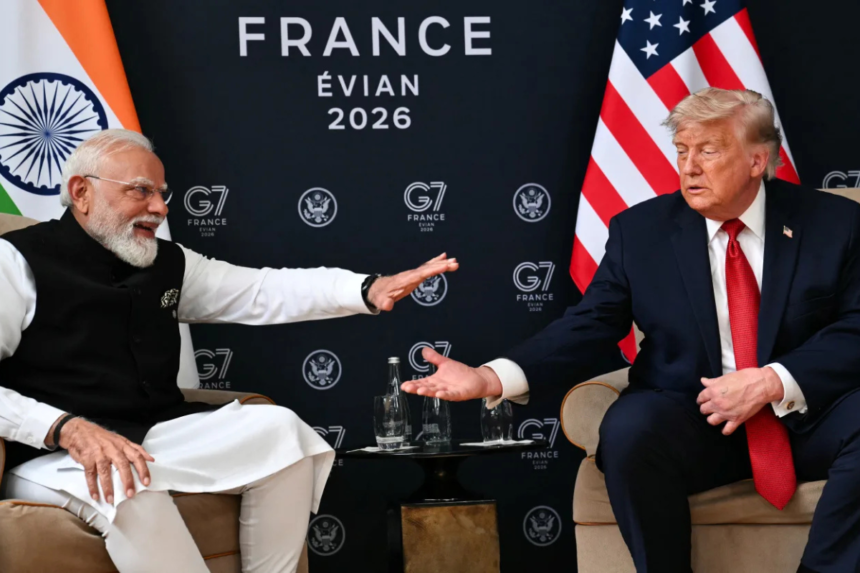
Their interaction underscored the importance of US-India ties amid growing geopolitical and economic cooperation.
Personal Diplomacy Takes Center Stage at G7
The longstanding personal rapport between U.S. President Donald Trump and Indian Prime Minister Narendra Modi was once again on display during their meeting on the sidelines of the G7 Summit, underscoring the importance of leader-level diplomacy in one of the world’s most consequential bilateral relationships.
Speaking to reporters, Trump praised Modi and reaffirmed his support for India under the prime minister’s leadership.
“If anybody attacks that man, we’re going to be there,” Trump said, referring to Modi. He also described India as a country that plays an important role in global affairs, adding that its influence remains significant as long as Modi remains in office.
The comments highlighted the strong personal chemistry that has defined the relationship between the two leaders over the years, despite emerging policy differences between Washington and New Delhi.
Warm Relations, Growing Frictions
While the relationship between Trump and Modi remains cordial, analysts note that broader strategic and economic ties between the United States and India face increasing challenges.
Recent developments have raised questions about the future direction of the partnership. The U.S. administration has adopted tougher positions on trade, immigration, and global strategic priorities, while simultaneously pursuing a recalibration of its relationship with China.
One development that attracted attention was the decision by the U.S. Department of War to remove the word “Indo” from the Indo-Pacific Command, a move some observers interpreted as reducing India’s perceived strategic importance in American regional planning.
For more than two decades, successive U.S. administrations have viewed India as a key partner in balancing China’s growing influence across the Indo-Pacific region. Any shift away from that framework has prompted debate among policymakers and analysts.
India’s Role in a Changing Geopolitical Landscape
Experts believe India remains an important strategic partner for Washington, but the nature of the relationship may be evolving.
Ronak D. Desai, a visiting fellow at Stanford University’s Hoover Institution, noted that while the personal connection between Trump and Modi remains strong, deeper policy differences continue to emerge beneath the surface.
Analysts also point to Trump’s recent comments about improving relations with China, including references to a potential “G2” framework involving Washington and Beijing. Such language has raised concerns among some observers who believe it could reduce the importance of middle powers, including India, in future geopolitical calculations.
According to Arpit Chaturvedi, South Asia Advisor at Teneo, recent U.S. actions suggest Washington believes it can address several China-related issues directly without relying on India as a central component of that strategy.
Security Concerns Remain a Priority
Security issues also featured prominently in discussions between the two leaders.
India recently lodged a formal protest with U.S. officials following attacks in the Gulf of Oman that affected Indian seafarers. During the G7 meeting, Modi reportedly urged Trump to prioritize the safety of Indian maritime workers as part of broader efforts to maintain stability in the Middle East.
The issue has become politically sensitive within India, where opposition leaders have criticized the government’s handling of relations with Washington and questioned whether New Delhi has been sufficiently assertive in protecting its interests.
Despite such criticism, Modi continues to enjoy strong domestic political support and remains one of India’s most influential political figures.
Trade Negotiations Continue
Economic ties remain one of the most important aspects of the U.S.-India relationship.
Both countries are currently negotiating a trade agreement aimed at expanding market access and strengthening commercial cooperation. Discussions have been ongoing since earlier tariff adjustments reduced duties on certain Indian exports.
During the G7 meeting, Trump described Modi as a “tough negotiator,” acknowledging India’s efforts to secure favorable trade terms.
However, challenges remain. The Office of the U.S. Trade Representative has proposed additional tariffs on imports from several economies, including India, creating uncertainty around the final shape of any future agreement.
Despite these hurdles, both governments continue to express optimism about reaching a mutually beneficial outcome.
Immigration Remains a Key Issue
Immigration policy continues to be another area of concern for India.
Recent U.S. efforts to tighten visa regulations, including proposals to significantly increase H-1B visa application fees, have attracted attention because Indian nationals represent the largest share of skilled visa holders in the United States.
When asked whether highly skilled Indian professionals would continue to have opportunities in America, Trump emphasized the longstanding employment relationship between the two countries and praised Indian talent.
The issue remains particularly important for India’s technology sector, which relies heavily on access to global markets and international talent mobility.
A Relationship Built on Both Leaders and Interests
The Trump-Modi meeting at the G7 Summit demonstrated that personal diplomacy continues to play a significant role in U.S.-India relations.
Yet the meeting also highlighted a broader reality: strong relationships between leaders cannot fully eliminate differences over trade, immigration, security, and strategic priorities.
As both nations navigate an increasingly complex geopolitical environment, the future of the partnership will likely depend not only on personal chemistry but also on their ability to align long-term national interests.
For now, the Trump-Modi relationship remains a symbol of continuity in a partnership that continues to evolve amid changing global dynamics.
Source: CNBC
US President Donald Trump (R) prepares to shake hands with India’s Prime Minister Narendra Modi during a bilateral meeting as part of the G7 summit, in Evian, eastern France, on June 17, 2026.
Mandel Ngan | Afp | Getty Images