


It shows how businesses are preparing their workforce for the AI era.
Microsoft has offered early retirement to roughly 7 percent of its U.S. workforce, marking the first program of its kind in the company’s history. Eligibility extends to employees whose combined age and years of service total 70 or more, up to the senior director level.
At first glance, the Microsoft buyout plan appears to align with a broader pattern of workforce reductions across the technology sector. However, the structure of the move signals something more deliberate than cost-cutting.
A Buyout Reflects Intent, Not Reaction
The distinction between layoffs and voluntary buyouts is not procedural. It is strategic.
Layoffs typically follow breakdowns in planning or shifts that catch organisations unprepared. A voluntary buyout, by contrast, reflects anticipation. It allows leadership to adjust workforce composition before misalignment becomes a crisis.
The Microsoft buyout plan suggests the company recognises that the nature of work is already changing. It is acting before those changes force abrupt decisions.
AI Investment Is Driving Structural Change
Microsoft’s investment in artificial intelligence has reached a scale that directly affects workforce requirements. The company allocated $37.5 billion in a single quarter toward data centres and AI infrastructure.
Such capital deployment reshapes the organisation at a foundational level. Roles that once created value are being redefined, while new capabilities become essential. The gap between existing skill sets and future needs continues to widen across large enterprises.
This is not a temporary adjustment. It is a structural transition.
Satya Nadella Frames Transformation with Clarity
When Microsoft reduced its workforce by 9,000 employees last year, Satya Nadella described the shift as a platform transformation affecting how the company builds products and how teams operate.
His acknowledgment that transformation is inherently complex reflects an understanding that organisational change cannot be reduced to efficiency metrics alone. The Microsoft buyout plan extends this perspective by introducing a controlled pathway for workforce evolution.
It balances operational need with a structured approach to transition.
Workforce Planning Must Shift from Headcount to Work Design
The implications extend beyond Microsoft. The Microsoft buyout plan highlights a broader requirement for leaders to rethink how work is structured inside their organisations.
The central issue is no longer the number of employees but the nature of the work itself. As AI systems take on analytical, repetitive, and process-driven tasks, the composition of roles must evolve accordingly.
Organisations that fail to map these changes in advance risk being forced into reactive measures.
Skills That Persist Beyond Automation
As artificial intelligence expands its capabilities, certain human competencies are becoming increasingly important. These include judgment, contextual decision-making, relationship-building, and leadership across complex environments.
While AI can execute tasks at scale, it does not replace the need for interpretation, coordination, and trust-building within organisations.
The workforce that remains relevant will be defined less by technical execution and more by these enduring capabilities.
A Shift in Leadership Responsibility
The Microsoft buyout plan underscores a broader shift in leadership responsibility. Workforce transformation is no longer a function delegated solely to human resources. It becomes a core strategic function tied to investment decisions and long-term organisational design.
Companies that treat workforce change as an aftereffect of technological adoption will face increasing constraints. Those who integrate it into strategy retain flexibility.
A Structural Reminder for Business Leaders
Microsoft’s approach illustrates how large organisations can manage transition before it becomes disruptive. The company is aligning its workforce with its future direction rather than allowing misalignment to accumulate.
This signals a wider reality. The impact of AI on work is already underway, and the window for proactive adjustment is narrowing.
The Microsoft buyout plan reflects preparation rather than reaction. It demonstrates how organisations can navigate change with structure, rather than being shaped by it under pressure.
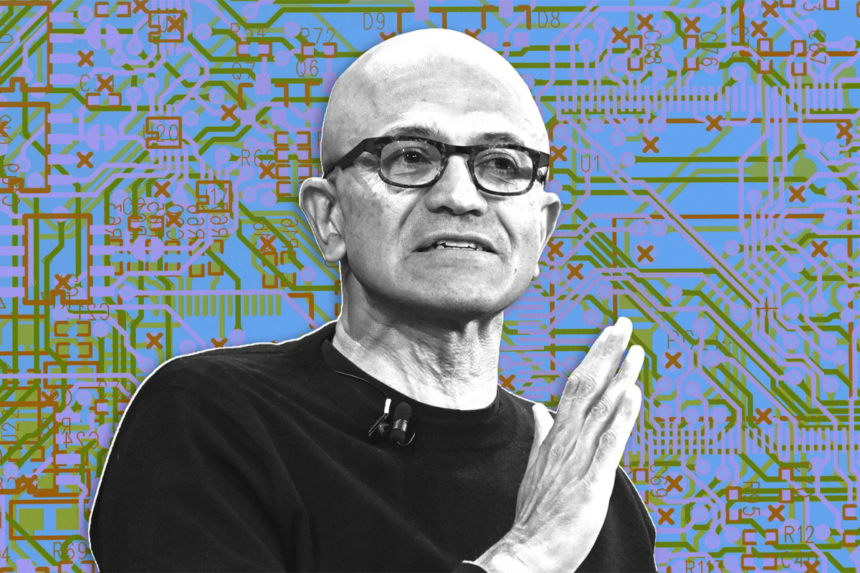
Microsoft CEO Satya Nadella. Illustration: Inc; Photo: Getty Images
Source: INC