


Thousands of protesters marched towards Parliament, demanding the education minister’s resignation over exam paper leaks and broader education reforms.
Thousands of students and activists gathered in New Delhi to demand education reforms and the resignation of senior government leaders, turning a youth-led protest into one of the country’s biggest demonstrations over the education system this year.
India’s Cockroach Janta Party (CJP), a youth-led satirical political movement, organized a march toward Parliament on July 20, calling for sweeping education reforms and the resignation of Prime Minister Narendra Modi and Education Minister Dharmendra Pradhan.
The protest, named “Chalo Sansad” (Let’s Go to Parliament), coincided with the opening day of Parliament’s monsoon session and drew thousands of demonstrators despite authorities refusing permission for the march.
Why Did the Protest Begin?
The movement traces its origins to growing public anger over alleged irregularities in competitive examinations, including the leak of the NEET paper and other education-related controversies.
Since June, protesters have staged sit-ins at Delhi’s Jantar Mantar, demanding greater accountability, reforms to India’s examination system, and the resignation of the education minister.
The demonstrations gained further attention after social activist Sonam Wangchuk joined the protest and began an indefinite hunger strike in support of the students.
Why Was Sonam Wangchuk’s Hunger Strike Significant?
On July 18, authorities moved Wangchuk to a hospital, describing the decision as necessary medical care.
However, Wangchuk and his supporters alleged that he had effectively been placed under detention, turning his transfer into another point of contention between protesters and authorities.
His continued hunger strike became one of the central issues driving the march toward Parliament.
Delhi Police Denied Permission
Ahead of the demonstration, Delhi Police announced that no permission had been granted for the march.
Authorities said prohibitory orders under Section 163 of the Bharatiya Nagarik Suraksha Sanhita (BNSS) were in force across New Delhi, restricting public assemblies and protest marches.
Traffic advisories and heightened security arrangements were also put in place around Parliament and central Delhi.
Clashes During the Protest
Thousands of protesters nevertheless gathered at Jantar Mantar before attempting to march toward Parliament.
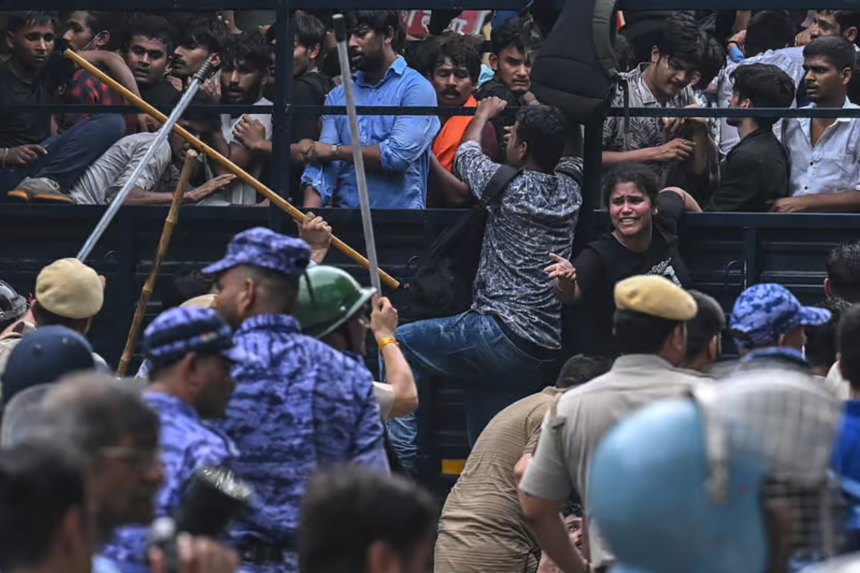
Video footage showed security personnel using tear gas and baton charges to disperse sections of the crowd, while demonstrators accused police of using excessive force against peaceful protesters.
Delhi Police, however, denied allegations of violence or unlawful detentions, stating that the situation was handled professionally.
Reports indicated that injuries were sustained by both protesters and security personnel during the confrontation.
Demonstrations Spread Beyond Delhi
Solidarity protests were also reported in several other cities, including Bengaluru, Mumbai, and Goa.
In Mumbai, police detained demonstrators participating in similar protests, while candlelight vigils were organized in Goa.
The wider participation reflected growing frustration among sections of students and youth over education-related issues.
Government Opens Communication
Amid the protests, Union Health Minister J.P. Nadda met representatives of the Cockroach Janta Party.
According to official statements, the meeting took place in a cordial atmosphere, during which protest leaders submitted a written memorandum outlining their demands.
The minister urged demonstrators to end their sit-in while discussions continued.
Internet Shutdown Draws Criticism
The Internet Freedom Foundation (IFF) criticized reported internet disruptions in parts of central Delhi during the protests.
The digital rights organization argued that any suspension of telecommunications should be accompanied by publicly available legal orders and warned that internet shutdowns restrict freedom of speech, peaceful assembly, and access to digital services.
IFF also called for greater transparency regarding any communication restrictions imposed during the demonstrations.
What Happens Next?
Although the march did not reach Parliament, the protests have intensified the national debate around examination reforms, government accountability, and students’ rights.
With Sonam Wangchuk continuing his hunger strike and discussions between protest representatives and government officials underway, the movement has evolved beyond a single demonstration into a broader conversation about India’s education system and public trust in competitive examinations.
Read more news and follow us on Instagram.
Police personnel baton-charge to disperse activists during a CJP-led protest on July 20.
Photo: AFP
Source: Khaleej Times