


NSE shares opened at ₹1,800 against the ₹1,785 IPO price, while the exchange ended its first trading session with a market capitalisation of about ₹4.45 lakh crore.
The National Stock Exchange of India made its long-awaited stock market debut on Thursday, with shares opening at ₹1,800 on the BSE, a modest 0.84% premium to its IPO price of ₹1,785.
The debut came after India’s second-largest IPO raised ₹22,561.57 crore through an offer for sale by existing shareholders. The issue attracted bids worth more than ₹90,000 crore and was subscribed 5.71 times, with institutional investors driving much of the demand.
NSE shares gained during the session, touching an intraday high of ₹1,878 before giving up some of those gains. The stock eventually closed at ₹1,818, up 1.85% from the issue price, even as the broader market fell sharply.
The relatively restrained opening was notable because unlisted-market indications had pointed towards a larger listing premium before the debut.
A ₹4.5 lakh crore exchange enters the market.
At the listing price, NSE’s market capitalisation was around ₹4.5 lakh crore, putting it substantially ahead of listed rival BSE by market value.
The IPO was also significant in terms of scale. At ₹22,561.57 crore, it became India’s second-largest public issue, behind Hyundai Motor India’s ₹27,870.16 crore IPO.
NSE Chairperson Srinivas Injeti described the listing as a significant moment for the institution, saying at the IPO press conference that the exchange belonged not only to its shareholders, directors and employees but to the country.
The listing ends a long wait for NSE investors after years of regulatory and governance issues delayed its public-market debut.
Institutional investors drove the IPO
The final subscription numbers showed a clear difference between institutional and retail demand.
The IPO received bids for 50.58 crore shares against 8.86 crore shares on offer, resulting in an overall subscription of 5.71 times. The qualified institutional buyer portion was subscribed 12.68 times, while the non-institutional category was subscribed 6.55 times. Retail investors subscribed 1.39 times their allocation.
The offering was entirely an offer for sale, meaning the proceeds went to existing shareholders rather than into NSE’s own balance sheet. The issue size was also reduced before the IPO after some shareholders opted to retain their holdings.
That limited supply has an important implication for early trading.
Relatively few shares are available to trade.
A large portion of NSE’s equity remains with existing shareholders, while pre-IPO investors are subject to applicable lock-in restrictions.
This means the amount of stock freely available in the market immediately after listing is relatively limited.
The situation could change as lock-in periods expire and additional shares become eligible for sale. The timing and scale of that additional supply will therefore be an important factor for investors assessing NSE’s trading liquidity and valuation.
The issue also means that Thursday’s listing price does not necessarily represent where the stock will settle once a larger portion of its existing shareholder base becomes eligible to trade.
NSE can trade on BSE and MSEI, but not on itself
NSE shares began trading on the BSE, while they were also admitted to the Metropolitan Stock Exchange of India under the “permitted to trade” category.
The arrangement allows securities listed on one exchange to be traded on another exchange without being separately listed there.
NSE Managing Director and CEO Ashishkumar Chauhan has said the exchange has not approached SEBI for permission to trade its own shares on its platform. Current regulations prevent stock exchanges from allowing their own shares to trade on their own systems.
The structure highlights the unusual position NSE now occupies: it is both a listed company and one of the country’s key pieces of market infrastructure.
The bigger question is where future growth comes from
NSE’s dominance in India’s derivatives market has been central to its earnings, but changes in options trading regulations have created questions about how quickly that business can grow.
Brokerages covering the stock have therefore pointed to other revenue streams, including listing services, data products, colocation and index licensing.
Prabhudas Lilladher expects NSE’s revenue growth to moderate after the strong expansion recorded between FY21 and FY26, while forecasting a recovery in EBITDA margins through FY29.
The brokerage expects the exchange’s earnings to increasingly reflect businesses beyond its traditional derivatives franchise.
That shift will be important because options trading has historically been a major contributor to NSE’s transaction revenue.
A debut against a falling market
The first trading session also gave NSE a difficult backdrop.
The Nifty 50 fell 1.6% to 23,063.10, while the Sensex dropped 1.7% to 73,580.54. The India VIX volatility index rose sharply as investors reacted to higher crude-oil prices, inflation concerns and rising bond yields amid continuing tensions in West Asia.
Against that background, NSE’s ability to remain above its issue price throughout the session stood out.
The stock nevertheless did not produce the sharp listing-day jump that some grey-market indicators had suggested before the debut.
What happens after the first day
The NSE listing gives public-market investors direct exposure to one of India’s most important financial-market institutions.
Its immediate performance will be influenced by several factors, including derivatives volumes, regulatory changes, new listings, data and index businesses, operating margins and the amount of additional equity that becomes available as shareholder lock-ins expire.
The first day’s numbers provide a starting point, not a complete picture.
NSE opened at ₹1,800, climbed as high as ₹1,878 and closed at ₹1,818. That amounted to a 1.85% gain over the IPO price by the end of its first trading session.
After more than a decade of waiting, India’s largest stock exchange is finally a listed company.
Now the market gets to determine how NSE’s value evolves beyond its debut.
Read more news and follow us on Instagram.
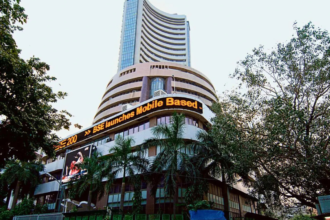
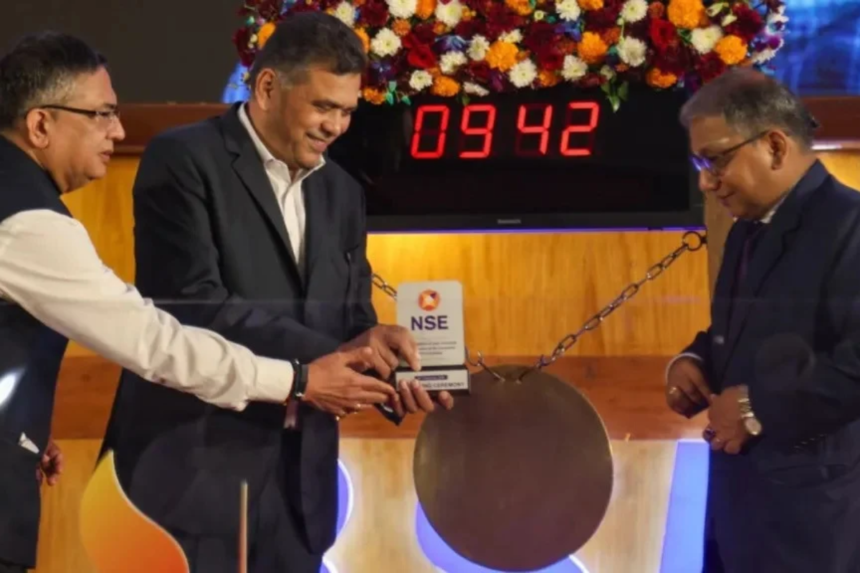
The National Stock Exchange of India Limited (NSE) marked its stock-market debut with a listing ceremony at BSE Limited in Mumbai on Thursday, September 24. (Express photos by Akash Patil)