


Raj Subramaniam became President and CEO of FedEx in 2022, taking charge of one of the world’s largest logistics companies as global supply chains entered a new era of e-commerce, automation, and digital transformation.
Every online purchase depends on an invisible network working behind the scenes.
Planes cross continents overnight. Trucks travel thousands of kilometres. Warehouses sort millions of packages every day. Behind one of the world’s largest delivery networks is FedEx, a company that moves an average of more than 16 million packages daily across over 220 countries and territories.
Leading that network is Raj Subramaniam, who became President and CEO of FedEx Corporation in June 2022, succeeding company founder Frederick W. Smith. In 2024, he also became Chairman of the Board, marking a historic leadership transition at one of the world’s most recognised logistics companies.
From India to the Top of FedEx
Born in Thiruvananthapuram, Kerala, Raj Subramaniam earned a degree in Chemical Engineering from IIT Bombay, followed by a Master’s degree in Chemical Engineering from Syracuse University and an MBA from the University of Texas at Austin.
He joined FedEx in 1991 as a marketing associate and spent more than three decades rising through the organisation.
During that time, he held senior leadership roles across marketing, operations, strategy, international business, and digital transformation, helping expand FedEx’s global footprint and strengthen its position in international logistics.
Leading a Global Logistics Giant
FedEx has grown into one of the world’s largest transportation companies.
The company employs more than 500,000 team members, operates approximately 700 aircraft, and maintains one of the largest air cargo fleets globally.
For the fiscal year ended May 31, 2025, FedEx reported US$87.9 billion in revenue, highlighting the scale of the business Subramaniam now leads.
His leadership comes during a period when global logistics is changing rapidly, driven by cross-border e-commerce, automation, artificial intelligence, and rising customer expectations for faster deliveries.
Transforming FedEx for the Next Generation
One of Subramaniam’s biggest priorities has been improving efficiency across the organisation.
FedEx has been implementing its Network 2.0 strategy, integrating parts of its Express, Ground, and Services businesses to streamline operations, reduce costs, and improve customer service.
The company is also investing heavily in automation, robotics, AI-powered logistics, predictive analytics, and advanced supply chain technologies to improve delivery performance while lowering operating costs.
These changes aim to make FedEx more agile as businesses increasingly demand faster and more flexible shipping solutions.
Navigating a Changing Supply Chain
The logistics industry has undergone significant shifts since the pandemic.
Global supply-chain disruptions, geopolitical tensions, inflation, labour shortages, and changing consumer behaviour have forced logistics companies to rethink how goods move around the world.
Under Subramaniam’s leadership, FedEx has focused on building more resilient and technology-driven logistics networks capable of adapting to changing market conditions while supporting global trade.
Building the Future of Global Commerce
As online retail continues expanding, logistics has become one of the world’s most important industries.
Every improvement in delivery speed, warehouse automation, route optimisation, and supply-chain visibility directly affects businesses and consumers alike.
Raj Subramaniam’s leadership reflects that evolution, combining operational expertise with technology and long-term strategic planning.
From leading one of the world’s largest transportation networks to modernising its operations through digital innovation, he represents a new generation of Indian-origin executives shaping the future of global commerce.
His journey from IIT Bombay to leading a Fortune 100 company also highlights how engineering, business strategy, and global leadership can come together to transform one of the world’s most critical industries.
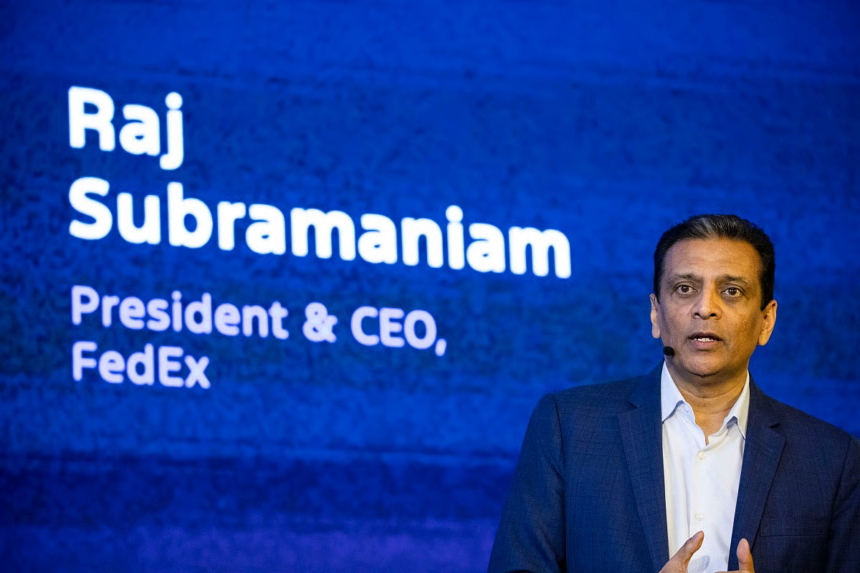
Photo: Raj Subramaniam, President and CEO of FedEx, speaks at a Ford Pro Accelerate event on September 30, 2025, in Detroit, Michigan.
AFP-BILL PUGLIANO