



Experts say higher visa costs could lead US companies to move more technology work to India instead of hiring H-1B workers in America.
A proposed H-1B fee hike could accelerate the shift of technology jobs from the US to India, as companies look for ways to access Indian talent without relocating workers, economist and former UN adviser Santosh Mehrotra said.
The proposed $103,265 additional fee on certain H-1B petitions could make it significantly more expensive for US companies to hire skilled foreign workers, potentially encouraging them to move more technology work to India-based Global Capability Centres (GCCs).
Why the H-1B fee hike matters
The US Department of Homeland Security (DHS) has proposed an additional fee for H-1B petitions subject to the annual cap, including applications eligible for the advanced-degree exemption.
The fee would be payable when the petition is filed and would be in addition to existing H-1B charges.
DHS estimates that the proposal could generate around $8.8 billion annually, based on approximately 85,000 cap-subject H-1B petitions.
Mehrotra said the impact would depend partly on whether companies absorb the additional cost or pass it on to workers.
“It’s a bit going to make life difficult for Indians, but it’s going to make life difficult for everyone,” he said, noting that Indians account for the largest share of H-1B beneficiaries.
US companies could shift more work to India.
The impact may extend beyond Indian technology workers and Indian IT companies.
Mehrotra pointed out that many major H-1B employers are actually US-based companies that use the programme to hire specialised talent.
At the same time, US companies have increasingly established their own Global Capability Centres in India, allowing them to build technology and professional teams locally.
According to Mehrotra, services that Indian IT companies previously provided from India are increasingly being brought in-house by multinational companies operating GCCs in cities such as Bengaluru, Hyderabad, Chennai and the Delhi-NCR region.
The higher cost of H-1B hiring could strengthen that trend.
Technology work that previously required an Indian professional to relocate to the US could instead be performed by teams based in India, allowing companies to access the country’s talent without incurring the additional visa cost.
What it means for Indian tech professionals
The shift could create both challenges and opportunities for India’s technology workforce.
Professionals seeking US-based opportunities may face greater difficulty if companies become more cautious about sponsoring H-1B workers.
However, increased investment in India-based GCCs could create more senior technology, engineering and specialised roles within the country.
Mehrotra also said Indian professionals looking for international opportunities may need to consider markets beyond the US, including Europe, Southeast Asia and the Middle East.
H-1B programme remains central to US tech hiring
The H-1B programme allows US employers to hire foreign workers for specialised occupations, including many technology and engineering roles.
The annual statutory cap for new H-1B visas is 85,000, comprising 65,000 regular visas and 20,000 visas reserved for applicants with a US master’s degree or higher.
Of the 65,000 regular-cap visas, 6,800 are reserved for nationals of Chile and Singapore.
If the proposed H-1B fee hike takes effect, the financial calculation behind hiring foreign workers in the US could change substantially. For companies that can perform the same work through teams in India, the economics may increasingly favour building or expanding operations there rather than moving more employees to the US.
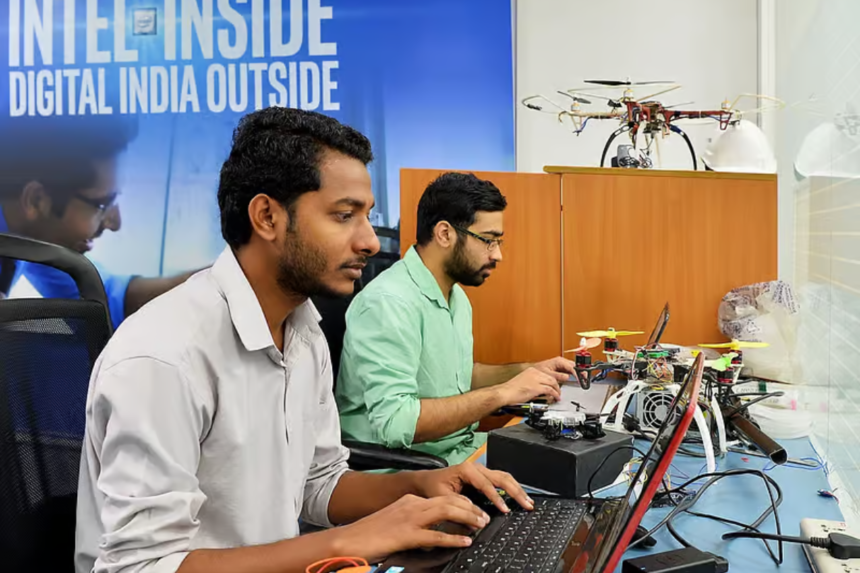
India’s IT sector is booming. Photo: KT file