



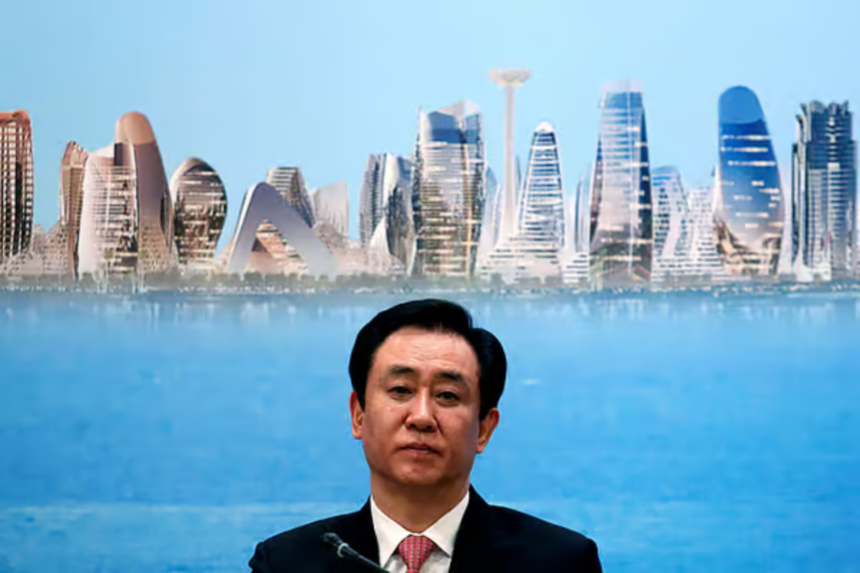
A Shenzhen court sentenced Hui Ka Yan to life imprisonment for financial crimes and fined Evergrande and its property arm 15.82 billion yuan.
China has sentenced Evergrande founder Hui Ka Yan to life in prison, marking the dramatic end of the property tycoon’s rise from one of the country’s richest businessmen to the centre of one of China’s biggest corporate scandals.
A court in Shenzhen also fined Evergrande Group and its real estate arm 15.82 billion yuan, or about $2.4 billion, for financial crimes including large-scale fraud.
Evergrande Founder Sentenced to Life
The Shenzhen Intermediate People’s Court sentenced Xu Jiayin, also known as Hui Ka Yan in Cantonese, to life imprisonment after finding him guilty of multiple offences.
The court said Xu was convicted of crimes including large-scale financial fraud. His political rights were revoked for life, and his personal property was confiscated.
According to the verdict, Evergrande and Xu engaged in financial fraud between 2016 and 2021 by inflating assets and concealing liabilities.
The court also said the defendants gained control of financial institutions through bribery.
Xu had pleaded guilty in April to charges that included embezzlement and bribery.
Evergrande’s Collapse
Evergrande once stood at the centre of China’s property boom, becoming one of the country’s largest developers as it expanded aggressively through borrowing.
The company’s business model depended heavily on access to credit and rising property demand.
That changed after Beijing introduced measures aimed at limiting excessive borrowing and speculation in the property sector.
Evergrande eventually defaulted in 2021 after struggling to repay creditors, triggering a prolonged debt crisis that spread across China’s property market.
The company was later ordered to liquidate, while its financial problems became a major concern for investors and policymakers monitoring China’s economic health.
$2.4 Billion Fine for Evergrande
The Shenzhen court ordered Evergrande Group and its property arm to pay a combined 15.82 billion yuan fine.
The court said the company’s conduct caused substantial economic losses and serious social harm.
It also ordered that remaining shortfalls from illegal gains be returned.
Five other senior Evergrande executives received prison sentences ranging from six to 18 years.
According to China’s state news agency Xinhua, 56 people were sentenced in connection with the case, with the shortest prison term set at one year and 10 months.
From Billionaire to Prisoner
The verdict represents a dramatic reversal for the 67-year-old Hui Ka Yan.
He was once among China’s richest billionaires and had also served as a member of the country’s top political advisory body.
His fall reflects the wider deterioration of China’s property sector.
Major developers that once benefited from rapid housing demand and easy access to financing have faced declining sales, mounting debt and falling investor confidence.
China’s new-home prices have now been contracting for three years, adding further pressure to developers and homeowners.
What the Evergrande Verdict Means
The Evergrande founder’s life sentence is significant beyond the company itself.
Evergrande’s collapse exposed the risks created by highly leveraged property development and aggressive financial practices. The verdict also sends a strong signal that Beijing is prepared to pursue severe penalties when corporate misconduct is judged to have caused widespread financial and social damage.
The case will continue to be watched alongside the struggles of other major Chinese developers, including Country Garden and Vanke.
For Evergrande, once a symbol of China’s property boom, the verdict closes one of the most extraordinary chapters in the country’s real estate crisis.
Source: File photo of Evergrande founder Xu Jiayin, also known as Hui Ka Yan in Cantonese. Photo: Reuters