

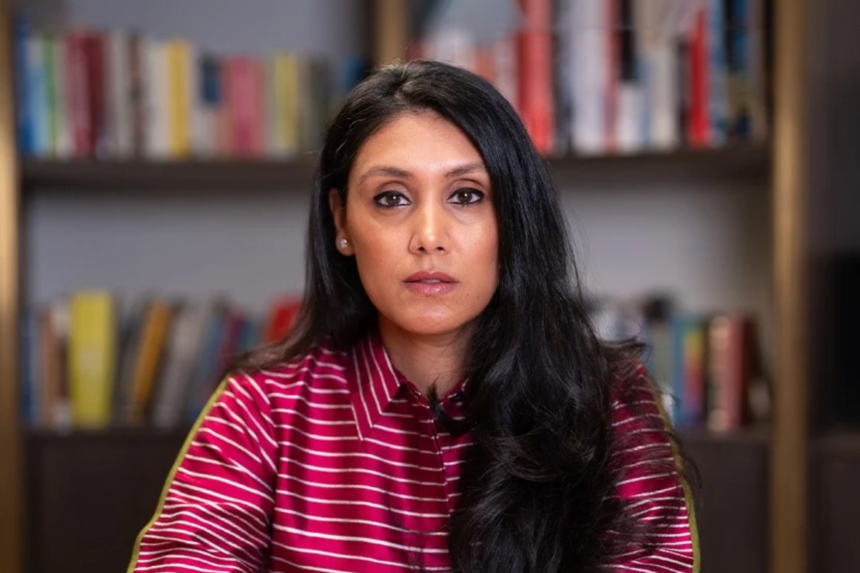
When Roshni Nadar Malhotra took over as chairperson of HCL Technologies in 2020, she inherited a technology company that had already spent more than four decades building its place in India’s IT industry.
What she inherited was not a startup that needed to find its market.
It was a global technology business that needed to decide what came next.
Six years into that transition, HCLTech has become increasingly focused on artificial intelligence, engineering, cloud, enterprise software, and digital services, while Roshni Nadar Malhotra has emerged as one of the most prominent women in India’s technology sector.
The scale of the family fortune has followed that transformation.
The M3M Hurun India Rich List 2026 places Roshni Nadar Malhotra and her family at ₹2.78 lakh crore, making them the fifth-richest family in India in the latest ranking. The figure is slightly below the ₹2.84 lakh crore attributed to the family in the 2025 ranking.
Her wealth is primarily linked to the Nadar family’s holdings and interests in HCL.
But the business story behind the number is increasingly about what happens when one of India’s most established technology companies enters an era dominated by artificial intelligence.
She did not start her career inside HCL’s technology business
Roshni Nadar Malhotra studied communications at Northwestern University before completing an MBA at Northwestern’s Kellogg School of Management.
She joined HCL in 2009, initially working across different parts of the group before taking on more senior responsibilities.
Her background was therefore somewhat different from that of many technology-company leaders who rise through engineering or software roles.
Her career developed around business strategy, leadership and the broader direction of the group.
That became particularly important when HCL entered a planned leadership transition.
In July 2020, Shiv Nadar stepped down as chairperson of HCL Technologies and Roshni Nadar Malhotra became chairperson of the company’s board. She became the first woman to lead a listed Indian IT company in that role.
Shiv Nadar remained involved as founder and later chairman emeritus and strategic adviser to the board, allowing the transition to take place without removing the founder from the company’s long-term strategic picture.
HCL is now a much bigger business than the company her father founded
The HCL that Roshni inherited had already evolved substantially from the company Shiv Nadar and his colleagues established in 1976.
HCLTech today operates across IT and business services, engineering and R&D, cloud, cybersecurity, artificial intelligence and enterprise software.
As of June 2026, HCLTech had more than 223,000 employees across 60 countries, with consolidated revenue for the preceding 12 months reaching $14.8 billion.
The company’s FY2025-26 revenue was ₹1,30,144 crore, while net income attributable to shareholders was ₹17,361 crore. Services revenue accounted for ₹1,18,158 crore and HCLSoftware generated ₹11,986 crore.
Those numbers place HCLTech firmly among the world’s large technology-services companies.
The challenge for Roshni and the management team is therefore not simply maintaining the company’s existing scale.
It is keeping that scale relevant as the economics of software development, consulting and business-process services change rapidly.
Artificial intelligence is now at the centre of HCLTech’s strategy
The biggest shift taking place at HCLTech is the move towards AI-led technology services.
In FY26, the company reported $620 million in annualised Advanced AI revenue, making HCLTech the first large India-headquartered technology-services company to report revenue under that category, according to the company.
The company has also created a five-part AI strategy covering transformation of its existing services, development of proprietary intellectual property, new AI-led offerings, partnerships and employee upskilling.
That distinction matters because generative AI is creating a complicated challenge for traditional IT-services companies.
Some technology work that once required large teams of engineers can potentially be completed faster with AI-assisted tools.
At the same time, companies need help integrating AI into their existing systems, securing AI deployments, redesigning workflows, and building new software around the technology.
HCLTech is positioning itself around the second opportunity.
Its strategy is to use AI to change how existing services are delivered while also building new products and services that can generate revenue beyond traditional labour-intensive technology outsourcing.
The software business gives HCL another route to recurring revenue
One of Roshni’s strategic priorities has been strengthening HCLTech’s products and platforms business.
The company acquired several software assets over the years and consolidated them under HCLSoftware, creating a dedicated enterprise-software business.
That gives HCLTech a different revenue model from conventional IT services.
Instead of earning primarily from consulting teams and technology projects, enterprise software can generate recurring revenue through licences and subscriptions.
HCLTech reported $1.05 billion in annual recurring revenue for HCLSoftware in FY26.
The company has continued to embed AI across its software portfolio, aiming to make its products more useful for enterprise customers dealing with automation, productivity and decision-making.
This is part of a larger attempt to reduce the distinction between services and software.
HCLTech wants to use its engineering and consulting capabilities to help customers adopt technology while also owning intellectual property that can be sold repeatedly across markets.
Engineering has become another important growth engine
HCLTech’s Engineering and R&D Services division is another major part of the company’s evolution.
The business works across areas ranging from semiconductor engineering and product development to cloud, edge computing, and intelligent physical systems.
In FY26, Engineering and R&D Services revenue grew 9.8% in constant currency, significantly faster than HCLTech’s overall business-services growth.
That growth reflects a broader shift in the technology industry.
Software is increasingly embedded into physical products, vehicles, industrial equipment, medical devices, and communications infrastructure.
For HCLTech, that creates an opportunity to combine its traditional software expertise with engineering capabilities.
It also explains why the company has been investing in areas such as semiconductor engineering and physical AI.
HCLTech is pushing into physical AI.
One of the more recent examples of that strategy is HCLTech’s Physical AI Innovation Lab in Santa Clara, launched in collaboration with NVIDIA.
The facility focuses on technologies that combine artificial intelligence with physical systems, including robotics, industrial applications, and intelligent machines.
The move reflects a broader change in the technology industry.
AI is no longer confined to chatbots and software interfaces. Companies are increasingly trying to use AI in factories, vehicles, robots, and other physical environments.
HCLTech’s engineering heritage gives it a natural entry point into that market.
It also provides another way for the company to differentiate itself from firms that are primarily focused on conventional IT outsourcing.
Semiconductor ambitions are part of the longer-term picture
HCLTech has also moved into India’s developing semiconductor ecosystem.
The company is participating in a joint venture with Foxconn, one of the world’s largest electronics manufacturing companies.
The venture is part of the broader effort to build semiconductor capabilities in India and reflects HCLTech’s interest in moving closer to the physical infrastructure underlying the digital economy.
For Roshni, this represents a continuation of a strategy that has gradually pushed HCL beyond traditional software services.
The company began with computers and enterprise technology.
It expanded into IT services.
It added software products.
Now it is exploring semiconductors, physical AI and engineering-led technology.
That progression is particularly relevant as governments and businesses increasingly treat semiconductor and AI infrastructure as strategic industries.
The succession story is still being written.
Roshni Nadar Malhotra’s position is unusual because she represents the second generation of a technology company whose founder remains closely associated with the brand.
Her father, Shiv Nadar, founded HCL in 1976 with a group of colleagues and built it into one of India’s best-known technology companies.
Today he serves as chairman emeritus and strategic adviser to the HCLTech board.
Roshni, meanwhile, chairs HCLTech and HCL Group.
The management of HCLTech remains professional rather than family-operated in the traditional sense. C Vijayakumar continues as CEO and managing director and is responsible for the company’s day-to-day operations.
That distinction is important.
Roshni’s role is primarily at the board and strategic level, while the operating leadership remains with an experienced professional management team.
It allows the company to retain family ownership and long-term direction without making the business dependent on family members running every operational function.
Her influence extends well beyond technology.
The business side of Roshni Nadar Malhotra’s career is only one part of her public work.
She is also a trustee of the Shiv Nadar Foundation, the philanthropic institution established by her father.
As of March 2026, the foundation says it had invested more than $1.83 billion in institutions focused on education and leadership development and had directly impacted around 57,000 students.
The foundation operates institutions including Shiv Nadar University, Shiv Nadar School, SSN College of Engineering, VidyaGyan and the Kiran Nadar Museum of Art.
One of its most distinctive programmes is VidyaGyan.
The leadership academy identifies academically strong students from economically disadvantaged rural backgrounds in Uttar Pradesh and provides them with residential education at no cost. Its two campuses in Bulandshahr and Sitapur together span 67 acres.
The idea reflects a broader theme in the Nadar family’s philanthropy: creating institutions intended to continue operating and producing social impact over several generations rather than relying primarily on one-time charitable donations.
Conservation has become another personal priority.
Roshni also founded The Habitats Trust, an organisation focused on conservation and biodiversity.
Its work covers endangered species and habitats across India, adding an environmental dimension to her activities outside HCLTech and the Shiv Nadar Foundation.
She has also been involved in environmental filmmaking and conservation storytelling.
Her long-running series On the Brink has documented endangered Indian wildlife, while her broader conservation work has focused on habitat protection and partnerships with organisations working on the ground.
This gives her public profile a combination that is unusual among India’s technology leaders: corporate technology, institutional philanthropy and conservation.
HCL’s financial performance shows the pressure as well as the opportunity
The transition to AI is taking place against a challenging backdrop for the global IT-services industry.
Companies are being cautious about discretionary technology spending, while AI is simultaneously creating new demand and putting pressure on some traditional services.
HCLTech nevertheless delivered 3.9% revenue growth in constant currency in FY26, with services revenue rising 4.8%. New deal wins had a total contract value of $9.3 billion during the year.
The company also generated ₹18,553 crore in free cash flow, equivalent to 107% of net income, according to its FY26 results.
Those figures illustrate the central balancing act for HCLTech.
The company has to continue growing its traditional technology-services business while investing in AI, software, engineering and new technology areas that may become increasingly important over the next decade.
The wealth figure tells only part of Roshni Nadar’s story
The ₹2.78 lakh crore figure associated with Roshni Nadar Malhotra and her family in the 2026 Hurun ranking is an estimate of family wealth, largely connected to ownership interests and the value of the HCL ecosystem.
It should not be confused with her annual income or cash holdings.
Her position is particularly notable because the underlying business is very different from the energy, steel and pharmaceutical companies represented by the other names near the top of India’s wealth rankings.
HCL’s value comes primarily from technology services, software, engineering capabilities and intellectual property.
That makes the fortunes of the Nadar family increasingly tied to how effectively HCLTech adapts to changes in enterprise technology.
From her father’s HCL to an AI-era technology company
Roshni Nadar Malhotra’s tenure at HCLTech is still relatively young compared with the company’s 50-year history.
Yet the transition is already visible.
The company now employs more than 223,000 people across 60 countries, generates annual revenue of roughly $15 billion, has built a dedicated software business, is investing in physical AI and semiconductor capabilities, and has begun reporting meaningful revenue from advanced AI services.
At the same time, the Nadar family’s philanthropic institutions continue to expand their work in education, leadership and conservation.
That makes Roshni Nadar Malhotra’s position more complicated than simply being the successor to a technology founder.
She is overseeing the next phase of a company that has to reinvent itself while preserving the strengths that made it successful in the first place.
For HCLTech, the question is whether AI will ultimately strengthen the economics of its enormous services organisation or fundamentally change the way enterprise technology work is bought and delivered.
For Roshni Nadar Malhotra, that transformation is now one of the defining challenges of her leadership.
And with a family fortune of ₹2.78 lakh crore placing her among India’s wealthiest business families, the outcome of that transition will have consequences well beyond the Nadar family’s balance sheet.
Read more news and follow us on Instagram.
Photo/ source: Shiv Nadar Foundation