


The two-seat autonomous vehicle is being displayed in Beijing and Shanghai, but Tesla has no plans for sales or commercial robotaxi operations in China for now.
Tesla has brought its futuristic Cybercab to China for the first time, giving the public in Beijing and Shanghai a closer look at the company’s purpose-built autonomous vehicle.
The two-seat Cybercab began public displays in China on September 17, just two weeks after Tesla started limited commercial operations with the vehicle in Austin, Texas.
But the China appearance is strictly a showcase. Tesla has said the displays do not represent a sales launch or the start of commercial robotaxi operations in the country.
The vehicle is being shown at Tesla’s experience center at China Central Place in Beijing through September 27 and at Shanghai’s HKRI Taikoo Hui through September 21.
A Robotaxi With No Steering Wheel or Pedals
The most striking feature of the Cybercab is what it does not have.
The vehicle has no steering wheel, pedals, or conventional rearview mirrors. Instead, Tesla designed it as a fully autonomous two-seat vehicle controlled by its driverless software.
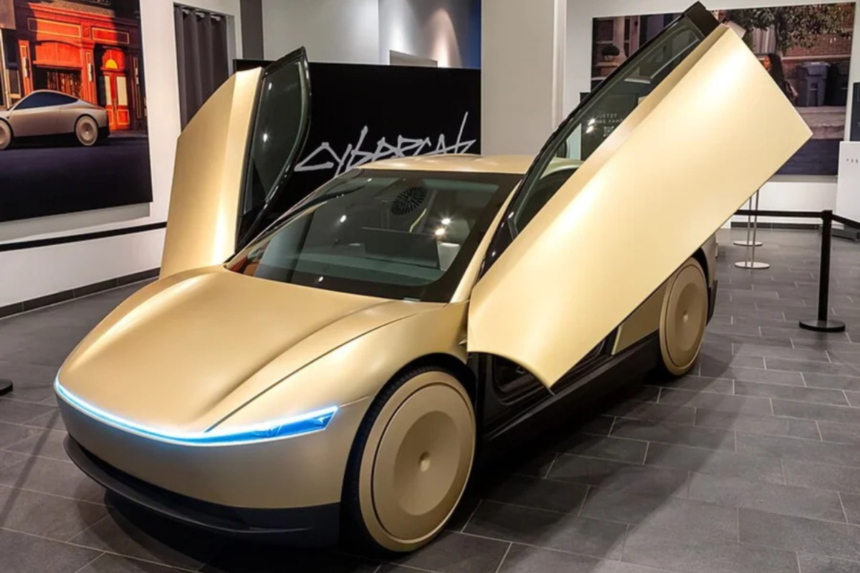
The cabin features two passenger seats and a 22-inch central display. The exterior uses butterfly-style doors, while the interior is designed around the needs of passengers rather than a human driver.
Tesla has also highlighted accessibility features, including Braille on controls and a rear cargo area designed to accommodate items such as a bicycle or folded wheelchair.
The vehicle relies on eight high-definition cameras and Tesla’s end-to-end autonomous driving system rather than LiDAR or high-definition maps.
Why Is the Cybercab Gold?
The Cybercab’s gold exterior has become one of its defining visual features.
Elon Musk has linked the color to his description of autonomous transport entering a “golden era.” Tesla has also designed the production process around efficiency, with the company saying the finish is applied during component manufacturing.
The distinctive color is therefore part of the vehicle’s identity as Tesla presents it to the public, rather than simply a conventional paint choice.
Austin Provides the First Real-World Test
While China is seeing the Cybercab as a static exhibit, Austin is where Tesla has begun putting the vehicle into commercial service.
Tesla started limited Cybercab rides in Austin on September 3. The initial fleet remains small, with Texas Department of Motor Vehicles records showing 45 Cybercabs registered for the local robotaxi operation as of August 31.
The service operates in selected areas rather than across the entire city.
The Austin rollout is significant because it moves the Cybercab from a concept and demonstration vehicle into an operating robotaxi. At the same time, US regulators are examining questions surrounding the vehicle’s certification and its lack of conventional driver controls.
Why Tesla Is Showing the Cybercab in China
China is the world’s largest electric vehicle market, making it an important market for Tesla’s future autonomous-driving ambitions.
However, Tesla has not yet launched its Full Self-Driving system commercially in China, and the regulatory framework presents additional challenges for a vehicle designed without a steering wheel or pedals.
For now, Tesla is using the China tour to showcase the vehicle’s design and technology rather than offering it to customers.
That distinction is important. Visitors in Beijing and Shanghai can see the Cybercab up close, but they cannot purchase one or book a commercial Cybercab ride in China.
Cybercab Is Designed Around Fleet Economics
Tesla’s approach to the Cybercab is not simply about removing the driver.
The vehicle has been designed specifically for autonomous fleet operations, where reducing energy use, maintenance requirements, and turnaround time can affect the economics of each ride.
Tesla has said its long-term target is to reduce operating costs substantially as the service scales. The Cybercab also incorporates automated charging and cleaning concepts intended to reduce human involvement in fleet operations.
The company’s “Unboxed” manufacturing approach is another part of that strategy. Tesla says the process allows different vehicle subassemblies to be produced in parallel before final assembly, to improve production efficiency.
China Showcase Comes Before Any Commercial Launch
Tesla’s Cybercab debut in China is therefore more about visibility than immediate commercial expansion.
The company is presenting a vehicle that represents its vision for autonomous transportation while stopping short of announcing Chinese sales or robotaxi operations.
That leaves the Cybercab in an unusual position. In Austin, it has begun carrying passengers. In China, one of Tesla’s most important automotive markets, it remains a display vehicle.
For now, the gold Cybercab can be seen in Beijing and Shanghai, but it is not ready to take passengers onto Chinese roads.
Read more news and follow us on Instagram
Tesla’s Cybercab, the two-seat robotaxi now on display at the company’s Beijing delivery centre. Credit: Wiki
Source: Business Connect