



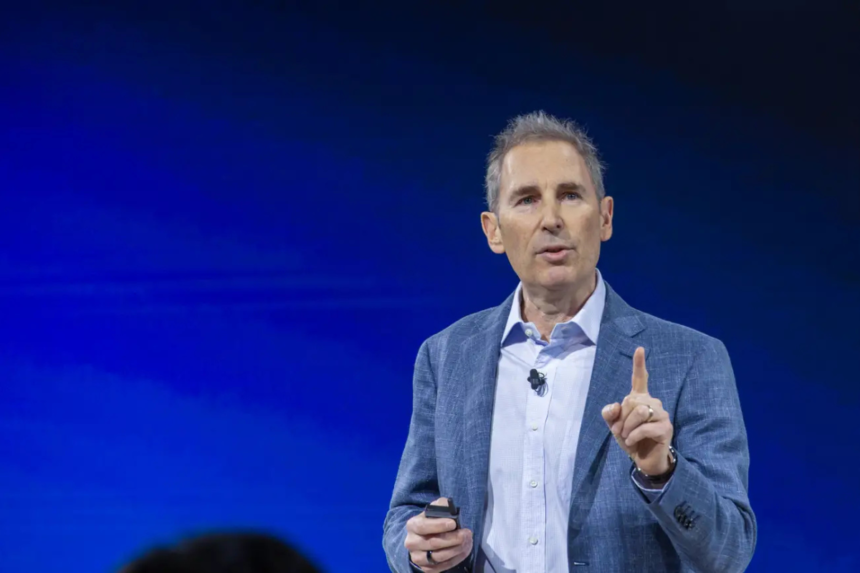
The company increased its 2026 capital spending plan as rising memory costs push up AI infrastructure investments.
Seattle: Amazon has raised its planned capital expenditure for 2026 to $220 billion, signalling an even bigger push into artificial intelligence infrastructure as soaring demand for cloud computing and rising memory costs drive higher investment.
The revised spending plan, announced alongside the company’s second-quarter earnings, is up from the $200 billion forecast Amazon issued earlier this year.
The results exceeded Wall Street expectations, with strong growth in Amazon Web Services (AWS) and advertising helping lift the company’s shares by more than 10% in after-hours trading.
Amazon Beats Revenue and Profit Expectations
Amazon reported revenue of $200.61 billion for the second quarter, surpassing analysts’ expectations of $196.47 billion.
The company also posted earnings per share of $5.75, well above the consensus estimate of $1.82, according to LSEG.
Its cloud computing division, Amazon Web Services (AWS), generated $42.2 billion in revenue, beating expectations of $40.54 billion.
Meanwhile, Amazon’s advertising business brought in $19.81 billion, also exceeding analysts’ forecasts.
Why Amazon Is Spending More
Chief Executive Officer Andy Jassy said the company increased its capital spending plans primarily because of higher costs associated with building AI infrastructure.
He pointed to rising prices for advanced memory components used in AI data centres, while also emphasising that demand for AI services continues to outpace Amazon’s available capacity.
“But even at that amount, we will still not have enough capacity to meet all the demand we have in 2026,” Jassy told investors during the earnings call.
“I believe this dynamic will also be true in 2027 too. In fact, the demand we already have for 2028 is striking.”
The comments suggest Amazon expects the current AI investment cycle to continue for several more years.
AWS Growth Accelerates
AWS remained Amazon’s biggest growth engine during the quarter.
Revenue from the cloud business increased 37% year-on-year, marking its fastest growth since 2021.
The performance follows similarly strong results from competitors.
Earlier this month, Microsoft reported 43% growth in Azure cloud revenue, while Google Cloud recorded 82% growth, reflecting surging enterprise demand for AI computing power.
AI Business Continues to Expand
Jassy described AWS as “booming” and highlighted rapid growth across Amazon’s AI products and custom semiconductor business.
The company’s Trainium and Graviton chips, designed to power AI workloads more efficiently, have each surpassed an annual revenue run rate of $25 billion, according to Amazon.
The company also continues expanding Amazon Bedrock, its generative AI platform that allows businesses to build applications using foundation models from Amazon and third-party providers.
Amazon has increasingly positioned its in-house chips as an alternative to expensive third-party AI processors while strengthening its enterprise AI offerings.
Heavy Spending Impacts Cash Flow
The AI investment boom is also weighing on Amazon’s finances.
Capital expenditure reached $54.2 billion during the June quarter, compared with $32.1 billion in the same period last year.
As a result, Amazon’s free cash flow turned negative.
For the trailing 12 months, the company recorded a free cash outflow of $7.6 billion, compared with a positive $18.2 billion during the previous year.
Despite the increased spending, Amazon says the investments are necessary to meet customer demand.
The company’s AWS backlog, representing signed contracts yet to be delivered, reached $496 billion, highlighting the scale of future business already secured.
Prime Day Timing Affects Outlook
Looking ahead, Amazon expects third-quarter revenue to range between $197 billion and $202 billion, slightly below analysts’ expectations of $204.1 billion.
The company attributed the softer forecast to the decision to move Prime Day from its usual July schedule to June, creating difficult year-on-year comparisons.
Amazon said that excluding the timing difference, third-quarter revenue growth would have been approximately four percentage points higher.
According to Adobe Analytics, US online retailers generated $26.4 billion in sales during this year’s Prime Day shopping event, helping Amazon increase North American revenue by 16% to $116.2 billion.
Anthropic Investment Boosts Earnings
Amazon reported net income of $62.6 billion, or $5.75 per share, compared with $18.2 billion, or $1.68 per share, a year earlier.
The company said the results included $53.4 billion in pre-tax gains, primarily related to its investment in AI startup Anthropic, whose valuation has risen sharply amid growing demand for generative AI technologies.
Healthcare Business Also Expands
Beyond AI and cloud computing, Amazon said its healthcare business continues to grow.
The company more than doubled the number of new customers using Amazon Pharmacy, while same-day prescription deliveries increased nearly fivefold during the quarter.
Although healthcare remains a relatively small part of Amazon’s overall business, the company continues investing heavily in digital pharmacy and healthcare services as part of its long-term growth strategy.
With AI demand accelerating across industries, Amazon’s record $220 billion investment plan underscores how the world’s largest technology companies are competing to build the infrastructure needed for the next generation of artificial intelligence.
Source: CNBC
Photo: Andy Jassy, chief executive of Amazon, in October. David Ryder/Bloomberg New