



Investors are cheering the strong start, but many are still debating whether the company’s valuation is too high.
SpaceX is off to a remarkable start on the public markets.
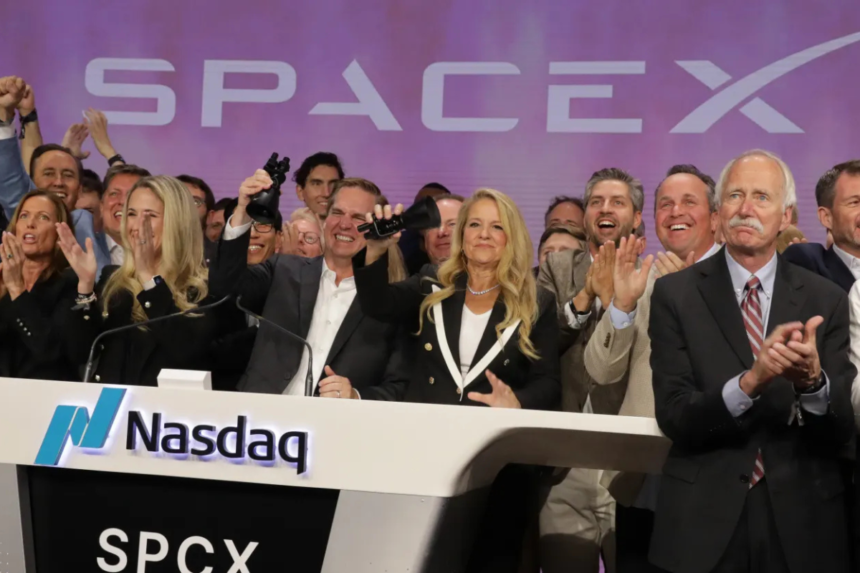
After delivering the largest initial public offering in history, Elon Musk’s company continued its rally on Monday, climbing roughly 6% in premarket trading after surging 19% during its Nasdaq debut. The stock, priced at $135 per share in the IPO, closed its first trading day at $161, pushing the company’s market capitalization above $2 trillion.
The strong debut reflects investor enthusiasm for SpaceX’s ambitious vision, which spans reusable rockets, satellite internet, artificial intelligence infrastructure, and future space-based computing. Yet beneath the excitement, a growing debate is emerging among analysts and investors about whether the company’s valuation can be justified by its current business fundamentals.
Investors Are Buying Into a Long-Term Vision
SpaceX is no longer viewed solely as a rocket company.
Over the past decade, it has expanded beyond launch services through Starlink, its satellite internet network, while also increasing its focus on artificial intelligence following its merger with xAI earlier this year.
Supporters argue that investors are not valuing SpaceX based on current earnings. Instead, they are pricing in the possibility that the company could dominate several industries simultaneously, including:
- Space transportation and launch services
- Satellite-based broadband connectivity
- Direct-to-cell communications
- Artificial intelligence infrastructure
- Future orbital computing and data center services
This broader narrative has helped fuel demand for the stock despite significant losses and heavy capital spending.
For many investors, SpaceX represents a long-duration technology bet rather than a traditional aerospace investment.
The Valuation Debate Intensifies
Not everyone is convinced.
Several analysts have expressed concerns that the company’s valuation has moved far ahead of its current financial performance.
Research firm CFRA initiated coverage with a “Sell” rating and a $115 price target, arguing that SpaceX faces substantial execution challenges due to its aggressive growth plans, elevated valuation, and capital-intensive business model.
Morningstar took an even more cautious stance, estimating the company’s fair value at just $63 per share and describing the stock as significantly overvalued.
The skepticism stems largely from the gap between future expectations and present-day economics.
SpaceX reportedly lost nearly $5 billion in 2025 while continuing to invest heavily in expansion. During the first quarter alone, capital expenditures reached $10.1 billion, more than double the amount spent during the same period a year earlier.
A large portion of that spending was directed toward artificial intelligence infrastructure and data center development.
For critics, the central question is simple: when will these investments begin generating meaningful returns?
Launch Leadership Remains SpaceX’s Biggest Advantage
Despite concerns about valuation, even skeptics acknowledge one area where SpaceX maintains a commanding lead: launch capability.
According to NewStreet Research, SpaceX enjoys an advantage that competitors may struggle to close for years.
The firm’s analysts believe the company has established a technological lead of at least a decade in rocket launches, supported by its reusable rocket program and the ongoing development of Starship.
That leadership matters because nearly every future business opportunity SpaceX is pursuing depends on affordable and reliable access to space.
Whether the goal is expanding Starlink, enabling direct-to-cell communications, deploying orbital infrastructure, or building future space-based data centers, launch capacity remains the foundation of the company’s strategy.
Supporters argue that this advantage creates a competitive moat that few companies can realistically challenge.
Betting on the Future of Space Infrastructure
The bullish case for SpaceX ultimately depends on a belief that today’s investments will create tomorrow’s dominant infrastructure platform.
Investors are effectively wagering that SpaceX can do for space what major technology companies did for the internet: build the foundational systems upon which entire industries operate.
That vision includes Starship dramatically reducing launch costs, Starlink becoming a global connectivity platform, and future AI infrastructure extending beyond traditional terrestrial data centers.
If those ambitions materialize, today’s valuation may appear reasonable in hindsight.
If they do not, critics argue the stock could face significant pressure as expectations adjust to reality.
A Different Kind of Public Company
The debate surrounding SpaceX highlights a broader shift in how investors evaluate growth companies.
Traditional valuation models focus heavily on current earnings, cash flow, and near-term profitability. SpaceX is being judged through a different lens, one centered on future market creation and long-term technological leadership.
This explains why analysts remain sharply divided.
Some see a company with enormous losses, aggressive spending, and ambitious promises.
Others see the early stages of a business positioned to dominate multiple trillion-dollar markets over the coming decades.
For now, investors appear willing to embrace the latter view. The question Wall Street continues to wrestle with is whether SpaceX can eventually transform its technological leadership into profits large enough to justify one of the richest valuations in market history.
Read more news, and follow us on Instagram
SpaceX CEO Gwynne Shotwell and executives ring the Opening Bell at the Nasdaq on June 12th, 2026.
Adam Jeffery | CNBC