

The billionaire investor outlines how rising debt, inflation, and slowing growth could trigger deeper economic stress.
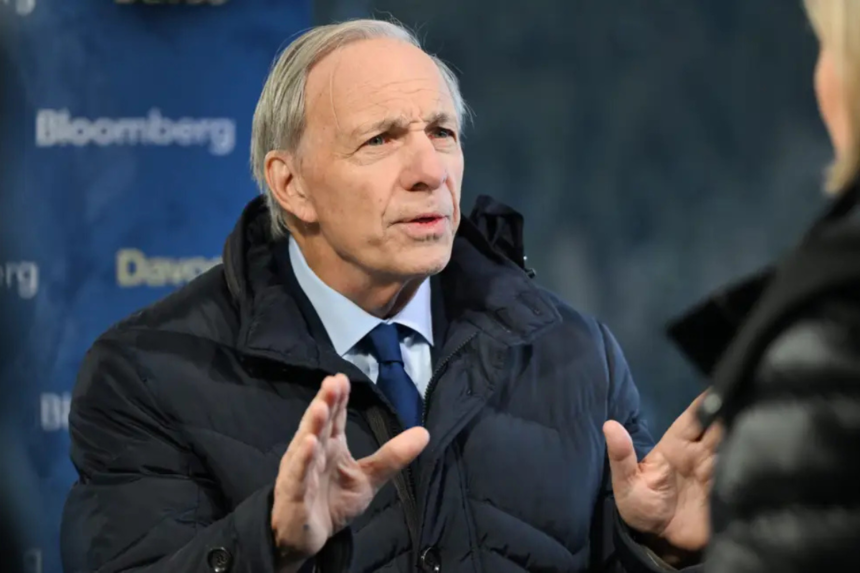
Ray Dalio believes the United States is moving toward a far more unstable economic period, one shaped by rising debt, persistent inflation, slowing growth, and weakening confidence in the country’s financial system.
Speaking on the “Interesting Times” podcast, the billionaire investor warned that excessive government borrowing and continued money printing could eventually push the US economy into what he described as a “disorderly” phase, where financial pressures begin limiting both economic flexibility and political choices.
Dalio said the growing imbalance between government spending and revenue is becoming increasingly difficult to sustain, particularly as deficits continue expanding across major economies.
Rising Deficits Are Becoming a Structural Problem
The US government spent roughly $7 trillion during the last fiscal year while generating only $5.2 trillion in revenue, according to Treasury Department data.
For Dalio, that gap matters because governments eventually need to finance deficits somehow, either through higher borrowing, higher taxes, or monetary expansion.
Historically, he argued, countries facing persistent deficits often rely on central banks and money creation to support spending. While that may temporarily ease financial pressure, it also weakens currencies over time and contributes to inflation.
Dalio warned that this cycle can eventually create deeper structural instability across financial markets.
“The financial crisis will mean that the capacity to spend will be very limited,” Dalio said, adding that governments could eventually struggle to maintain military spending, social programs, and broader economic support if borrowing costs continue rising.
According to Dalio, higher interest rates would likely follow, which could slow borrowing, weaken asset prices, pressure stock markets, and tighten overall financial conditions.
Dalio Warns About a Possible Slow-Growth Crisis Environment
One of Dalio’s biggest concerns is the possibility of stagflation.
Stagflation refers to a difficult economic environment where inflation remains high while economic growth slows and unemployment pressures rise. It is considered one of the hardest conditions for policymakers and investors because traditional solutions for inflation often weaken growth further.
Dalio said the combination of rising deficits, higher borrowing costs, and slowing economic momentum could eventually push the US toward that type of environment.
The concern becomes even more serious if governments continue expanding spending while productivity and economic output fail to keep pace.
For investors, stagflation creates a particularly difficult landscape because both stocks and bonds can come under pressure simultaneously.
Gold Remains Central to Dalio’s Strategy
In addition, Ray Dalio reiterated his long-held view that Gold remains one of the strongest safeguards during periods of monetary instability.
He advised investors to allocate between 5% and 15% of their portfolios to gold, arguing that it can help protect against inflation, currency debasement, and broader financial disruption.
To support this position, Dalio pointed to historical patterns showing that fiat currencies often weaken during periods of excessive debt expansion and aggressive monetary intervention, while gold tends to preserve value more effectively.
As he put it, “When we look at history, we see that in all such periods, all the fiat currencies go down, and gold goes up.”
For years, Dalio has argued that governments facing large deficits often erode the purchasing power of currencies through inflation and monetary expansion. As a result, this thesis, widely known as the “debasement trade” … has gained traction among investors increasingly concerned about long-term debt sustainability and the stability of traditional monetary systems.
Concerns About the Dollar and Global Monetary Order
Beyond his concerns about near-term economic risks, Ray Dalio also highlighted longer-term challenges facing the global dominance of the US dollar.
While many economists continue to dismiss the possibility of rapid de-dollarisation, Dalio argued that reserve currency systems inevitably evolve. To support his point, he pointed to historical examples such as the decline of the British pound sterling as a dominant reserve currency during the 20th century, emphasising that no financial system remains permanently at the top.
At the same time, Dalio warned that geopolitical tensions, including the ongoing Iran conflict, could gradually weaken global confidence in the United States as both an economic and political power. In his view, rising oil prices, inflation concerns, and broader geopolitical instability have already renewed debate over the future role of the United States dollar in global trade and finance.
Even so, he acknowledged that the dollar continues to hold a dominant position for now. Demand for US Treasuries has remained relatively stable, while international capital continues to flow into the United States despite mounting concerns over debt levels and inflation.
Earlier this year, the US Dollar Index strengthened as investors responded to expectations of higher interest rates, although it later cooled as market sentiment shifted. For Dalio, this reflects a broader reality: while the dollar’s position remains secure today, structural pressures could reshape that dominance over time.
Markets Are Facing More Uncertainty Than Clarity
Dalio emphasized that one of the biggest risks facing investors today is uncertainty itself.
Rather than predicting a single specific outcome, he argued that the range of possible economic scenarios has widened significantly over the last few years.
“We do not know a lot about what the world will look like in three to five years,” Dalio said.
“What we don’t know is much greater than anything we know.”
That uncertainty, combined with geopolitical tensions, rising debt burdens, inflation pressure, and shifting global power dynamics, is what Dalio believes makes the current period especially fragile.
For investors, governments, and businesses alike, the challenge may no longer be preparing for a normal economic cycle, but adapting to a world where instability itself becomes a more permanent feature of the global economy.
Source: BI, WEF