


As regional tensions intensify, executives are reassessing strategy, costs, and growth expectations in an increasingly uncertain business climate.
More than two months after the Iran war began, the business consequences are becoming harder for global companies to ignore.
What initially looked like a regional geopolitical crisis is now influencing corporate strategy, investment decisions, tourism flows, energy markets, supply chains, consumer confidence, and global demand forecasts. Across first-quarter earnings calls, executives from banking, luxury retail, technology, manufacturing, and advertising companies have started outlining how the conflict is reshaping business conditions.
The message emerging from boardrooms is not uniform. Some industries remain resilient and continue to see strong activity. Others, particularly sectors heavily exposed to Middle Eastern consumers and tourism, are beginning to feel direct pressure from falling traffic, delayed spending, and rising operational costs.
Investment Banks Still See Momentum Despite Geopolitical Risk
For major financial institutions, deal activity has remained stronger than many expected.
David Solomon said during Goldman Sachs first-quarter earnings call that investment banking activity, especially mergers and acquisitions, continued to remain “incredibly robust” despite geopolitical uncertainty.
Solomon acknowledged that executives are monitoring developments in the Middle East carefully. However, he also suggested that many corporate leaders remain more focused on the long-term opportunities created by artificial intelligence than on short-term geopolitical disruptions.
According to Solomon, AI-related opportunities are currently outweighing some of the geopolitical concerns shaping global markets.
At JPMorgan Chase, Jamie Dimon offered a more cautious perspective.
While Dimon described the broader economy as resilient, he warned that geopolitical instability was adding to an increasingly complex risk environment. JPMorgan executives noted that the Middle East conflict could eventually weaken deal activity and business confidence if instability continues.
The bank’s leadership said the current pipeline remains “surprisingly resilient,” but acknowledged that prolonged uncertainty could eventually affect corporate decision-making and investor sentiment.
Luxury Brands Are Seeing Demand Slow Across the Middle East
Luxury companies appear to be among the sectors most directly affected by the conflict.
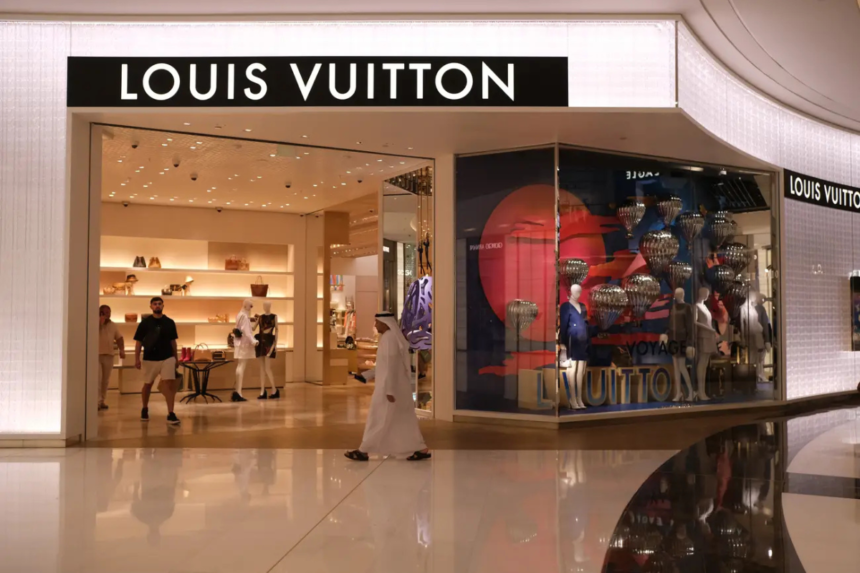
The Middle East has long been a major market for global luxury brands, supported by affluent consumers, tourism, and high-end retail spending. Now, many of those companies are reporting weaker traffic and softer demand across the region.
LVMH executives said the company’s first-quarter performance was negatively affected by the war in Iran.
Cécile Cabanis said demand in the Middle East had fallen significantly, largely due to reduced foot traffic in shopping malls. She noted that Sephora had performed better than some of the group’s other brands because of its stronger presence in Saudi Arabia, which she described as relatively resilient during the conflict.
Meanwhile, Bernard Arnault warned shareholders that the conflict could evolve into a “world catastrophe” if instability continues.
Arnault said the Middle East crisis had already affected luxury demand during the first quarter and warned that prolonged escalation could create severe economic consequences globally.
Kering, the parent company of Gucci, also reported weaker performance connected to the conflict.
Armelle Poulou said geopolitical tensions weighed on traffic and sales across the Middle East, contributing to an 11% decline in regional retail revenue during the quarter.
The company also reported softer tourist spending in Europe as fewer travelers from Asia and the Middle East visited luxury shopping destinations.
Hermès reported a 6% sales decline in the Middle East during the first quarter, while French stores also experienced reduced spending from Middle Eastern customers.
Despite the slowdown, CFO Eric du Halgouët said the profitability impact remained manageable for now, provided the conflict does not continue for an extended period.
Other luxury brands, including Prada Group, Moncler, and Hugo Boss, also reported weaker traffic, reduced tourism, and declining Middle Eastern sales linked to the war.
Advertising and Marketing Clients Are Delaying Major Spending
The conflict is also influencing corporate spending behavior.
Publicis Groupe said some clients have delayed major transformation and capital expenditure projects because of uncertainty surrounding the Middle East situation.
CEO Arthur Sadoun said clients had become more experienced at navigating global instability after years shaped by COVID, inflation, tariffs, and the war in Ukraine.
At the same time, he emphasized that most brands are avoiding major cuts to marketing budgets because companies understand that reducing advertising too aggressively can result in lost market share that becomes expensive to recover later.
Publicis reported a 5.1% decline in organic revenue across its Middle East and Africa business, with the United Arab Emirates and Israel among the most affected markets.
Technology and Semiconductor Companies Face Supply Chain Risks
The conflict is beginning to affect industrial supply chains as well.
TSMC warned that the Iran war could raise costs for chemicals and industrial gases essential to semiconductor manufacturing.
CFO Wendell Huang said the company expected price increases for key inputs tied to Middle Eastern supply chains. One major concern is helium, a critical material used in semiconductor production.
Around one-third of global helium production comes from Qatar, and disruptions linked to the conflict have already contributed to shortages.
Although TSMC said it currently has sufficient reserves to manage temporary disruptions, the company acknowledged that prolonged instability could pressure profitability.
BlackRock Still Sees Strong Investment Appetite
Not every financial indicator points toward retreat.
Larry Fink said BlackRock has not seen significant changes in investment behavior from Middle Eastern sovereign wealth funds despite the conflict.
According to Fink, capital continues flowing into investments across the region, although conversations with government officials have become more focused on risk management and long-term strategy.
He acknowledged that prolonged instability could eventually affect investor behavior, but said BlackRock still sees “huge opportunities” in the region and plans to continue expanding its presence there.
Consumer Brands Are Warning About Inflation and Confidence
Consumer-focused companies are increasingly worried about rising costs and weakening confidence.
Mondelēz International CEO Dirk Van de Put said the Iran conflict is contributing to higher costs for oil, fertilizers, packaging, and logistics.
He warned that consumers, particularly in the United States, remain anxious about affordability, job security, and the broader economic outlook.
According to Van de Put, consumers are becoming more selective about purchases and increasingly prioritizing value-driven retail channels such as Walmart and Costco.
Similarly, Whirlpool Corporation CEO Marc Bitzer said the Iran war had intensified consumer concerns about the cost of living.
Whirlpool responded by implementing its largest price increase in a decade, raising prices by more than 10% to offset inflationary pressure and higher operational costs.
Businesses Are Preparing for a Longer Period of Uncertainty
Across industries, one theme appears repeatedly.
Executives no longer see the Iran conflict as a temporary geopolitical headline. Many companies are now actively reassessing forecasts, operational exposure, investment timelines, and supply chain resilience under the assumption that instability could continue.
Some sectors remain surprisingly resilient. Others are already seeing measurable declines in tourism, traffic, demand, and consumer confidence.
What increasingly concerns corporate leaders is not simply the conflict itself, but the uncertainty surrounding how long it could last and how deeply it could reshape global business conditions.
For now, companies are adapting in real time, balancing caution with opportunity while preparing for a business environment that looks significantly more fragile than it did just a few months ago.
Source: BI
LVMH, which owns Louis Vuitton, has said that lower footfall in Middle East malls has affected business. Kaveh Kazemi/Getty Images