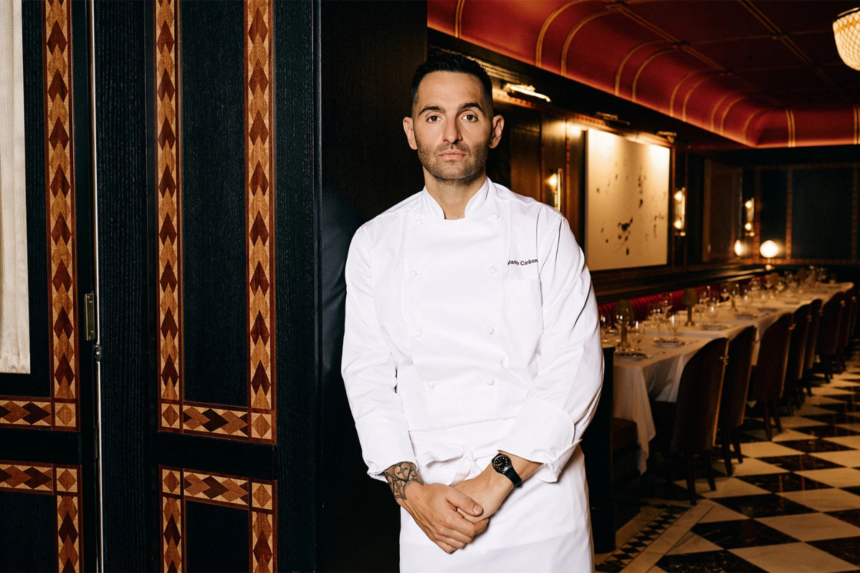
While most brands chase reinvention, Mario Carbone scaled a global phenomenon by doubling down on identity, proving that the strongest growth often comes from radical consistency.
For most restaurants, a weekend like the Formula 1 Miami Grand Prix is about volume. More tables, more covers, more throughput.
For Mario Carbone, it is about the scale of experience.
Through Major Food Group, he approaches events like Carbone Beach as something closer to a production than a restaurant. A controlled environment built to match the intensity of the moment, where hospitality is the foundation, but the execution is designed to carry the weight of global attention.
The logic is precise. When attention compresses into a single place, what is built inside that space has the potential to travel far beyond it.
Demand Is Not Engineered. It Is Earned
From the outside, Carbone appears exclusive. Limited access. High demand. Difficult reservations.
From the inside, the thinking is different.
The focus is not on restricting supply. It is on building something strong enough that demand becomes a byproduct. Many brands attempt to manufacture scarcity through positioning and controlled access. Carbone rejects that approach.
The premise is simple. If the product is undeniable, people will organize themselves around it.
This shift reflects a deeper evolution. Early in the journey, external validation carries weight. Over time, conviction replaces feedback as the primary driver. The brand is no longer shaped by reaction. It is shaped by an internal standard that does not move.
Identity Over Adaptation
Carbone does not design around the audience.
Whether the room holds athletes, executives, or cultural figures, the product remains unchanged. The goal is not to tailor the experience to the guest list. The goal is to build something that defines the moment itself.
This is where most brands diverge. They adjust constantly, trying to stay relevant to different segments. Carbone moves in the opposite direction. It sharpens identity until it becomes transferable across contexts.
That is how a restaurant crosses into culture, business, and entertainment without repositioning itself for each.
Scaling Without Dilution
Expansion inevitably introduces complexity, new markets, new teams, and new operating partners. Yet for Major Food Group, the real risk is not growth itself but drift. As the company expands globally and extends into retail through Carbone Fine Food, its greatest operational challenge lies in preserving sameness across distance.
That challenge is governed by a single principle: the product does not change. A dish served in Doha must match the one served in Miami, not just in spirit, but in precise execution. Maintaining that standard cannot be automated through systems alone. It requires discipline, rigorous training, and alignment at every layer of the business. Growth does not make that easier; it amplifies the consequences of getting it wrong.
The Discipline Behind Expansion
Opportunities increase with visibility. The constraint shifts from access to selection. Carbone’s approach filters partnerships through alignment rather than scale. Philosophical consistency becomes the gatekeeper. Decisions made for short-term gain introduce long-term instability.
This is where many expanding brands fracture. They grow faster than their identity can hold.
Carbone’s model avoids that by narrowing, not widening, the criteria for growth.
Instinct, Refined by Data
The relationship between instinct and data is not oppositional. Data informs. Experience interprets.
Over time, repeated exposure to outcomes sharpens decision-making. Instinct becomes structured, not reactive. It is no longer guesswork. It is pattern recognition built through iteration.
This balance allows the brand to evolve operationally without altering its core.
Conclusion
What appears as expansion from the outside is, in reality, restraint.
The brand grows by refusing to change what defines it.
Consistency becomes the strategy. Identity becomes the engine. Demand becomes the outcome.
The result is a business that moves across markets, formats, and industries without losing coherence, because the foundation remains fixed while everything around it scales.
Mario Carbone at Carbone London. Photo: Sofi Adams
Source: INC