



When Digital Channels Stop Working
Aryan faced a common early-stage problem. No installs, no visibility, and no traction despite trying ads and social media.
Instead of refining campaigns endlessly, he changed direction. He stepped away from digital platforms and moved into physical spaces where attention is harder to ignore.
Taking the Product to the Street
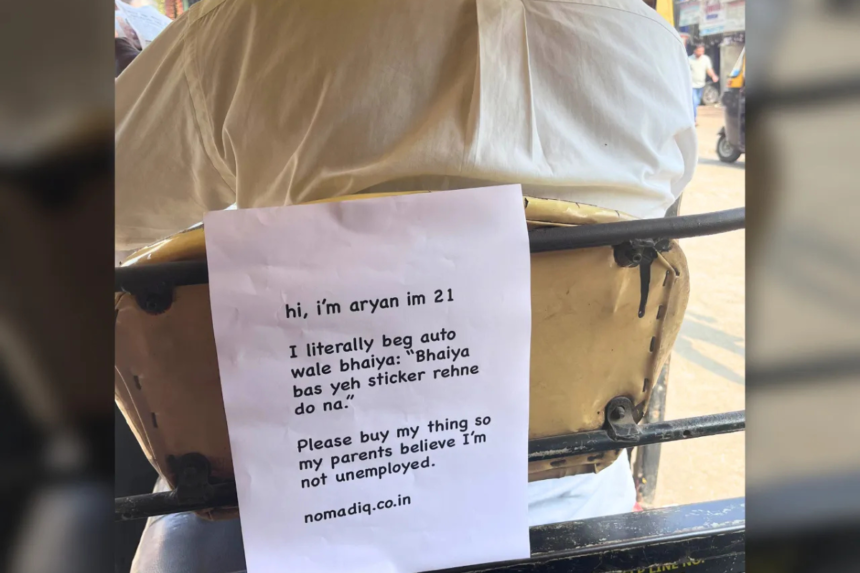
His approach was simple. Printed posters placed inside auto-rickshaws across Bandra, Andheri, and Kurla.
The message was direct and personal. It introduced him, his age, and his situation without polish. That lack of refinement became the strength of the idea.
Passengers did not see a brand. They saw a person building something from scratch.
Immediate Impact Without Spend
The results came quickly. Within 48 hours, the experiment led to press mentions, early sign-ups, and inbound interest from potential collaborators.
This response did not come from scale. It came from placement. The message appeared in a confined space where attention could not be skipped or scrolled past.
Distribution Before Perfection
The core insight is structural. Early-stage products do not fail because they lack features. They fail because they are not seen.
Aryan’s approach reinforces a basic principle. Distribution determines whether a product exists in the market. Without it, product quality remains irrelevant.
Why the Unusual Works
Auto-rickshaw posters are not efficient in the conventional sense. They do not scale instantly. They are not measurable like digital campaigns.
Yet they introduce something digital often lacks. Surprise.
Unexpected placement interrupts routine behavior. It forces attention. That attention converts into curiosity, which can convert into action.
Offline Trigger, Online Amplification
The offline effort extended into digital space through user behavior. People photographed the posters and shared them online, creating a secondary wave of visibility.
This sequence matters. Physical presence created credibility. Digital sharing multiplied reach.
The effect exceeded what paid campaigns typically achieve at the same stage.
A Pattern in Early-Stage Growth
The experiment reflects a broader pattern. Early traction rarely comes from optimized systems. It comes from direct, sometimes uncomfortable outreach.
Founders who wait for perfect campaigns remain invisible. Those who insert themselves into real environments gain feedback, attention, and momentum.
What This Signals
Aryan’s approach does not represent a tactic to copy. It reflects a shift in thinking.
Attention is not captured by refinement alone. It is captured by presence, placement, and timing.
In the early stages, visibility is the constraint. Solving that changes everything that follows.
Source: ISN