


The Amazon India executive discusses what is driving growth in everyday essentials, the path to profitability, and the company’s expansion beyond major cities.
Amazon India is moving deeper into quick commerce, but Harsh Goyal believes winning the market will require more than delivering groceries in minutes.
The vice president of Everyday Essentials at Amazon India says customers now take eight- to 10-minute deliveries for granted. The real competition, he argues, is around assortment, freshness, pricing and the overall shopping experience.
Amazon Now has crossed $1 billion in annualised gross sales in India, with orders doubling every quarter since its launch in Bengaluru in January 2025. The service now operates in more than 60 cities and towns through over 750 micro-fulfilment and urban fulfilment centres, with Amazon targeting 100 cities by Diwali.
Amazon Now Scales Faster Than Expected
Amazon initially launched Now across just four or five pin codes in Whitefield, Bengaluru. Goyal said customer demand exceeded even the company’s most optimistic projections within the first few weeks.
The business had fewer than 50 micro-fulfilment centres and operated in Bengaluru and parts of Delhi NCR around this time last year. It has since expanded to more than 750 centres across cities including Mumbai, Hyderabad, Chennai and Kolkata, as well as smaller markets such as Amritsar, Visakhapatnam, Mangaluru, Tirupati and Guntur.
For Goyal, the speed of expansion makes Amazon Now one of the fastest-growing businesses he has seen during his 14 years at Amazon.
Delivery Speed Is Becoming the Baseline
Amazon’s strategy is built around the idea that delivery time alone is no longer enough to distinguish one quick-commerce platform from another.
Goyal said customers increasingly expect deliveries within eight, 10 or 11 minutes. Amazon is therefore focusing on a wider assortment, reliable product quality and particularly strong standards for fresh produce.
The company sources fresh products directly from farmers and aims to move them through the supply chain with minimal handling. It also wants to differentiate through transparent pricing and fewer unexpected charges at checkout.
The broader Amazon ecosystem is another part of the proposition. While quick-commerce services typically focus on a limited selection of products, Amazon wants customers to use its platform for everything from essentials delivered within minutes to a much larger assortment delivered later the same day or the following day.
Prime Customers Are Driving Frequent Orders
Amazon Now is also benefiting from the company’s existing Prime customer base.
Nearly 70% of orders on a typical day come from Prime members, according to Goyal. In some locations, the share reaches 75% to 80%.
Prime members also receive additional benefits on Amazon Now, including a lower free-shipping threshold of ₹99 compared with ₹149 for non-Prime customers, along with potential cashback benefits on larger baskets.
Goyal said Prime customers also shop more frequently, giving Amazon Now an advantage through the trust and loyalty already built around the wider Amazon platform.
Amazon Sees a Path to Profitability
Amazon entered quick commerce with a model built around several assumptions, including order frequency, operational efficiency and the economics of fulfilment.
Goyal said that after scaling beyond $1 billion in annualised gross sales and processing millions of units every day, most of those assumptions are broadly playing out as expected.
The company believes scale can eventually improve profitability through better supply-chain efficiency, last-mile operations, technology and waste reduction.
Amazon also sees a broader benefit. Customers who begin shopping through Amazon Now are increasing their purchases across other parts of the Amazon India platform, creating what Goyal describes as a halo effect.
The business still requires investment, but Amazon believes the quick-commerce operation can eventually become profitable while also strengthening its wider marketplace.
Smaller Cities Require a Different Model
Amazon is taking a different approach to expansion beyond India’s largest cities.
Rather than building a dedicated quick-commerce network everywhere, the company is converting existing retail stores into omnichannel operations. Customers can continue visiting these stores physically, while people living within a two-to-three-kilometre radius can also order the same inventory through Amazon Now.
The model effectively turns participating stores into micro-fulfilment centres without removing their traditional retail function.
Amazon currently has around 75 to 80 participating retail stores across 30 cities.
Local Retailers Can Become Part of the Network
Goyal sees quick commerce as a potential additional sales channel for local retailers rather than simply a threat to their businesses.
Retailers continue serving walk-in customers while gaining access to online demand through Amazon. Because many store costs, including rent, utilities, and staffing, are fixed, additional sales can potentially improve the economics of the existing infrastructure.
Amazon requires participating retailers to meet standards for assortment, availability, hygiene, freshness, and product quality. Retailers also bring knowledge of local buying habits, which can help Amazon adapt its assortment to different markets.
For smaller population clusters, this model could allow Amazon to expand without building an entirely new supply chain in every location.
The Next Challenge Is Improving the Network
Amazon’s expansion comes with its own operational challenge. The company wants to continue improving assortment, freshness, quality and supply-chain efficiency while adding roughly two micro-fulfilment centres every day.
Goyal said Amazon follows a philosophy of continuous dissatisfaction with its own performance. Even as the service scales, the focus remains on finding areas where the customer experience can improve.
That becomes particularly important as Amazon moves towards its target of 100 cities.
What Will Decide the Quick-Commerce Race?
Goyal’s view is that customers will ultimately choose platforms that combine broad assortment, reliable quality and freshness, transparent pricing and a trustworthy experience.
The challenge for Amazon is turning those customer expectations into a sustainable business model.
More orders can improve supply-chain efficiency, while better assortment and quality can encourage customers to buy more. That creates a cycle in which stronger customer experience drives higher volumes, and higher volumes can improve operational efficiency.
For Amazon Now, the next phase of the quick-commerce battle may therefore be less about shaving another minute off delivery times and more about building the network that makes those deliveries worthwhile.
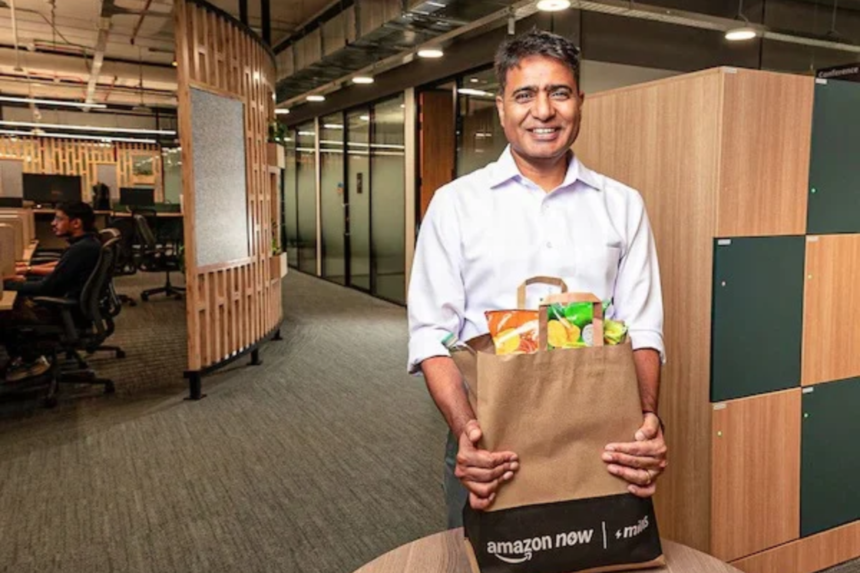
Harsh Goyal, Vice President, Everyday Essentials, Amazon India. Photo by Madhu Kapparath
Source: Forbes