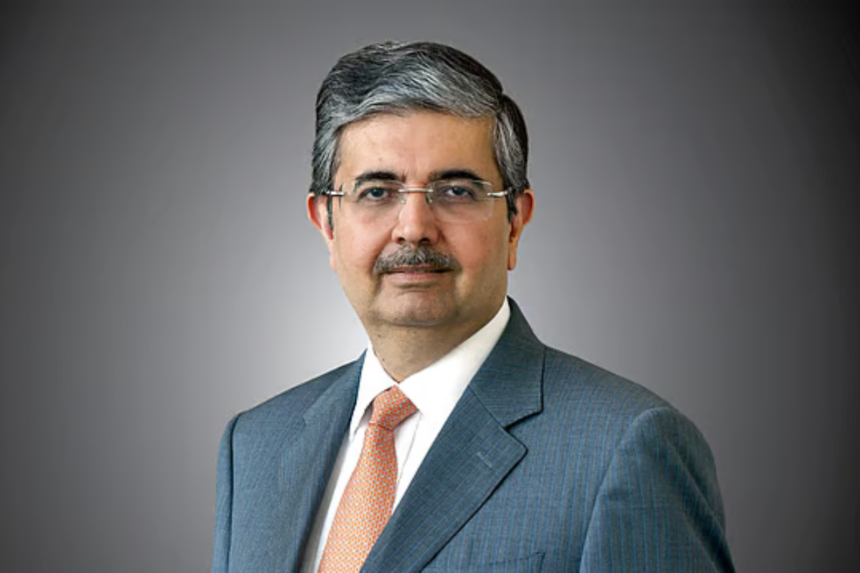
In 1985, Uday Kotak started a finance business with a relatively modest amount of capital.
Four decades later, the business has become Kotak Mahindra Group, spanning banking, asset management, investment banking, insurance, securities and other financial services.
Uday Kotak is now one of India’s richest financial-services entrepreneurs. The M3M Hurun India Rich List 2026 estimates his wealth at ₹1.19 lakh crore, making him the country’s wealthiest individual in the financial-services sector.
What makes his journey particularly notable is the transformation of the original business. Kotak did not inherit a bank or a large industrial company. He built a financial institution and then converted it into a bank at a time when India’s banking industry was dominated by established institutions.
The business started with bill discounting.
Kotak’s first venture was established in 1985 as Kotak Capital Management Finance, focusing on bill discounting.
The business later expanded into investment banking, auto finance, stock broking, and other financial activities. The group entered investment banking through a joint venture with Goldman Sachs and built an auto-finance business through Kotak Mahindra Prime.
The expansion mattered because Kotak was not building a single financial product. He was gradually assembling businesses across different parts of the financial system.
That strategy eventually gave the group a broader base from which to grow.
The banking licence changed everything.
The pivotal moment came in 2003, when Kotak Mahindra Finance became India’s first non-banking finance company to convert into a commercial bank after receiving a banking licence from the Reserve Bank of India.
The transition gave the group access to a much larger financial-services opportunity.
Kotak Mahindra Bank could now build a deposit franchise and lending business alongside the group’s existing activities.
The bank subsequently expanded its footprint and strengthened its position in India’s private banking market. One of its biggest steps came in 2014, when ING Vysya Bank merged with Kotak Mahindra Bank, significantly increasing the scale of the franchise.
The bank is now the centre of the group.
The scale of Kotak Mahindra Bank today is far removed from the finance company Kotak started in the 1980s.
For FY2025-26, the Kotak Mahindra Group reported ₹19,288 crore in consolidated profit, compared with ₹22,126 crore a year earlier. The bank’s financial-services operations include banking, securities, asset management and insurance businesses.
The bank’s standalone balance sheet has also expanded substantially over the years. In FY2025, deposits stood at ₹4.99 lakh crore and advances at ₹4.27 lakh crore, compared with ₹2.80 lakh crore and ₹2.24 lakh crore respectively in FY2021.
That expansion has turned Kotak’s original financial-services idea into a large banking franchise with millions of customers and a wide range of products.
Kotak stepped away from the CEO’s chair.
One of the biggest changes in the group came in 2023, when Kotak resigned as managing director and CEO of Kotak Mahindra Bank.
He became a non-executive director, ending a nearly four-decade period in which he had played a central role in building the institution.
Ashok Vaswani subsequently became managing director and CEO in January 2024.
The leadership transition has entered another phase in 2026. Vaswani announced in June that he would not seek reappointment after his term ends on December 31, 2026, citing personal reasons. The bank has begun the process of identifying his successor.
For Kotak, this means his role is now primarily that of founder, promoter and non-executive director rather than operating chief.
The founder still has a substantial stake.
Stepping away from day-to-day management did not mean stepping away from the economics of the business.
As of March 2025, Kotak, together with the promoter group, held 25.88% of Kotak Mahindra Bank’s paid-up share capital, according to the bank’s annual report.
That ownership is central to understanding his wealth.
The ₹1.19 lakh crore Hurun estimate is not the cash generated by the bank or the value of its deposits and loans. It largely reflects the market value of the founder’s ownership and other assets.
Beyond banking
Kotak Mahindra Group has developed into a diversified financial-services platform.
Its businesses cover asset management, investment banking, stock broking, insurance, private banking, vehicle finance, microcredit and asset reconstruction, among others.
The diversification was built gradually rather than through a single transformational acquisition.
That has been a recurring feature of Kotak’s career. The group repeatedly entered adjacent financial businesses, built capabilities around them, and eventually connected them to the wider franchise.
The next phase is about institutional continuity.
Uday Kotak’s most important transition may now be less about expansion and more about what happens after the founder is no longer running the institution.
Kotak Mahindra Bank has already moved from founder-led management to professional leadership. The impending CEO transition in 2026 adds another test of that model.
The group enters this phase with a large banking franchise, multiple financial-services businesses and a founder who remains a significant shareholder.
Four decades after the original finance company began operations, the central question is no longer whether Uday Kotak can build a financial institution.
He already has.
The next chapter is about how well that institution continues to evolve without him in the CEO’s chair.
Read more news and follow us on Instagram.
Image: Fortune India