



The capital markets regulator says companies across the real estate and industrial sectors are considering public listings, pointing to growing interest in raising funds through the stock market.
Companies in the UAE’s real estate and industrial sectors are showing interest in entering the public markets, according to Waleed Saeed Al Awadhi, chief executive of the Capital Market Authority (CMA).
Al Awadhi said it was too early to predict the number of initial public offerings (IPOs) and new listings the country could see in 2027. He said the regulator’s focus was on ensuring that companies entering the market meet governance and disclosure requirements while providing investors with more opportunities.
The CMA is also reviewing the regulatory framework for retail and fractional sukuk, which could allow investors to access fixed-income products through smaller contributions.
DIP Holding becomes UAE’s first IPO of 2026
In 2026, the CMA approved the public offering of shares in DIP Holding, which announced plans to list on the Dubai Financial Market (DFM).
The IPO is the UAE’s first of the year. Dubai Investments is selling a 20% stake in the company through the offering, with the final share price set at Dh1.12.
The offering raised Dh1.9 billion and valued DIP Holding at Dh9.7 billion at listing. The company reported strong investor demand, with the IPO significantly oversubscribed. Trading on the DFM is scheduled to begin on November 11.
Earlier this month, Hamed Ali, CEO of the DFM and Nasdaq Dubai, also described the emirate’s IPO pipeline as promising despite only one offering reaching the market so far in 2026.
“The pipeline is looking good across several different sectors,” Ali said at the Dubai Fintech Summit.
He added that the exchange was working to attract more companies to the market, while also focusing on activity after companies complete their listings.
“When we look at the growth of the market, one is IPOs and the second is post-IPO,” Ali explained.
CMA reviews retail and fractional sukuk framework
The CMA’s review of retail and fractional sukuk comes as the UAE expands access to government-backed Islamic debt for individual investors.
The Ministry of Finance’s first Dh50 million retail T-Sukuk issuance was oversubscribed nearly nine times. Investors were able to subscribe digitally with a minimum investment of Dh1,000. The ministry set the profit rate for its second issuance at 5.06%.
Al Awadhi said regulated digital investment platforms could help simplify access to financial markets, provided they operate within appropriate regulatory safeguards.
These requirements include regulatory authorisation, transparent disclosure of costs and risks, protection of client assets and oversight of automated investment services.
“Lower investment thresholds do not necessarily mean lower risks, and our priority is to ensure that greater accessibility is accompanied by adequate investor safeguards,” he said.
Investor protection among CMA’s priorities for 2027
Al Awadhi told the Khaleej Times that the CMA had identified three main priorities for 2027: investor protection, broader market access and digital transformation.
The authority is also planning to establish an Investor Protection Fund and introduce additional safeguards for exceptional market circumstances.
The regulator’s approach reflects its focus on expanding participation in the UAE’s capital markets while maintaining governance standards and protecting investors as more companies consider public listings.
Source: KT
Read more news and follow us on Instagram
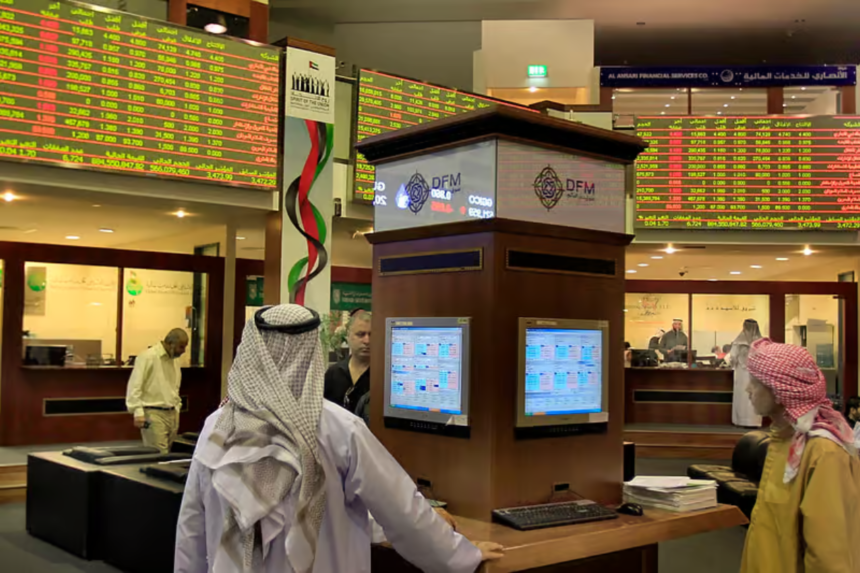
Photo: Investors observe stock prices at the Dubai Financial Market.