




In an ecosystem that often rewards speed, visibility, and rapid scaling, Nadine El Shater’s journey has followed a quieter, less predictable path.
Today, she is the founder of Virclo and Kein Hotel (Kein Hotel is a boutique serviced apartments Hotel), alongside other ventures.
What appears, from the outside, as a growing portfolio of ventures is in reality the result of several years of consistent, often unseen effort. Long before launching publicly, Nadine El Shater spent time testing ideas, refining concepts, and developing systems over time.
“The visible phase is always the smallest part of the journey,” she notes in private conversations. “Most of the work happens before anything can be shown.”
This gap between perception and reality is central to understanding how she operates. While many founders are encouraged to move quickly and validate ideas through early exposure, El Shater’s process is defined more by iteration than announcement.
A significant part of this process involved multiple development cycles of Virclo. Early versions of the platform were shaped through continuous refinement, as she worked closely with different teams to align the technical realisation with the original vision.
Over time, this became less about iteration as correction, and more about precision in translation — ensuring that the depth of the concept was fully reflected in its final form.
These experiences contributed to a more selective approach to decision-making, particularly when it comes to external capital.
Over time, Nadine El Shater made the decision to turn down multiple investment opportunities, with a consistent focus on maintaining long-term structural direction.
In an ecosystem where funding is often equated with validation, her stance reflects a different metric of progress — one that prioritises clarity over acceleration.
This perspective is not incidental. It can be traced back to her early exposure to business, long before digital platforms became the primary drivers of visibility.
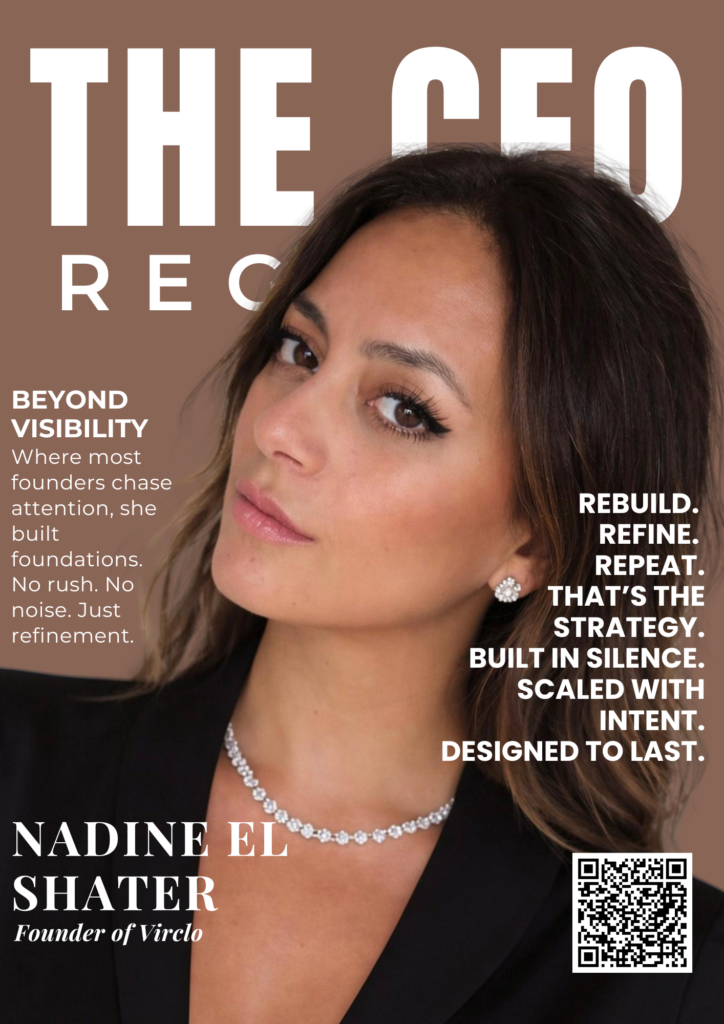
Nadine El Shater began her entrepreneurial journey at the age of 16, operating in real-world settings defined by direct interaction, negotiation, and trade.
By 19, she was trading internationally and had established her own company.
These early experiences continue to inform how she evaluates structure, timing, and scale today.
Her approach remains consistent: build with a long-term perspective, and protect the integrity of the core structure as ventures evolve.
At the same time, her natural way of working remains highly immediate. Once direction is clear, action follows without delay — often on the same day — guided by momentum, clarity, and a preference for tangible outcomes over extended planning.
In Virclo’s case in particular, this approach shaped a development process defined by refinement and precision, ensuring the concept evolved into its intended form.
What remains consistent across her work is a focus on clarity in creation and a commitment to building ideas that are fully aligned with their purpose from the beginning.