



For more than a decade, Northern Virginia has dominated the global data center industry. That dominance may soon end.
New research from Jones Lang LaSalle indicates that Texas is on track to overtake Virginia as the world’s largest data center market by 2030. The shift reflects a dramatic redrawing of America’s digital infrastructure map as artificial intelligence drives unprecedented demand for computing power.
The End of Northern Virginia’s Monopoly
Northern Virginia became the center of the data center universe during the early cloud computing era. Its proximity to government networks, fiber infrastructure, and early tech adoption made it the default hub.
Now, expansion pressure is pushing development outward.
According to JLL’s North America Data Center Report, more than half of all new US data center construction is happening outside traditional hubs. Emerging markets include Texas, Tennessee, Ohio, and Wisconsin.
The gravitational center is moving.
Texas by the Numbers
Texas alone currently has 6.5 gigawatts of data center capacity under construction.
That represents nearly one-fifth of the 35 gigawatts recently added to the US development pipeline.
To put that scale in context, 35 gigawatts roughly equals the annual electricity consumption of entire countries such as the UK or Italy. Adding that much capacity would nearly double the nation’s current data center footprint.
The expansion is fueled by aggressive spending from major tech firms, including Amazon, Microsoft, Google, and Meta. Collectively, these companies are expected to invest over $600 billion in AI infrastructure expansion in 2026.
Why Texas Is Winning
Texas offers three structural advantages.
Land. Power. Incentives.
The state’s vast geography enables hyperscale campuses that would be difficult to replicate in more densely built regions. Projects in Abilene, West Texas, and El Paso reflect this advantage.
Energy access is equally critical. AI workloads demand extraordinary electricity volumes, and Texas combines abundant natural gas resources with expanding renewable energy generation.
Some projects are even pairing data centers with on-site power plants to guarantee supply.
Tax incentives and regulatory flexibility further strengthen the state’s competitive position.
The Rise of Secondary Markets
Texas is not alone.
Tennessee, Ohio, and Wisconsin are also emerging as serious data center markets. Developers are spreading across the country in search of grid capacity and cheaper land as power constraints intensify in legacy hubs.
The AI boom has reshaped infrastructure logic. Where fiber connectivity once dominated site selection, electricity access now leads.
A National Infrastructure Reset
The scale of current development signals more than regional competition. It represents a structural transformation of US digital infrastructure.
Data centers are no longer clustered in a handful of coastal corridors. They are expanding into interior states with energy resources and available land.
If projections hold, Texas could surpass Northern Virginia before the decade ends.
The center of the internet may be moving west.
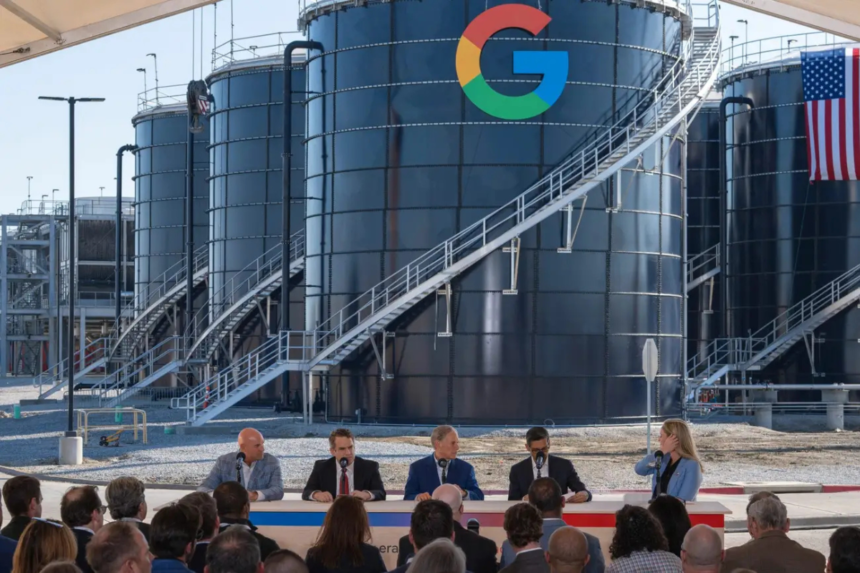
Google executives meet with officials at a Google data center in Midlothian, Texas. Fortune via Reuters Connect
Photo/Source: BI