



In capital markets, speed is often mistaken for strength.
Valuations spike. Announcements multiply. Visibility expands.
But long-duration infrastructure rarely rewards velocity. It rewards architecture.
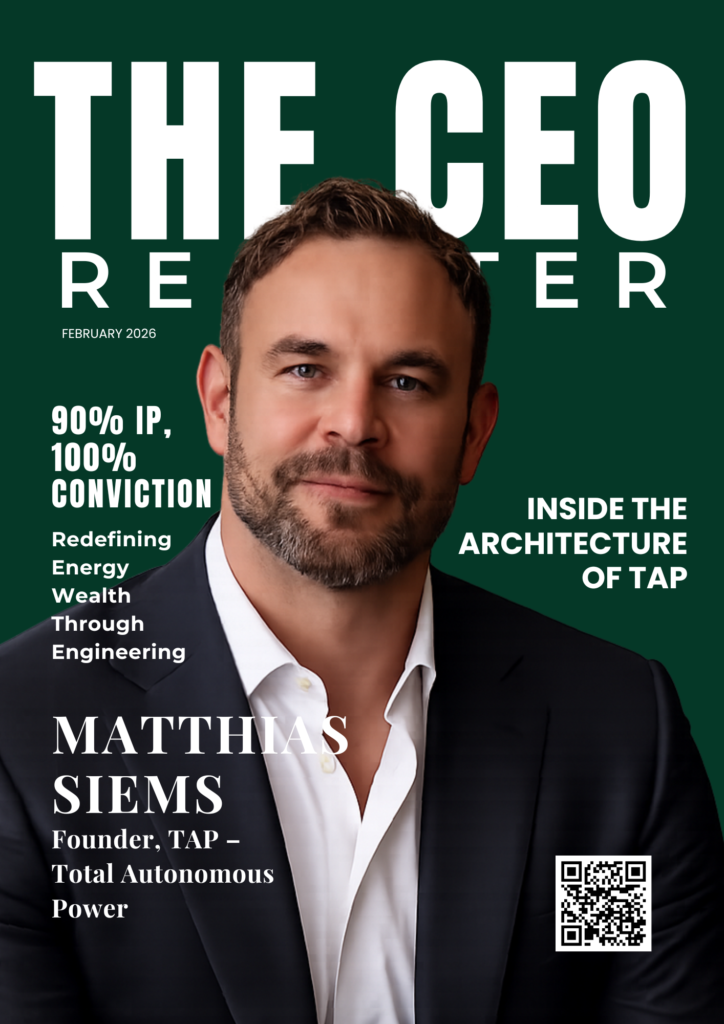
Matthias Siems, founder of NEO 7even Venture Capital and architect of TAP – Total Autonomous Power, operates on this latter philosophy.
Rather than framing TAP as a startup disruption, Siems structured it as a sovereign-compatible infrastructure system, a magnetic-field-based electricity platform protected by a globally diversified patent portfolio and assessed in 2026 at $8.77 billion.
The ambition was not media visibility.
It was state-level durability.
Technology as Structured Sovereignty
TAP’s underlying system is engineered from calibrated Neodymium and Samarium-Cobalt composite magnet configurations. The intellectual property includes material composition engineering, vacuum magnetization processes, and proprietary field architecture mechanics.
Unlike fuel-based generation models, TAP is positioned as non-combustion-based and independent of weather cycles.
But Siems’ focus extends beyond physics.
It extends to geopolitical positioning.
Energy infrastructure, he argues, must align with national resilience strategies. This perspective explains his emphasis on government-aligned pilot programs and measured expansion rather than aggressive public-market listing.
As of 2026, there is no public listing. Wealth remains concentrated in founder-level equity tied directly to protected IP assets.
Concentrated Risk, Concentrated Control
The valuation sensitivity framework presented internally outlines three scenarios:
- A conservative model at $6.5 billion
- A base case of $8.77 billion
- An expansion scenario exceeding $12 billion
With approximately 23% founder-controlled equity, Siems’ personal exposure is almost entirely linked to intellectual property performance.
This is not diversified billionaire behavior.
It is a concentrated founder conviction.
More than 90% of his wealth composition remains tied to intellectual property and technology equity, with less than 10% in diversified private holdings.
Rethinking the CEO Archetype
In an era where many energy executives are trained financiers or policy administrators, Siems represents a different archetype: physicist, inventor, capital allocator, and infrastructure strategist combined.
Through NEO 7even, he backs robotics, aerospace, and energy architecture ventures—but always with operational oversight. He refers to himself not as an investor, but as a builder-investor.
The distinction is subtle, but meaningful.
It suggests control over execution, not just ownership of equity.
Beyond Disruption Narratives
Markets may debate the ultimate scalability of magnetic-field-based generation. Analysts may scrutinize adoption curves. Policymakers may question integration timelines.
That scrutiny is expected in infrastructure.
What matters for leadership observers is this:
Energy wealth may no longer be confined to oil fields, pipelines, or turbine farms.
It may increasingly rest in patent portfolios, sovereign grid licensing agreements, and protected scientific architecture.
If the twentieth century belonged to resource barons, the twenty-first may reward infrastructure physicists. And some of them will build quietly.