

The most heavily funded AI companies this year share a clear pattern.
One openly talks about replacing human workers.
Another builds AI companions meant to simulate friendship.
A third promotes tools that help students bypass learning altogether.
Taken together, the signal is hard to ignore. Silicon Valley is not investing in AI to support people. It is investing in AI to replace them.
That choice carries consequences far beyond productivity gains.
Two paths. One direction chosen.
Every organisation deploying AI today is quietly choosing between two futures.
In the first, AI replaces human thinking, judgment, and relationships. Knowledge is concentrated inside a few platforms. Human skill weakens over time. Dependence grows.
In the second, AI supports humans. It preserves expertise. It rewards contributors. It strengthens judgment instead of outsourcing it. Only one of these paths scales easily.
Only one attracts aggressive capital.
Why replacement wins funding
Replacement removes limits.
One AI therapist can serve millions.
One AI writer can displace entire teams.
One system can operate endlessly with near-zero marginal cost.
From a venture perspective, that math is irresistible.
Service-based AI is slower. It keeps humans in the loop. It requires compensation, consent, and collaboration. Those things reduce margins.
So capital flows where friction is lowest. That is not an accident. It is an incentive design.
The hidden cost. Skill erosion.
As AI takes over thinking tasks, human capability declines.
Multiple studies show that heavy reliance on generative AI weakens memory, reasoning, and problem-solving. When people stop practicing judgment, they lose it.
Organisations already struggle to retain institutional knowledge. Replacement AI accelerates that loss. Once expertise leaves human hands, it does not come back easily.
Service-based systems do the opposite. They reinforce learning. They document judgment. They keep decision-making human.
When everyone uses the same AI, innovation shrinks
Most dominant AI models train on the same narrow datasets. The result is homogenisation.
Local knowledge disappears. Cultural nuance fades. Non-Western perspectives flatten. Innovation slows because diversity disappears.
Human progress has always come from difference. Replacement AI standardises thought instead of expanding it.
A different model exists
Some builders are moving in another direction.
Instead of scraping knowledge and reselling it, they design systems where people retain control. Contributors own their input. Communities decide how AI uses their expertise.
In this model, AI organises knowledge instead of extracting it. It supports judgment instead of replacing it.
That approach does not scale as fast. It does not generate hype as easily. But it preserves something essential. Human agency.
Control is the real issue
The debate is not about technology. It is about control. Replacement AI creates dependency. Service AI builds capability. Once systems replace thinking, humans adapt downward. Once systems support thinking, humans grow.
That difference determines whether AI weakens society or strengthens it.
The future is being locked in now
Silicon Valley will keep funding replacement. It scales profit quickly. Change will not come from ethics panels or after-the-fact safeguards. It will come from organisations refusing to deploy tools that hollow out human capability.
The infrastructure being built today will define how knowledge, work, and power function for decades.
The question is no longer abstract.
Do we want AI that replaces human potential, or AI that helps it grow?
Both futures are possible. Only one deserves to exist.
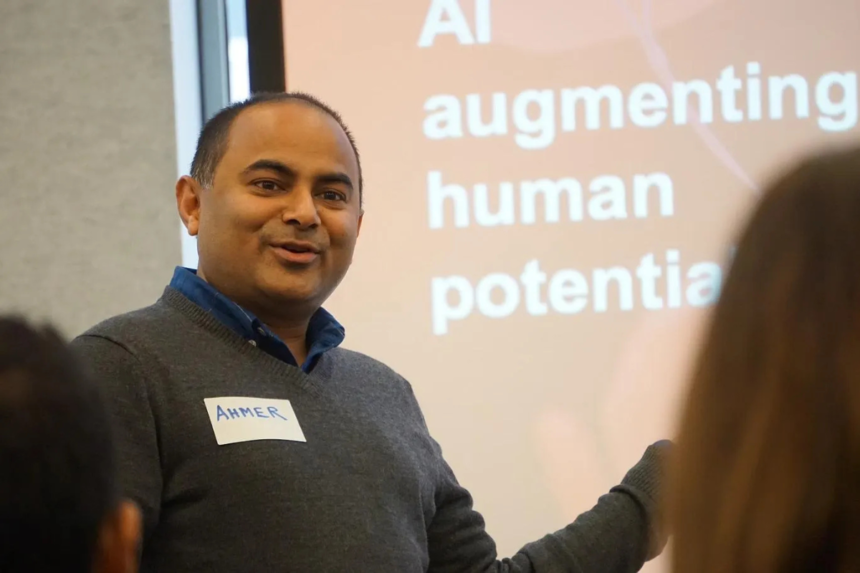
Inam’s vision is “AI for the people, by the people.”
Ahmer Inam, Photo: Frobes
Follow us on Instagram and stay updated with our current news