



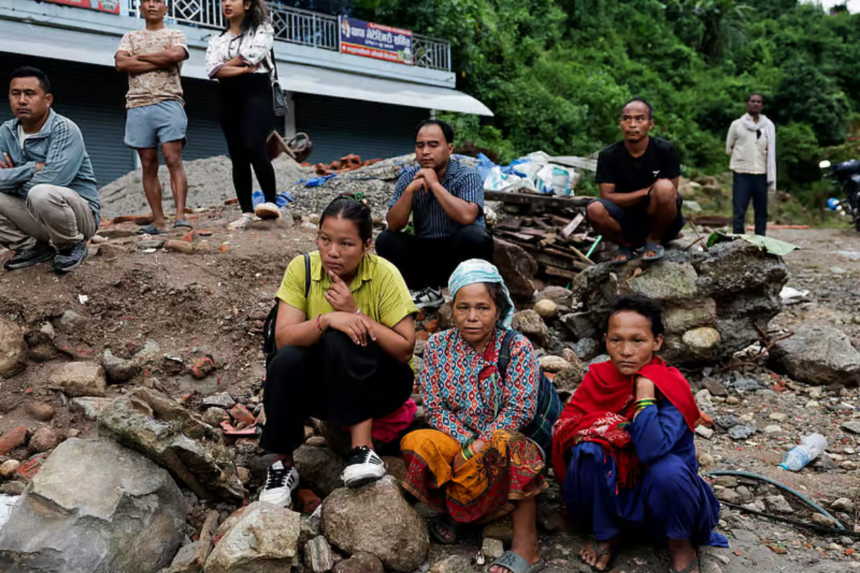
At least 165 people have died, and 826 remain missing in Nepal after a glacial collapse triggered catastrophic flash floods along the Bhotekoshi and Trishuli river corridors.
Kathmandu: Rescue teams are searching for hundreds of missing people after a glacial collapse triggered catastrophic flash floods across parts of Nepal and Tibet, sweeping away homes, roads, bridges and critical infrastructure.
Nepalese authorities said 165 bodies had been recovered and 826 people remained missing as of Thursday, August 27. The missing include security personnel, residents and 579 tourists, among them 466 foreign nationals.
The disaster struck on Wednesday after a massive surge of water, mud and rocks travelled downstream from the Himalayan border region, devastating communities along the Bhotekoshi and Trishuli river systems.
Glacier collapse triggered the deadly floods.
The disaster was initially linked to a possible earthquake, but the US Geological Survey later determined that the seismic signal came from the collapse itself rather than an earthquake.
Satellite analysis indicates that a large section of glacier and rock collapsed at high altitude, sending debris into the Lhende River in Tibet. The debris temporarily blocked the river before the natural barrier gave way, releasing a powerful surge downstream.
The resulting flood carried enormous amounts of water, ice, mud and rock into the river valleys.
At the Nepal-Tibet border, security-camera footage captured the flood sweeping through and burying a border crossing. Downstream, entire sections of settlements were covered in mud and debris.
Hundreds of tourists remain missing.
The disaster has hit a region used by trekkers and pilgrims travelling between Nepal and Tibet.
Of the 579 tourists reported missing in Nepal, 466 are foreign nationals, according to figures released by Nepalese authorities.
The missing include visitors from several countries, including India, the United States, Australia, the United Kingdom and Canada. Many were travelling in connection with the Mount Kailash pilgrimage or tourism in the Himalayan region.
Across the border in Tibet’s Gyirong County, Chinese authorities have separately reported hundreds of people missing, pushing the combined number of people unaccounted for in Nepal and Tibet above 1,300.
Rescue operations intensify
Nepal has deployed the Army, Police and Armed Police Force for search-and-rescue operations.
At least 15 helicopters have been deployed, while rescue teams are using aerial searches and ground operations to reach isolated communities. More than 100 people had been rescued by Thursday morning, with injured survivors being evacuated for treatment.
The response remains difficult because floodwaters have destroyed roads and bridges, while mud and debris have made several areas inaccessible.
The disaster damaged around 40 kilometres of roads and at least 19 bridges, according to reports, further complicating efforts to reach people who may still be stranded.
Hydropower and infrastructure badly hit
The floods have also damaged critical infrastructure along the river corridor, including hydropower facilities, roads and electricity networks.
The destruction has left some communities without normal road access and disrupted communications and essential services.
In some affected areas, rescue teams are relying heavily on helicopters because ground routes have been washed away or buried under debris.
More flooding remains a concern.
Authorities and emergency teams are also monitoring conditions upstream because further rainfall and unstable terrain could create additional flooding or landslide risks.
Chinese authorities have warned of potential hazards linked to a swollen or blocked water body in the affected Himalayan area, while rescue teams continue working under difficult conditions.
A warning from a rapidly warming Himalayas
Scientists say it is too early to establish exactly how much human-caused climate change contributed to this particular glacier collapse.
However, the disaster highlights the growing risks associated with a rapidly warming Himalayan region.
Glaciers across the Hindu Kush Himalaya have been losing ice at an accelerating rate, while unstable slopes and glacial lakes can increase the potential for sudden floods and landslides. Researchers are continuing to examine the conditions surrounding this week’s collapse.
For now, the priority remains the search for those still missing.
As rescue teams move deeper into the affected river corridors, authorities expect casualty and missing-person figures to change as previously inaccessible areas are reached and more information becomes available.
Read more news and follow us on Instagram.