



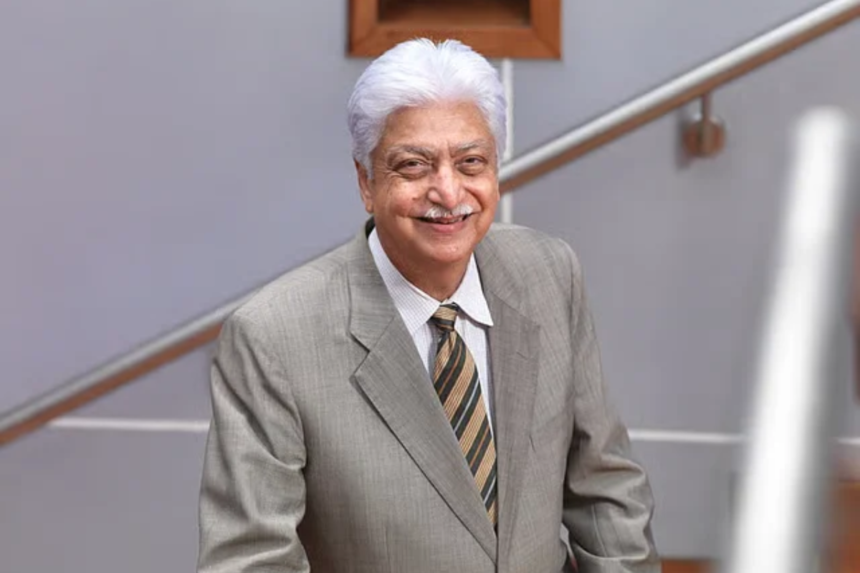
Azim Premji took over his family business at the age of 21.
At the time, the company was known for vegetable oil. Decades later, the business had become Wipro, one of India’s largest technology services companies.
That transformation remains the defining chapter of Premji’s business career.
In the M3M Hurun India Rich List 2026, Azim Premji and his family rank eighth with an estimated wealth of ₹2.63 lakh crore.
A business built far beyond its original industry
Founded in 1945 as a vegetable oil manufacturer, Wipro expanded into consumer products and engineering businesses under Premji’s leadership.
The major shift came in the 1980s when the company entered the computer and information technology industry. Over time, Wipro moved from hardware into software and IT services, eventually building a global customer base.
The company went public on the New York Stock Exchange in 2000, marking another milestone in its international expansion. Wipro celebrated 25 years of its NYSE listing in 2025.
Premji’s strategy was not simply to add technology to an existing business. He gradually made technology the centre of the company.
Wipro enters its AI chapter.
Wipro is now positioning itself as a consulting-led, AI-powered technology services company.
The scale of the business is substantial. For FY2025-26, Wipro reported ₹92,620 crore in gross revenue, while IT services revenue stood at $10.48 billion. Total bookings reached $16.4 billion, including $7.8 billion in large deals.
AI is increasingly becoming part of that strategy.
In 2026, Wipro launched an AI-native business and platforms unit designed to scale AI-powered platforms and solutions across industries. The company has also been expanding Wipro Intelligence, its portfolio of AI-led services and platforms.
The shift matters because the traditional IT-services model is changing. Clients are increasingly looking for technology partners that can combine consulting, software, data and AI rather than simply provide technology manpower.
Wipro’s current strategy reflects that change.
The business is now in professional hands.
Premji stepped away from the executive chairmanship in 2019, with his son Rishad Premji becoming Executive Chairman.
Rishad had joined Wipro in 2007 and previously held roles spanning strategy, investor relations and financial services. Today, he works with the executive leadership team on the company’s strategic direction.
The company’s day-to-day operations are led by Srini Pallia, CEO and Managing Director. Wipro’s current leadership describes its strategy around a consulting-led and AI-powered approach.
This structure has separated family ownership from operational management while keeping the Premji family closely involved in the company’s long-term direction.
The other side of the Premji fortune
Premji’s wealth story is also closely tied to philanthropy.
For more than two decades, Azim Premji and the promoter group have pledged 66% of the economic ownership of Wipro to the Azim Premji Foundation. Wipro says the commitment has created a $29 billion endowment to support the foundation’s work.
The foundation focuses heavily on public education and works across areas including healthcare and livelihoods.
This is different from treating philanthropy as a separate activity from business wealth. A significant portion of the economic value created through Wipro has been directed towards a long-term philanthropic institution.
Building institutions beyond the company
The Azim Premji Foundation was established in 2001 with education at the centre of its work.
Its initiatives include work with government-school systems, teacher education, research and higher education. The organisation also runs Azim Premji University and scholarship programmes aimed at students from disadvantaged backgrounds.
Premji has therefore built two very different institutional legacies.
One sits inside the corporate world, where Wipro continues to compete in a rapidly changing technology industry.
The other operates in education and social development, where the foundation has committed a substantial endowment to long-term programmes.
A legacy now entering its next phase.
Wipro today bears little resemblance to the company Premji inherited in 1966.
Its FY2026 revenue exceeded ₹92,000 crore, its technology business spans global markets, and its strategy is increasingly centred on AI. At the same time, the company remains under family influence through Rishad Premji, while professional executives run its operations.
For Azim Premji, the remarkable part of the journey is not simply the scale of the fortune attached to his name.
It is the fact that the original family business was transformed into a global technology company, while a large share of the economic value created along the way was committed to building institutions outside the corporate world.
That combination of entrepreneurship, ownership, and philanthropy defines the Premji legacy today.
Read more news and follow us on Instagram
Photo: Fortune India