



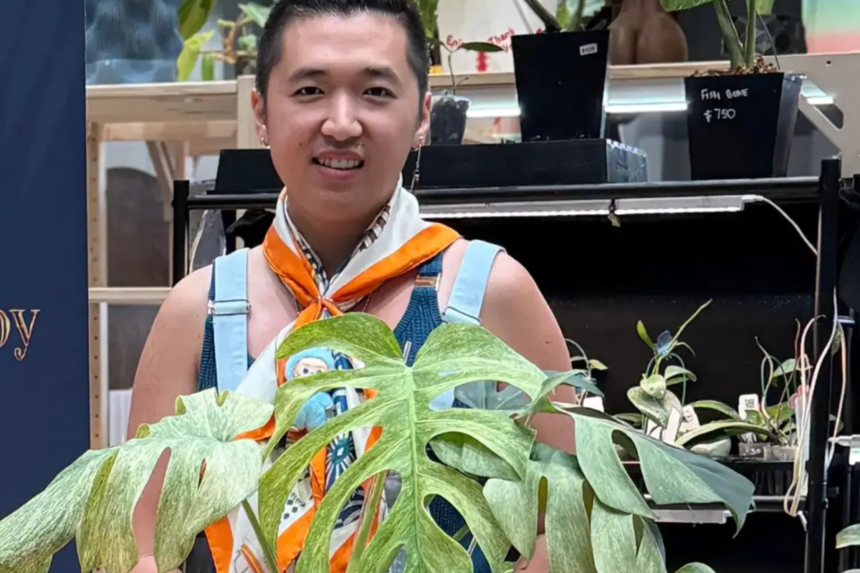
Harry Luu did not plan to build a rare plant business. He planned to build a career in mathematics.
While pursuing graduate studies, he found calm in cultivating houseplants. Mathematics demanded precision and focus. So did plants. What began as a hobby grew into a collection, then into a network within the rare plant community.
During the pandemic, demand surged. Collectors searched for increasingly scarce and unusual specimens. Luu began trading up, acquiring rarer plants and studying pricing trends with the discipline of a mathematician.
Eventually, the hobby became an enterprise.
Leaving Academia With a Safety Net
After earning his degree, Luu began teaching math in California. But three years ago, he left academia to run his rare plant business full-time.
The decision carried weight. He supports a family of eight, including his husband, parents, siblings, and extended relatives. Born in Vietnam, he views his move to the United States and his education as a collective investment by his family. Financial stability is not optional. It is a responsibility.
The transition was not impulsive. Luu had built years of sales data and invested wisely during graduate school, generating strong returns. He also understood he could return to teaching if necessary. The risk was measured.
Pricing Plants in Five Figures
As his reputation grew, so did the value of the plants he sold. Using the Palmstreet marketplace, he built a following within the rare plant community.
This year, he completed two record-breaking sales in a single day. One plant, an Anthurium Variegated Forgetii x Heinz, sold for $16,000. Another, the only specimen of a True Variegated Lux Albo Mother Plant, sold for $26,000.
Luu approaches pricing analytically. He evaluates rarity and desirability, then compares those factors against three years of historical sales data. Scarcity drives value, but he resists overpricing. Long-term brand credibility matters more than a single inflated sale.
In a niche where trust and reputation determine survival, sustainability outweighs spectacle.
Volatility and 100-Hour Weeks
Despite occasional six-figure weeks, income is unpredictable. One week can generate over $200,000 in sales. Another may produce none. The market is seasonal, with winter months often slow.
What does not fluctuate is the workload.
Luu estimates he works about 100 hours a week. Plants fill his home and a large greenhouse on his property. His brother assists with maintenance, but breeding decisions and strategic direction remain his responsibility.
The business is not passive. It is physical, analytical, and constant.
Building Toward Balance
Luu believes he is nearing a point where the rare plant business can sustain itself without his nonstop involvement. That shift would allow him to step back from operations and focus on cultivation and community engagement.
His long-term vision extends beyond sales. He wants to share knowledge, travel with his plants, and reconnect with the enthusiasm that first drew him to gardening.
The five-figure transactions attract headlines. The foundation, however, is discipline, data, and family obligation.
For Luu, the rare plant business is not just commerce. It is a calculated path toward financial independence, cultural responsibility, and a life built on something he genuinely loves to grow.
Harry Luu has sold rare plants for $16,000 and $26,000. a piece. Courtesy of Harry Luu
Source/ Photo: Business Insider