


What looked like a simple toffee turned into a marketing win, reportedly worth crores in earned attention.
In marketing, brands spend crores trying to achieve one thing: attention people willingly share.
Very few brands get it naturally.
This week, Parle Products achieved exactly that. Not through a celebrity campaign, a massive ad budget, or a carefully engineered launch strategy, but through a single packet of Melody toffee handed over during a diplomatic meeting.
What followed became a case study in earned media, cultural timing, and brand legacy.
The Viral Moment That Took Over the Internet
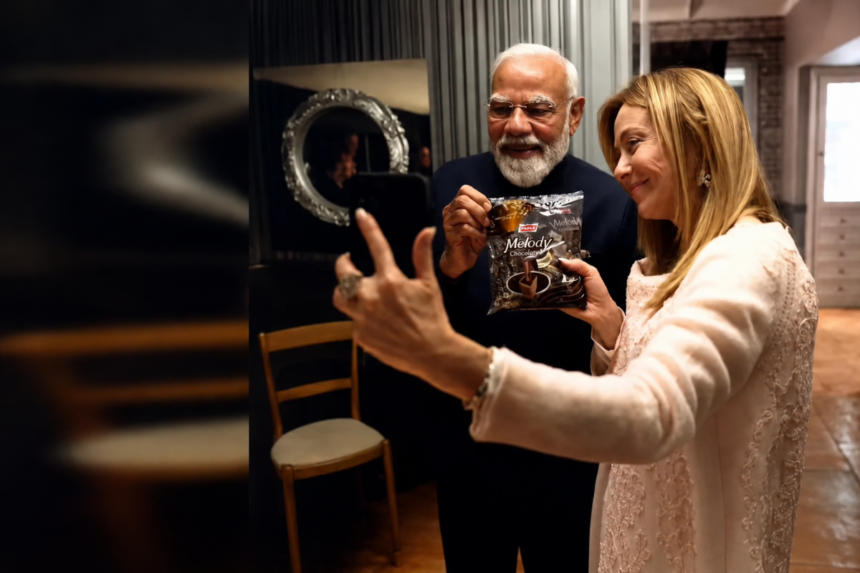
During Prime Minister Narendra Modi’s visit to Italy, he shared a playful moment with Italian Prime Minister Giorgia Meloni.
As a lighthearted gesture, Modi gifted Meloni a packet of Melody toffee.
The internet instantly connected the dots.
For months, social media users had jokingly merged the names “Modi” and “Meloni” into the nickname “Melodi.” Modi turned that meme into reality with one small cultural reference that millions instantly understood.
Meloni later shared the clip online, and within hours, the video exploded across platforms.
According to reports:
. The clip crossed more than 100 million views within hours.
. Searches for “Parle” and “Melody” surged across Google and X.
. Even Parle Industries stock reportedly hit the upper circuit due to confusion and viral attention, despite having no connection to Melody toffee itself.
Meanwhile, Parle Products quickly responded with a thank-you post celebrating the fact that one of India’s most recognizable candies had reached the global stage.
Why This Became a Marketing Goldmine
Most advertising campaigns fight for attention.
This moment earned attention naturally.
That difference matters.
A national TV campaign in India can cost crores. Celebrity endorsements cost even more. Large-scale digital campaigns routinely burn through Rs 5 crore to Rs 10 crore budgets.
Parle spent none of that.
Yet Melody dominated social media timelines, news coverage, memes, search trends, and public conversation across India and beyond.
The actual product involved reportedly costs around Rs 10.
That is the power of cultural relevance.
The Real Reason Melody Worked
The success of this moment did not begin in Italy.
It began decades ago.
Melody already existed inside Indian memory.
Generations grew up eating it. The packaging was instantly recognizable. The name already carried emotional familiarity. No explanation was needed.
The moment people saw the packet, nostalgia did the rest.
That is what marketers call brand equity.
A new product could never have generated the same reaction.
The Biggest Business Lessons From the Melody Moment
1. Brand Legacy Creates Compounding Value
Melody was not trending because it was new.
It trended because it was deeply embedded in Indian culture long before the viral clip appeared.
Years of distribution, consistency, affordability, and familiarity created recognition that money alone cannot be manufactured overnight.
For entrepreneurs, this is the lesson:
Long-term brand building matters even when results are invisible in the short term.
2. Viral Moments Cannot Be Manufactured Reliably
Parle did not orchestrate this event.
No agency could have scripted a better outcome.
But the company did something important afterward: it reacted quickly and appropriately.
Its response stayed simple, warm, timely, and culturally aligned.
Brands often fail because they either react too slowly or try too hard to sound clever.
Parle avoided both mistakes.
3. Culture Beats Advertising
The “Melodi” meme ecosystem already existed online.
People were already emotionally invested in the joke.
The toffee simply became the perfect real-world symbol inside an already active cultural conversation.
That is why the moment exploded organically.
Advertising interrupts attention.
Culture attracts it.
4. Distribution Builds Emotional Power
Melody succeeded because nearly every Indian recognized it immediately.
That recognition only exists when a product has lived inside people’s daily lives for years.
Distribution is not only about sales reach.
It is also about emotional presence.
The more frequently a brand exists in ordinary life, the stronger it becomes during extraordinary moments.
Why Marketers Will Study This Case for Years
This was not merely a funny viral clip.
It demonstrated how:
. Legacy brands still hold enormous cultural power.
. Nostalgia can outperform expensive advertising.
. Earned media creates stronger emotional engagement than paid media.
. Internet culture increasingly shapes real-world brand value.
Most importantly, it proved that brands do not always need louder campaigns.
Sometimes they simply need deeper roots.
Source: Business Connect
Read more news, and follow us on Instagram