



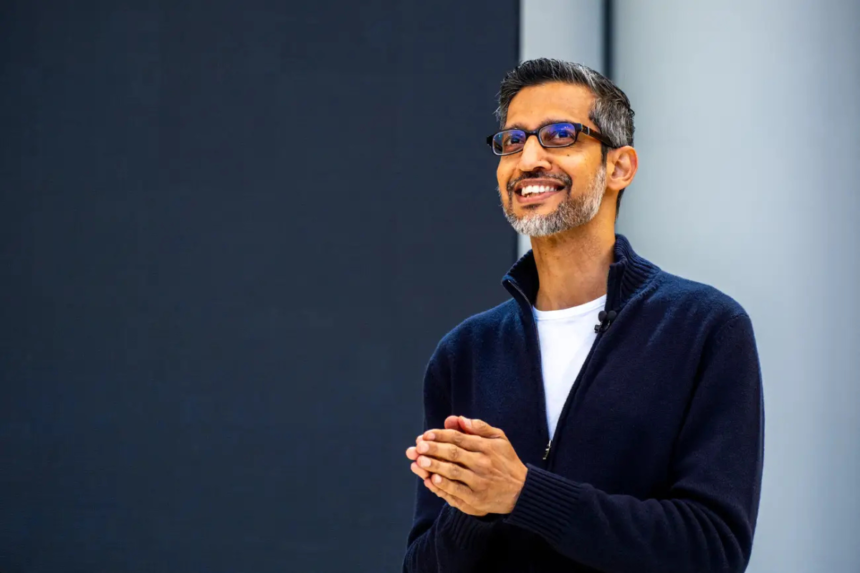
He joined Google in 2004 as a product manager. No founder aura. No celebrity status. Just execution.
Two decades later, Sundar Pichai runs Alphabet Inc., one of the most powerful companies on the planet. His compensation peaked at $226 million in 2022. By 2025, he entered billionaire territory. The climb was not loud. It was strategic.
Early Life. Discipline Before Ambition
Born Pichai Sundararajan in Chennai, India, Sundar Pichai grew up in a modest two-room apartment. His father worked as an electrical engineer, while his mother was a stenographer. Resources were limited, but his focus was not.
Early on, he displayed an unusual memory for numbers, a trait that signaled strong analytical ability. He went on to study metallurgical engineering at the Indian Institute of Technology Kharagpur. From there, he earned a scholarship to Stanford University and later completed his MBA at the Wharton School at the University of Pennsylvania.
Before joining Google, he built early professional experience at Applied Materials and McKinsey & Company. These roles sharpened his structured thinking, deepened his systems exposure, and strengthened his strategic training, capabilities that would later define his leadership in Big Tech.
The Chrome Bet That Changed Everything
Pichai interviewed at Google on April 1, 2004. The day Gmail launched. He began with Google Toolbar.
His first major inflection point came when Microsoft made Bing the default search engine on Internet Explorer. That threatened Google’s distribution.
Pichai pushed for Google to build its own browser. Leadership approved.
Google Chrome launched in 2008. It became the world’s most used browser. That single strategic move shifted power away from platform dependency and into Google’s control.
Execution earns leverage.
Android. Scale Over Ego
In 2013, Pichai took over Android. He aligned it more tightly with Google services and expanded global access through Android One.
Chrome OS followed. Chromebooks scaled. He helped shape Google’s $3.2 billion acquisition of Nest.
By 2014, Larry Page placed him in charge of core products, including Search, Maps, Ads, and infrastructure. The internal message was clear. He was next in line.
CEO of Google. Then Alphabet
When Alphabet Inc. was formed in 2015, Pichai became CEO of Google. In 2019, he replaced Larry Page as CEO of Alphabet itself.
He inherited a near-$2 trillion enterprise spanning search, YouTube, Android, cloud computing, hardware, and moonshots.
Leadership at that level becomes less about product launches and more about capital allocation, regulatory navigation, and workforce discipline.
The Hard Years. Layoffs and Scrutiny
The pandemic hiring surge added nearly 37,000 employees in a year. By 2023, cost pressure forced recalibration. Google cut 12,000 roles. More reductions followed through 2024 and 2025.
Internal backlash was intense. Public scrutiny followed. Pichai accepted responsibility.
At the same time, regulators intensified pressure. In 2024, a US federal judge ruled Google violated antitrust law in search dominance. European authorities fined the company over AI training practices. Congressional hearings became routine.
The job stopped being glamorous. It became defensive.
AI First. Then AI Urgency
Sundar Pichai declared Google an “AI-first” company in 2016. However, the strategy took on new urgency in 2022 after OpenAI’s ChatGPT triggered a competitive shockwave across the tech industry.
In response, Google issued internal alerts, rapidly reallocated resources, and pushed product teams to accelerate AI development cycles.
As a result, Gemini launched in 2023 as a multimodal AI system. Soon after, the company expanded AI features across Search, Gmail, Docs, and Workspace, while AI Overviews began redefining the traditional search interface.
Meanwhile, by early 2026, Alphabet projected capital expenditures between $175 billion and $185 billion, with the majority directed toward AI infrastructure. During the same period, Gemini crossed 750 million monthly active users.
Taken together, this was not an incremental adaptation. Instead, it marked a structural redirection of the company’s long-term future.
Compensation and Power
In 2022, Pichai earned $226 million, largely from long-term stock grants. In fiscal 2024, total compensation fell to $10.73 million. Performance cycles fluctuate. Equity remains the real lever.
Influence at this level is measured in market shifts, regulatory outcomes, and infrastructure bets.
The Pattern Behind the Rise
Pichai’s ascent follows a pattern.
He did not chase visibility. He built defensible platforms.
He did not dominate rooms. He aligned systems.
He did not disrupt the founders. He extended their strategy.
Chrome secured distribution. Android secured scale. AI secures the next decade.
From a product manager in 2004 to CEO of Alphabet, the arc reflects a single trait repeated over time. See what threatens the core business. Fix it before it collapses.
That discipline built one of the most powerful executive careers in modern technology.
Read more news, and follow us on Instagram
Alphabet CEO Sundar Pichai is leading the company through the AI arms race. CAMILLE COHEN/AFP via Getty Images
Source: BI