


SpaceX talent is being used to help improve Grok as AI becomes a bigger priority for Musk.
Artificial intelligence has become the next major battleground for the world’s largest technology companies, and Elon Musk appears determined to ensure his businesses remain at the center of that race.
In his latest strategic shift, Musk has revealed that some of SpaceX’s top engineering talent is now focused on improving Grok, the AI model developed by xAI. The move highlights how Musk is increasingly integrating expertise across his companies as he pushes to compete with leading AI developers such as OpenAI, Anthropic, and Google.
The decision also signals that artificial intelligence is becoming a core priority not only for xAI but for the broader SpaceX ecosystem.
SpaceX Engineers Shift to AI Development
In a post on X, Musk said that “a few dozen” of SpaceX’s top Starlink and Starship engineers have shifted much of their time toward AI development.
According to Musk, the additional engineering talent has significantly accelerated improvements to Grok’s underlying models and training infrastructure.
He described the pace of development as increasing “tremendously,” suggesting that the integration of experienced aerospace engineers is helping xAI rebuild and improve its AI systems at a faster rate.
The announcement reflects Musk’s growing practice of sharing talent and technical expertise across his companies rather than operating them as isolated organizations.
Cursor Team Also Joins the Effort
The AI push extends beyond SpaceX’s internal teams.
Musk confirmed that engineers from Cursor, the AI coding startup SpaceX recently agreed to acquire in a deal reportedly valued at $60 billion, are also contributing to Grok’s next-generation foundation models.
According to Musk, the new models are being trained using, in part, Cursor’s proprietary training data.
Cursor has gained attention for developing AI-powered software development tools, and its expertise is expected to strengthen Grok’s coding capabilities, an area where the chatbot has trailed several competing AI models.
Grok 4.5 Enters Private Testing
Musk also announced that Grok 4.5 has entered private beta testing within Tesla and SpaceX.
Using two of his largest companies as early testing environments allows engineers to evaluate the model using real-world engineering, manufacturing, and operational workflows before broader public deployment.
Musk added that SpaceX plans to release entirely new AI models “trained from scratch” every month for the remainder of the year, indicating a much faster product release cycle than the company has previously maintained.
AI Has Become SpaceX’s Next Strategic Priority
The latest announcement follows several major structural changes across Musk’s AI businesses.
Earlier this year, xAI underwent a significant organizational restructuring after the departure of its final remaining co-founder. Musk acknowledged at the time that Grok had fallen behind competing models, particularly in software development and coding tasks.
He described the company as being rebuilt “from the foundations up.”
More recently, SpaceX and xAI became more closely integrated following corporate restructuring, while the acquisition of Cursor further expanded the company’s AI capabilities.
Together, these moves demonstrate Musk’s intention to combine engineering, software development, and computing infrastructure under a unified AI strategy.
Building AI Infrastructure at Scale
Beyond improving Grok itself, Musk has outlined much larger ambitions for artificial intelligence.
Following SpaceX’s record-breaking public offering earlier this month, he said the company intends to invest heavily in AI infrastructure, including plans to build a network of orbital data centers supported by Starlink satellites and launched using Starship rockets.
The vision is to create a massive computing network capable of training and running increasingly advanced AI models.
According to investor materials released before SpaceX’s public offering, the company estimates its total addressable market at approximately $28.5 trillion, with artificial intelligence accounting for about $26.5 trillion of that opportunity.
Competition in the AI Race Continues to Intensify
The AI industry has become increasingly competitive as companies invest billions of dollars into computing infrastructure, specialized hardware, and advanced foundation models.
OpenAI, Google, Anthropic, Meta, and several emerging startups continue to release increasingly capable systems across coding, reasoning, multimodal AI, and enterprise applications.
By redirecting some of SpaceX’s most experienced engineers toward AI development, Musk is demonstrating that he views engineering talent as one of the company’s most valuable competitive advantages.
Rather than building AI solely through xAI, he is drawing expertise from across his broader business empire to accelerate development.
As the pace of AI innovation continues to increase, the growing collaboration between SpaceX, xAI, Tesla, and Cursor suggests that Musk is betting on an integrated approach to compete with the industry’s biggest players.
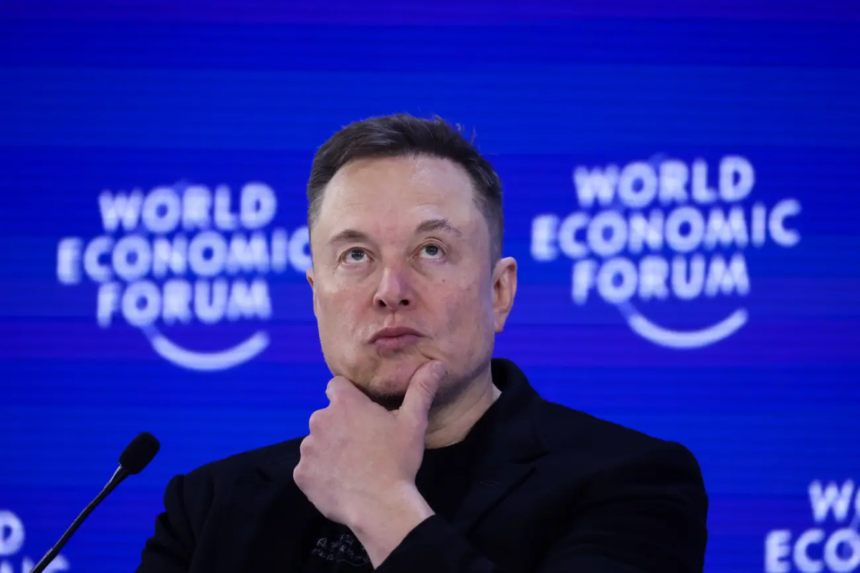
Elon Musk said SpaceX would release new AI models “trained from scratch” every month. WEF/Getty Images
Source: BI