



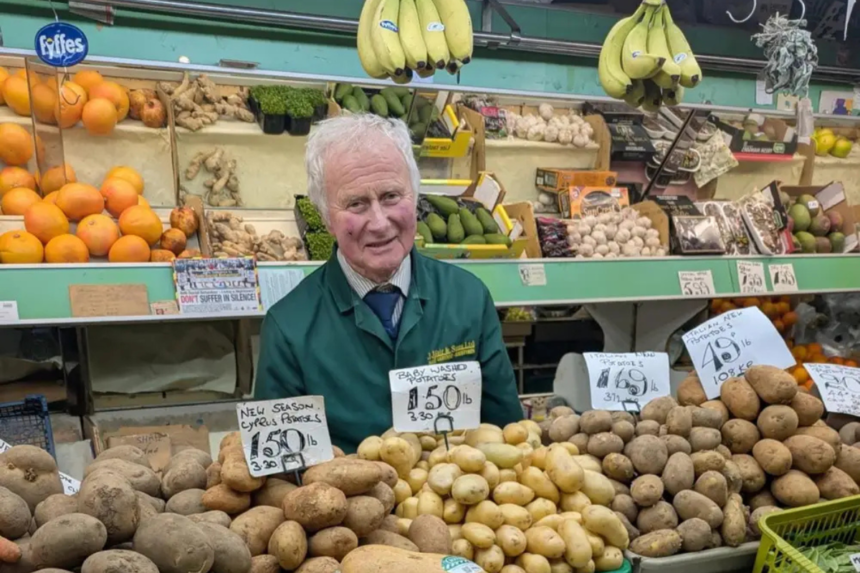
This as-told-to essay is based on a conversation with Robin Blair, 80, owner of JJ Blair & Sons, a family-run greengrocer founded in 1875 in Darlington, England. It has been edited for clarity and length.
There’s an old saying in our family: There are two chairs that will kill you, the electric chair and the armchair.
I’ve no intention of meeting either.
Retirement has never appealed to me. Sitting still, watching television, and slowing down feels far more dangerous than work ever has. My father stayed active in our family grocery business well into his 90s. I expect to do the same.
I was raised behind the counter
In many ways, I joined the business in 1940, when I was only a few months old. We traded from an indoor market, and my mother would tuck me under the counter while she served customers.
As soon as we could walk, we helped at the nursery. By five, I was planting cabbages, sowing seeds, and tending tomatoes. Each child was given a small plot of land and allowed to keep whatever profit they made.
That’s where I learned quickly. Lettuce sold fast. Tomatoes took longer. Competition between siblings was friendly but fierce. I left school at 15 and went straight into the business full-time, happy to trade classrooms for the fields.
From horses to hand-written signs
In the early years, we grew everything ourselves. Mornings were spent harvesting and washing produce, which we loaded onto a wooden cart pulled by our horse, Bobby, for the three-and-a-half-mile journey to market.
My grandfather, who founded JJ Blair & Sons 150 years ago, took pride in every detail. He polished the horse’s harness before every trip. There were no vans, no shortcuts. Everything was done properly.
The market ran from mid-afternoon until midnight. At nine, a bell rang, and traders auctioned off unsold produce. Without refrigeration, anything left went back to the nursery for compost.
Our family motto was simple: More flash, more cash. If the produce looked good, it sold better. That still holds. I make sure apples shine, bananas sit at the right stage of ripeness, and berries always look inviting.
Supermarkets changed everything
The 1960s through the early 80s were our strongest years. The market had nearly 200 stalls and sat at the heart of town. Then supermarkets arrived.
They undercut prices, offered parking, and made shopping easier. Competing hasn’t been simple. Today, we’re the last greengrocer left in the market.
Even so, customers still come. They want fresh produce, familiar faces, and conversation. I still write price signs by hand, carefully marking pounds, ounces, and kilograms. It matters. People notice effort.
I still work long days, and I prefer it that way
Discipline shaped me early. I wake at 4:30 a.m. six days a week to prepare for the market, which opens at eight. Afterward, I head back to the nursery, where we grow bedding plants.
In summer, I sometimes work until nine or ten at night. Longer evenings make the effort worthwhile.
This business gave me a life I never imagined. I lost my brother Keith, my business partner, in 2013. Still, I’m proud to keep going at 80.
I don’t know if the business will stay in the family. When I ask my daughter, she laughs and says, “Never say never.”
I turn 81 in May. As long as my health holds and my wife keeps me grounded, I’ll keep working.
The armchair can wait.
Greengrocer Robin Blair with his wares. Courtesy of Alyson Williamson (Photo: Business Insider)
Follow us on Instagram and stay updated with our current news