


Digital payments and instant transfer systems are changing how UAE residents send money abroad, making transfers faster and easier.
For UAE residents sending money home, remittances have gone from a slow, paper-heavy process to transfers that can reach beneficiaries within seconds.
Rashed A. Al Ansari, Group CEO of Al Ansari Financial Services, has witnessed that transformation firsthand. When the company’s business began in 1966, international transfers could take three days. Today, some transactions are completed almost instantly.
“I remember it used to take a very long time. It was three days,” Al Ansari recalls. “Now it’s instant.”
The change reflects six decades of technological development, evolving customer expectations and tighter financial regulations in one of the world’s major remittance markets.
From Paper Ledgers to Instant Transfers
The early remittance business relied heavily on paper ledgers, carbon copies and traveller’s cheques. Sending money abroad required more time and manual processing.
As technology improved, electronic payments gradually replaced those processes. Today, digital payment systems allow many UAE-to-international transfers to reach beneficiaries within seconds.
The shift is particularly significant in the UAE, where expatriates make up around 85% of the population and regularly send money to families in their home countries.
The industry has also changed beyond remittances. Travel cards have reduced the need for people to carry large amounts of foreign currency while travelling, allowing customers to load dirhams, make purchases and withdraw cash through ATMs when required.
Technology Has Changed, But Compliance Remains Critical
Faster payments have not removed the need for financial checks.
According to Al Ansari, the biggest challenge to transaction speed today is often compliance rather than technology.
Remittance providers must screen senders and beneficiaries for potential sanctions or suspicious activity. A partial name match can sometimes trigger a manual review, delaying an otherwise legitimate transaction.
Financial companies are increasingly using AI to reduce these delays. Systems can compare information such as dates of birth and other identifying details almost instantly, helping distinguish genuine customers from potentially risky matches.
From One Branch to More Than 280
The Al Ansari story began in 1966, when the founder moved from food trading into money transfers as the UAE’s growing expatriate population created demand for remittance services.
He obtained a licence in Abu Dhabi five years before the formation of the UAE and opened the company’s first branch in Abu Dhabi’s Central Market.
Six decades later, Al Ansari has grown to more than 280 branches across the UAE and is moving towards 300.
The group has also expanded into Bahrain, Kuwait and India. Its international growth includes the acquisition of Bahrain’s BFC Group for $200 million, while expansion into Oman remains subject to regulatory approval.
Digital Remittances Rise From 1% to 30%
One of the clearest signs of the industry’s transformation is the rise of digital transactions.
When Al Ansari Exchange launched its app in 2018, only about 1% of remittances were processed digitally. The pandemic accelerated adoption as customers increasingly turned to online services.
Digital transactions now account for around 30% of remittances, with the company expecting that figure to reach 60% within five years.
The shift has been substantial. Some months, the app processes more than 600,000 transactions.
Yet branches remain important. Domestic workers and labourers, in particular, may continue to prefer physical locations because of language barriers, familiarity or limited access to smartphones.
Six Decades of Remittances
The UAE’s remittance industry has changed dramatically since the 1960s. Paper records have given way to digital platforms, three-day transfers have become near-instant payments, and customers can now move money across borders without visiting a branch.
But the industry’s evolution is not simply about speed.
It is also about making financial services easier to access while maintaining the compliance systems required to protect the financial network.
For companies such as Al Ansari, the next stage will likely combine instant payments, digital adoption and AI-assisted compliance.
The journey from three days to three seconds shows how dramatically UAE remittances have changed. The next transformation may be measured not in days or seconds, but in how seamlessly money can move across borders while remaining secure and compliant.
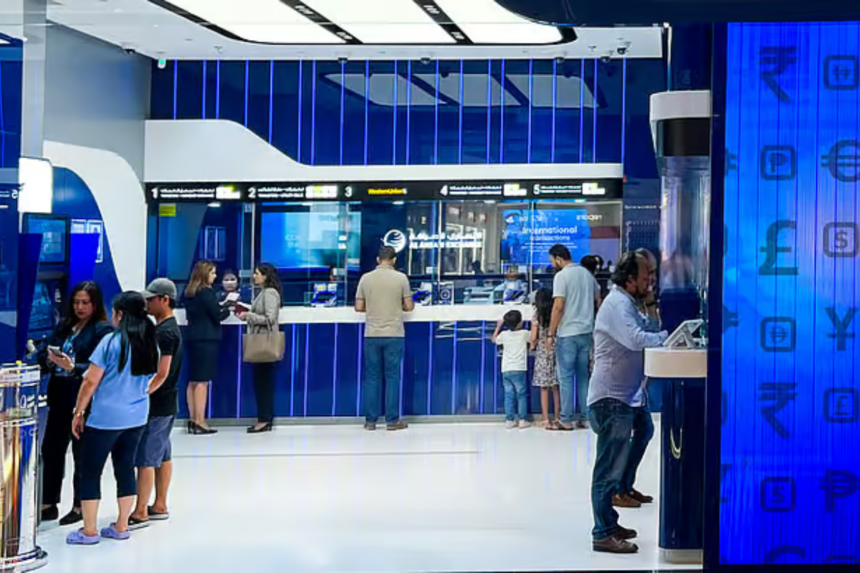
UAE residents remit funds through Al Ansari Exchange. Photo: Al Ansari Financial Services
Source: Khaleej Times