


CEO Srini Gopalan says Starlink’s planned mobile service is unlikely to replace traditional mobile networks and will remain largely complementary
T-Mobile CEO Srini Gopalan has played down the threat posed by SpaceX’s planned Starlink mobile service, arguing that satellite connectivity is more likely to complement traditional cellular networks than replace them.
Gopalan questioned what specific gap Starlink would fill as a standalone mobile provider and whether customers would have a strong reason to switch from established carriers such as T-Mobile, AT&T and Verizon.
His comments come as SpaceX prepares to expand Starlink beyond its current role as a satellite connectivity partner for mobile operators. The company plans to develop Starlink Mobile into a broader wireless service, potentially putting it into direct competition with the largest US carriers.
Starlink Wants to Enter the Mobile Market
Starlink currently provides satellite-to-phone connectivity in partnership with T-Mobile through T-Satellite, allowing compatible phones to connect when traditional cellular coverage is unavailable. T-Mobile describes the service as an extension of its network rather than a replacement for conventional mobile service.
SpaceX now intends to take the concept further. The company has said its next-generation Starlink Mobile service will use additional satellite capacity alongside spectrum acquired from EchoStar. SpaceX executives have indicated that the service could begin competing directly with established wireless operators as the network expands in 2027.
SpaceX President and COO Gwynne Shotwell has said the company expects to attract customers from AT&T, Verizon and T-Mobile. Elon Musk has also argued that a combination of satellites and smaller terrestrial stations could eventually provide greater connectivity and bandwidth than conventional cellular networks.
Gopalan Questions Starlink’s Market Advantage
Gopalan remains unconvinced that satellite technology alone gives Starlink a strong competitive position in mainstream mobile services.
His argument is straightforward. Traditional operators already operate extensive terrestrial networks, while satellite connectivity has historically been most valuable in areas where cell towers cannot provide coverage.
That distinction is already visible in T-Mobile’s existing Starlink partnership. T-Satellite automatically connects compatible phones when traditional service is unavailable, but T-Mobile warns that satellite performance can vary and that data speeds and supported applications differ from conventional cellular networks.
The technology therefore currently works best as an additional layer of connectivity rather than a complete substitute for a 4G or 5G network.
T-Mobile and Starlink Are Both Partners and Potential Rivals
The situation creates an unusual relationship between the two companies.
T-Mobile is currently working with SpaceX to provide satellite connectivity to its customers, while SpaceX is preparing a service that could eventually compete for those same customers.
The partnership has already demonstrated the value of combining terrestrial and satellite networks. T-Satellite allows users to stay connected in remote areas and other locations outside conventional cellular coverage.
The question now is whether SpaceX can turn that supplemental service into a full-scale mobile business.
Starlink’s planned expansion could give the company access to a much larger market, particularly if its upgraded satellites and terrestrial infrastructure deliver substantially higher data capacity than today’s direct-to-cell services.
T-Mobile Sees More Room to Grow
Gopalan’s confidence also reflects his broader view of T-Mobile’s growth prospects.
The company has gained customers over several years and has increasingly expanded beyond traditional wireless services into areas such as home broadband.
Gopalan has argued that investors may be underestimating the amount of growth still available to T-Mobile. He has also identified rural markets and households that have historically prioritised network quality as important opportunities for expansion.
T-Mobile’s strategy increasingly involves combining its existing wireless infrastructure with additional technologies rather than relying on a single form of connectivity. Its Starlink partnership itself reflects that approach.
Satellite Connectivity May Become an Extension, Not a Replacement
The larger question is whether satellite networks will eventually challenge the traditional structure of the mobile industry.
Starlink has significant advantages, particularly its ability to provide coverage over areas where building conventional cellular infrastructure can be expensive or impractical. Academic research on direct-to-cell systems also suggests that satellite connectivity can extend coverage into poorly served regions, although capacity and performance remain important constraints.
For the moment, however, the emerging model looks more hybrid than disruptive. Terrestrial networks can provide high-capacity service in populated areas, while satellites can fill coverage gaps in remote locations and during emergencies.
That is precisely the model T-Mobile is already pursuing with T-Satellite.
Whether Starlink can move beyond that role and become a genuine nationwide competitor will depend on the performance, capacity, pricing and scale of its planned mobile network.
For Gopalan, the arrival of Starlink does not fundamentally change T-Mobile’s position. Instead, he sees satellite technology as another layer that can improve connectivity while traditional cellular networks continue to serve the majority of everyday mobile demand.
Source: Business Connect
Read more news and follow us on Instagarm
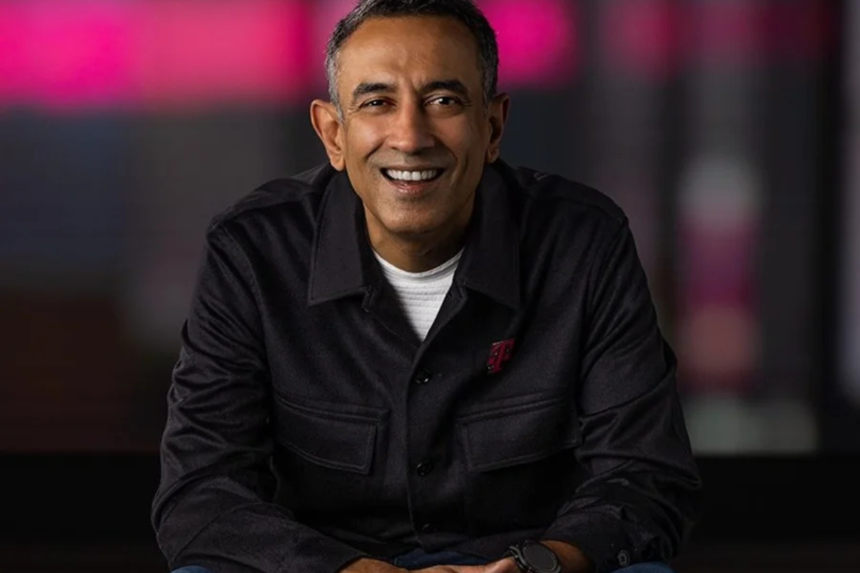
Srini Gopalan, CEO of T-Mobile (Credit: T-Mobile)