


Elon Musk, Tim Cook, and other major business leaders could join the trip as economic ties take centre stage in US-China talks.
President Donald Trump is bringing some of America’s biggest business leaders into the center of US-China diplomacy as he prepares to meet Chinese President Xi Jinping this week.
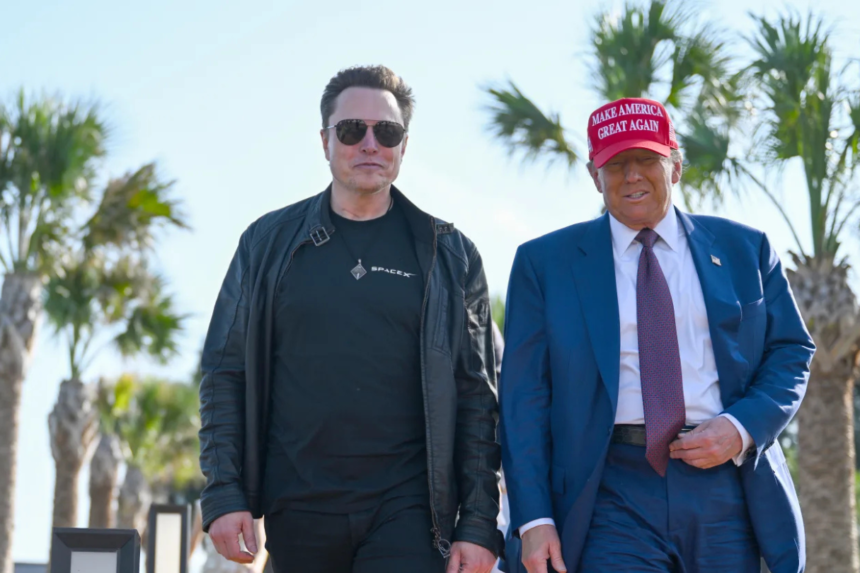
According to a White House official, Trump invited executives, including Tesla CEO Elon Musk, Apple CEO Tim Cook, BlackRock CEO Larry Fink, and Boeing CEO Kelly Ortberg to join the delegation traveling to China.
The trip signals that economics, technology, and corporate influence will sit at the heart of the summit.
Key Highlights
. Trump invited top US CEOs to join his China summit with Xi Jinping
. Executives from Tesla, Apple, BlackRock, Boeing, Goldman Sachs, and Qualcomm are expected to attend
. Trade, AI, export controls, Taiwan, and the Iran conflict are expected to dominate discussions
. Trump hopes to secure new business deals and economic agreements with Beijing
. NVIDIA CEO Jensen Huang is notably absent from the delegation
. Markets are closely watching the summit amid ongoing US-China tensions
A Delegation Filled With Corporate Power
The delegation includes leaders from sectors deeply connected to China:
. Technology
. Finance
. Aerospace
. Semiconductors
. Manufacturing
Executives Expected to Attend
. Elon Musk. Tesla
. Tim Cook. Apple
. Larry Fink. BlackRock
. Kelly Ortberg. Boeing
. Stephen Schwarzman. Blackstone
. Jane Fraser. Citigroup
. David Solomon. Goldman Sachs
. Cristiano Amon. Qualcomm
. Sanjay Mehrotra. Micron Technology
. Michael Miebach. Mastercard
. Ryan McInerney. Visa
Their presence highlights how tightly business and geopolitics are now connected between the world’s two largest economies.
What Trump Wants From the Summit
Trump has repeatedly tied foreign policy to economic leverage, and this visit appears designed to push both diplomacy and business negotiations at the same time.
Topics Expected on the Agenda
. Trade relations
. Artificial intelligence
. Export controls
. Semiconductor restrictions
. Taiwan
. Supply chain security
. The Iran conflict
Trump has also said he hopes to secure:
. Business deals
. Purchase agreements
. Economic cooperation measures
Why China Still Matters
Despite rising political tensions, China remains critical for many American companies.
For firms like Apple, Tesla, Qualcomm, and Boeing, China remains important for:
. Manufacturing
. Supply chains
. Consumer demand
. Long-term revenue growth
That reality creates a difficult balance.
Washington continues pushing tougher controls in strategic industries, while major corporations still depend heavily on the Chinese market.
The Missing Name: Jensen Huang
One of the most noticeable absences is Nvidia CEO Jensen Huang.
NVIDIA now sits at the center of:
. AI development, semiconductor competition
. Global chip supply chains
Last week, Huang said representing the United States would be “a great honor” if invited.
But Nvidia was not included in the expected delegation list.
The absence stands out because AI and chip restrictions are expected to become central topics during discussions with Beijing.
CEOs Are Becoming Part of Global Diplomacy
The summit reflects a broader shift in global politics where business leaders are increasingly involved in geopolitical negotiations.
Executives today are directly affected by:
. Tariffs
. Sanctions
. Export bans
. AI regulation
. Supply chain disruptions
. Regional conflicts
Governments increasingly view major corporations as strategic players rather than simply private companies.
Markets Are Watching Closely
Investors are closely monitoring the summit because US-China tensions continue affecting:
. Technology stocks
. Semiconductor companies
. Manufacturing sectors
. Global trade flows
. AI investment. Financial markets
The presence of major CEOs sends a broader signal that both Washington and Beijing still recognize the economic risks of uncontrolled escalation.
Citigroup CEO Jane Fraser recently said:
“We all need that engagement to be occurring.”
That position increasingly reflects the view across global corporate America.
More Than a Diplomatic Visit
Trump’s China trip is becoming more than a state visit.
It is increasingly a meeting where politics, technology, trade, and corporate influence are converging.
The future of US-China relations will not be shaped only by governments.
It will also be shaped by the companies building the technologies, supply chains, financial systems, and economic networks connecting both countries.
U.S. President-elect Donald Trump greets Elon Musk as he arrives to attend a viewing of the launch of the sixth test flight of the SpaceX Starship rocket on November 19, 2024, in Brownsville, Texas.
Brandon Bell | Getty Images News | Getty Images
Read more news and follow us on Instagram
Source: CNBC