



New AI-based forecasts from BofA challenge fan sentiment by predicting a different team will lift football’s biggest prize.
As excitement builds ahead of the 2026 FIFA World Cup, a clear divide is emerging between fan expectations and artificial intelligence forecasts over who will lift football’s biggest trophy.
According to a recent survey by Bank of America, France national football team has emerged as the overwhelming fan favourite. Around 40% of respondents backed Les Bleus to claim another World Cup title, while many also tipped Kylian Mbappé to finish as the tournament’s top scorer.
However, Microsoft Copilot offers a different assessment.
Based on data-driven modelling, the system reportedly gives the Spain national football team an equally strong, and in some projections, even stronger path to becoming world champions.
This contrast reflects a broader shift in modern sports analysis. Increasingly, AI-driven forecasting is challenging emotional fan expectations, historical loyalties, and narrative-based predictions with simulation-led analysis.
Why Fans Still Back France
France’s popularity among supporters is hardly surprising.
Over the past decade, the team has consistently established itself as one of international football’s strongest forces, combining tournament experience, exceptional squad depth, athleticism, and proven success on the biggest stage.
Since winning the 2018 FIFA World Cup and reaching the final of the 2022 FIFA World Cup, France has remained firmly among football’s elite national teams.
In addition, the continued presence of world-class players such as Mbappé reinforces confidence among supporters who view France as the safest bet for another title run.
Mbappé, in particular, remains central to that confidence.
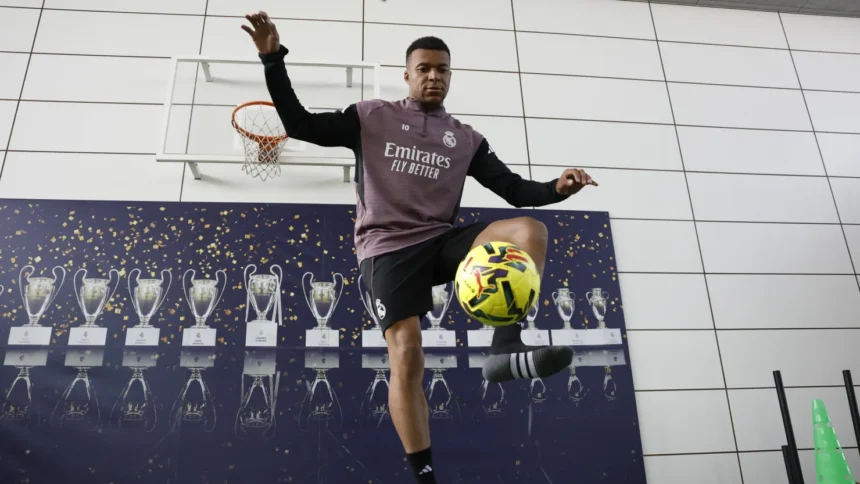
The Real Madrid CF forward is widely viewed as the face of the next football generation and enters the tournament as one of the sport’s biggest stars. His pace, finishing ability, and tournament experience make him a leading candidate for the Golden Boot award.
For many fans, France represents the safest and most emotionally convincing choice.
Why AI Is Leaning Toward Spain
Why AI Is Backing Spain
While fan sentiment often leans on reputation and legacy, AI forecasting systems assess teams through a far more data-driven lens.
Rather than relying on emotion or historical prestige, platforms such as Microsoft Copilot evaluate factors including squad balance, player age curves, tactical flexibility, possession metrics, injury risk, defensive efficiency, fixture pathways, and tournament probability simulations.
As a result, this analytical approach appears to favour Spain national football team.
Over the past several years, Spain has quietly rebuilt its squad around a younger generation of technically strong players who can control matches through possession-based systems while maintaining tactical discipline.
At the same time, the current side has addressed one of the main criticisms levelled at earlier Spanish squads: a lack of directness. Unlike previous iterations, this team combines technical control with greater attacking flexibility and faster transitional play.
AI systems also tend to reward consistency and structural balance across an entire squad rather than placing excessive weight on individual superstars. In tournament football, that broader equilibrium often proves more decisive than headline talent alone.
The 2026 World Cup Will Be the Biggest Yet
Meanwhile, the upcoming 2026 FIFA World Cup is set to transform the scale of international football.
Co-hosted by the United States, Canada, and Mexico, the tournament will feature 48 teams competing across 104 matches in 16 host cities — making it the largest World Cup ever staged.
According to projections from FIFA and the World Trade Organization, the event could generate more than $80 billion in global economic output, contribute nearly $41 billion to global GDP, and support over 800,000 jobs worldwide.
Beyond its economic impact, the expanded format introduces entirely new competitive dynamics, creating fresh pathways for emerging teams and increasing the unpredictability of football’s biggest stage.
Nations such as Uzbekistan, Jordan, Cape Verde, and Curaçao are set to participate for the first time, adding unpredictability and broader global representation.
Prize Money and Commercial Scale Continue Growing
FIFA recently confirmed that participating teams will share total prize money worth $871 million.
Even smaller nations are expected to receive at least $12.5 million each, with preparation and qualification payments increased to help teams manage travel, training, and operational costs.
At the same time, the tournament’s commercial scale is drawing scrutiny.
FIFA’s introduction of dynamic ticket pricing has sparked controversy after some match tickets reached unusually high resale values.
Reports have shown prices ranging from hundreds to several thousand dollars for premium matches, while one resale listing reportedly reached $11.5 million on FIFA’s official platform.
Gianni Infantino previously said demand had reached roughly 508 million ticket requests for only seven million available seats.
The imbalance highlights how global demand for elite football events continues growing far faster than supply.
AI Predictions Are Becoming Part of Sports Culture
The disagreement between fan expectations and AI forecasts reflects something larger happening across sports.
Artificial intelligence is increasingly being used not only for tactical analysis inside clubs but also for public forecasting, betting models, scouting, injury prevention, and tournament simulations.
While fans often build predictions around emotion, loyalty, star players, and historic narratives, AI systems prioritize probabilities, patterns, and statistical efficiency.
That does not necessarily mean AI will prove correct.
Tournament football remains unpredictable precisely because it is shaped by variables difficult to fully model, including pressure, momentum, injuries, referee decisions, crowd influence, and moments of individual brilliance.
Still, AI-generated forecasts are beginning to influence how tournaments are discussed, analyzed, and even consumed by audiences worldwide.
The growing role of these systems suggests the future of football conversation may increasingly involve two parallel worlds: what fans believe should happen, and what the data believes probably will.
Kylian Mbappe exercising inside the gym at Ciudad Real Madrid on May 06, 2026, in Madrid, Spain.
Antonio Villalba | Real Madrid | Getty Images
Source: CNBC
Kylian Mbappe exercising inside the gym at Ciudad Real Madrid on May 06, 2026, in Madrid, Spain.
Antonio Villalba | Real Madrid | Getty Images