



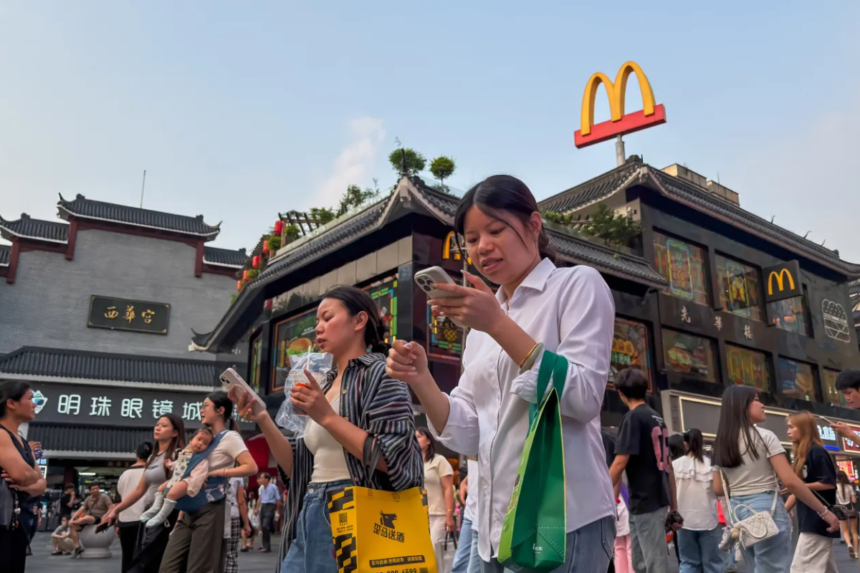
While many foreign companies scale back, McDonald’s is investing further in stores, digital services, and local growth.
While several global consumer brands are slowing expansion or struggling to maintain momentum in China, McDonald’s is moving in the opposite direction.
The American fast-food giant is expanding aggressively across mainland China, increasing store openings, leaning further into digital operations, and strengthening its position in a market where many international brands are facing weaker demand and rising competition from local companies.
The company plans to grow from more than 7,700 stores at the end of 2025 to 10,000 locations in mainland China by 2028. That would make China one of the company’s most important growth engines globally, second only to the United States in total store count.
At a time when companies like Starbucks, Nike, and LVMH are navigating slowing consumer demand and changing spending patterns in China, McDonald’s appears to be benefiting from a different strategy, one built around affordability, consistency, nostalgia, and local adaptation.
Nostalgia Still Gives McDonald’s an Advantage
Part of McDonald’s strength in China comes from something difficult to replicate: emotional familiarity.
China’s first McDonald’s opened in 1990, during a period when the country was rapidly opening to international brands and global consumer culture. For many Chinese consumers who grew up during that era, McDonald’s became associated with modernity, aspiration, and childhood memories.
That emotional connection still matters.
During the recent May Day holidays, customers gathered at McDonald’s newly opened McDonaldland-themed store in Beijing’s Chaoyang Park after the company reintroduced its classic vanilla and strawberry milkshakes at selected locations.
The milkshakes had been discontinued in China since 2014, but their return generated strong attention online and quickly became a nostalgia-driven trend.
Consumers described the drinks as reminders of their childhood and early experiences with Western fast food.
For many middle-class Chinese consumers born in the 1980s and 1990s, McDonald’s remains tied to memories of a rapidly changing China entering a more global era.
That emotional brand equity gives McDonald’s an advantage that newer competitors often struggle to recreate.
Affordability Matters More in China’s Slower Economy
McDonald’s is also benefiting from shifting consumer behavior during a weaker economic environment.
As China’s economy slows and consumers become more price-sensitive, value-driven spending has become increasingly important across retail and dining categories.
Many international brands positioned as premium or aspirational are facing pressure as consumers reduce discretionary spending and increasingly turn toward lower-cost local alternatives.
McDonald’s, however, sits in a different position.
The company has managed to maintain an image associated with international quality standards while still competing aggressively on price.
Its low-cost combo offerings, including value meals priced around 14 yuan, have helped position the brand as affordable without feeling cheap.
That balance appears especially important in today’s Chinese market, where consumers remain cautious about spending but still seek reliability, consistency, and familiarity.
According to branding consultancy executives cited by CNBC, Chinese consumers are increasingly prioritizing value rather than simply choosing the lowest-priced option.
McDonald’s has managed to position itself as offering dependable quality at a relatively accessible price point.
Local Adaptation Remains Central to Growth
Another key reason behind McDonald’s continued success in China is localization.
While the company maintains core global products like the Big Mac, it regularly refreshes its menu with items tailored specifically to Chinese tastes and consumer trends.
Localized offerings such as honey barbecue chicken bones, region-specific desserts, and seasonal menu items help keep the brand culturally relevant while encouraging repeat visits from consumers constantly looking for novelty.
This combination of global familiarity and local adaptation has become one of McDonald’s biggest strengths in China.
The company is not attempting to compete purely as a Western brand anymore. Instead, it increasingly operates like a localized consumer platform built specifically around Chinese dining habits and preferences.
That flexibility has allowed it to remain competitive even as domestic Chinese food chains improve rapidly.
China Has Become a Major Growth Engine for McDonald’s
China is now central to McDonald’s long-term global expansion strategy.
Half of the company’s new store openings last year came from mainland China, making it one of the largest contributors to overall unit growth.
The business also continues to perform relatively well financially. McDonald’s reported that same-store sales in its international development licensed markets segment, which includes China, rose 3.4% during the first quarter.
A significant portion of McDonald’s China operations is owned by Chinese investor Trustar, a private equity unit of Citic Capital, giving the business a strong local partnership structure inside the market.
That partnership model has likely helped McDonald’s navigate China’s increasingly competitive and politically sensitive consumer environment more effectively than some other multinational brands.
Digital Expansion Is Becoming Increasingly Important
Beyond physical store growth, McDonald’s is also investing heavily in digital infrastructure and customer engagement tools across China.
China’s fast-food and retail sectors have become deeply integrated with mobile ordering, delivery ecosystems, digital loyalty systems, and platform-based commerce.
McDonald’s has adapted quickly to those expectations, expanding app-based ordering, delivery partnerships, digital promotions, and online engagement campaigns.
This has helped the company remain relevant to younger consumers while improving operational efficiency and customer retention.
In many ways, McDonald’s China strategy increasingly resembles a technology-enabled consumer ecosystem rather than a traditional restaurant expansion model.
Why McDonald’s Is Succeeding While Others Struggle
The broader contrast is becoming difficult to ignore.
Several global brands entered China, assuming international status alone would remain enough to sustain growth. But consumer behavior in China has evolved significantly over the last decade.
Local brands have improved rapidly in quality, marketing, and operational sophistication. At the same time, nationalism, affordability concerns, and changing spending patterns have altered how Chinese consumers evaluate foreign companies.
McDonald’s appears to have adapted faster than many peers.
Instead of positioning itself purely as a premium Western import, the company evolved into something more flexible: familiar, affordable, localized, digitally integrated, and emotionally recognizable.
That combination is helping McDonald’s expand at a time when many multinational consumer brands are becoming more cautious about China’s future growth outlook.
For now, the company is making a clear bet that despite economic pressure and changing market conditions, China still represents one of the most important long-term growth opportunities in global consumer business.
Pedestrians use smartphones while walking past a McDonald’s restaurant at Dongmen Pedestrian Street on April 18, 2026, in Shenzhen, Guangdong Province, China.
Cheng Xin | Getty Images
Source: CNBC