


Her eye-catching red carpet look sparked fresh debate over what it takes to create a high-profile fashion moment.
A Viral Question With Industry Implications
When Simone Biles revealed on TikTok that her red carpet styling cost $23,000, the reaction was immediate. The number triggered a familiar instinct, that the price must be excessive.
But the question she raised was more precise. Not outrage. Calibration. Is this normal?
The response online leaned predictable. Most users rejected the number outright. Some offered advice. Others framed it as overcharging. Yet the conversation quickly moved beyond cost and into something more structural.
What Red Carpet Actually Buys
The appearance in question aligns with the Laureus World Sports Awards in Madrid, an event often described as the sporting equivalent of the Oscars.
That comparison matters.
At the Academy Awards, styling is not a support function. It is a performance layer. Visibility is the product. Attention is the outcome. Costs scale accordingly. A-list appearances routinely involve millions of dollars when jewelry, design, and brand partnerships are included.
Against that backdrop, $23,000 sits closer to baseline than excess.
Biles was not paying to “look good.” She was paying to occupy attention at a specific level of global visibility.
The Economics of Attention
Red carpet styling operates on a different logic than everyday consumption. It is not transactional. It is strategic.
A look is designed to circulate. It is built for photography, media pickup, brand alignment, and narrative reinforcement. The value lies less in the garment and more in its reach.
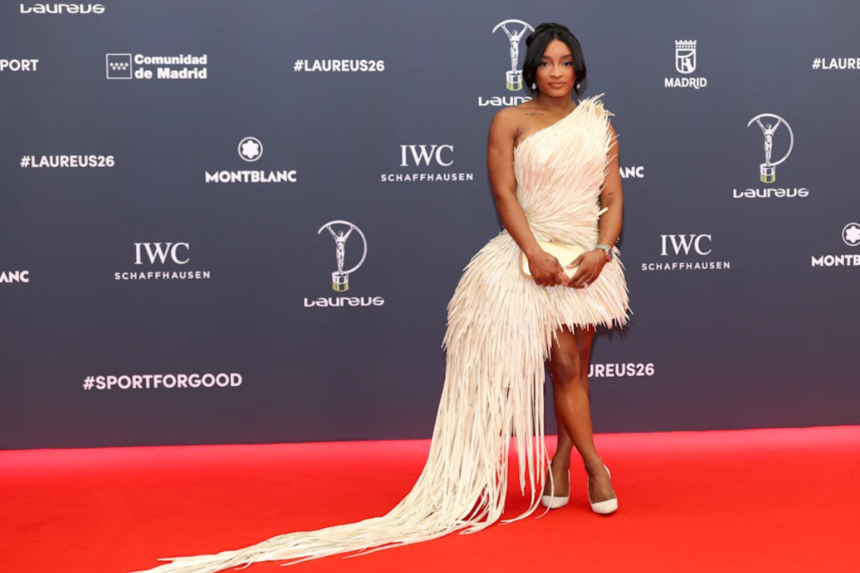
The gold one-shouldered dress Biles wore did exactly that. It generated coverage, commentary, and sustained visual recall. In that sense, the outcome matched the intent.
Cost, in this environment, is not tied to utility. It is tied to amplification.
Choice, Not Obligation
What makes this moment distinct is not the number. It is the agency behind it.
Biles is not dependent on red carpet visibility to build relevance. Her stature, built through performance, already exists independent of fashion cycles. That changes the equation.
Most public figures operate within an unspoken contract. Visibility must be maintained. Presentation must meet expectations. Biles sits outside that pressure.
Her own statement reflects that tension. If this is the standard, she is willing to step away from it.
That is not rejection. It is optionality.
A Leadership Signal in Disguise
There is a quieter layer beneath the conversation.
Industries normalize costs by repetition. Once enough participants accept a standard, it becomes invisible. Rarely does someone at the top question it publicly.
That matters because influence at her level does not require confrontation to create change. A shift in behavior is enough. If she chooses simplicity over spectacle, the signal will travel faster than any commentary.
Redefining the Standard
The debate around $23,000 will fade. The structure behind it will remain.
High-profile styling will continue to operate as an attention economy, where cost reflects reach rather than necessity. That system is stable.
What is not fixed is participation.
Biles has already demonstrated a pattern. When expectations conflict with personal boundaries, she does not negotiate with them. She resets them. The question is no longer whether $23,000 is normal. It is whether the standard itself holds when someone with enough influence decides not to follow it.
Simone Biles during the Laureus World Sports Awards 2026 gala. Photo: Getty Images
Source: INC