


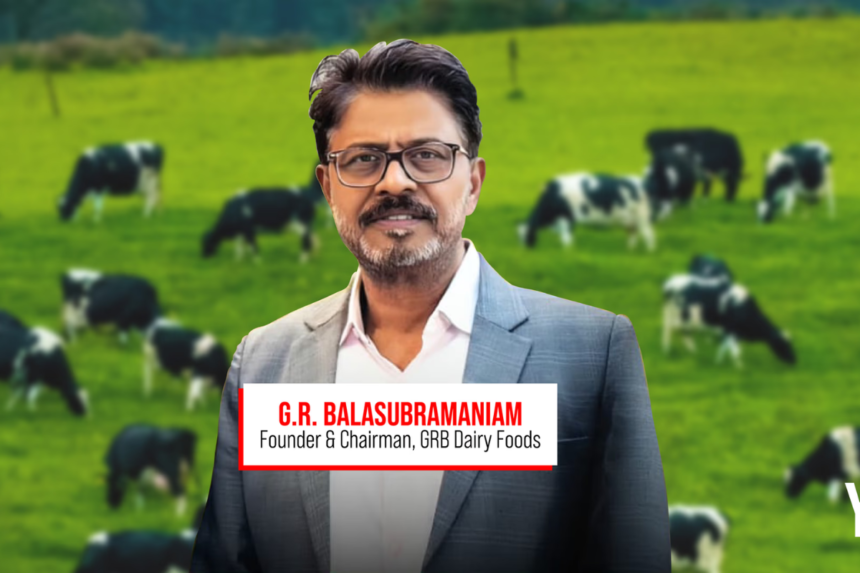
From a ₹3,000 start to a global FMCG brand, G.R. Balasubramaniam built scale through discipline, distribution, and uncompromising product quality.
A Founder Who Refuses the Word “Struggle”
G.R. Balasubramaniam does not describe his journey as difficult.
His benchmark is different. Real hardship, in his view, belongs to those who cannot meet basic needs. Everything else is simply life unfolding as it must.
That perspective sits in contrast with the structure of his own story, which includes early displacement from education, years of labor without ownership, and a late start with almost no capital.
From Village to Trade
Balasubramaniam grew up in a small village near Palani, in an environment with limited infrastructure and access to education. He showed early academic promise but left school at 13 to support a family-run butter business in Bengaluru.
For 14 years, he worked across every layer of the trade. Sourcing, production, delivery, and customer relationships. There was no formal title, but the exposure was complete.
This period formed his operating base. Not through structured learning, but through repetition and immersion.
The Break That Forced Independence
At 28, following a shift in family dynamics, he stepped out with ₹6,000 in savings. Half went into rent. The rest remained as working capital.
There was no clear plan. The first move was not production. It was trust-building. He started a small chit fund, relying on relationships built over the years. That system generated ₹50,000, which became his first inventory investment.
This is where the business began to take shape. Not from capital, but from credibility.
Identifying the Gap
The insight that defined the company was simple.
Butter spoils quickly. Retailers lost money. Hotels converted butter into ghee inefficiently, often producing inconsistent quality.
Balasubramaniam reversed the process. He bought butter, converted it into ghee himself, and sold the finished product.
The shift was not operational. It was strategic. He moved up the value chain while solving a problem for both suppliers and buyers.
Quality as a Fixed Variable
From the beginning, quality was non-negotiable.
Large dairy players optimized for efficiency, using industrial processes that produced consistent but less flavorful ghee. Balasubramaniam followed a method closer to traditional preparation, prioritizing aroma, texture, and taste.
The production cost was higher, and the pricing reflected that reality. Retailers initially resisted, questioning whether the market would accept the premium. Customers, however, responded differently. Demand grew through product experience rather than advertising. Households validated the quality through repeated use, and as consumer trust strengthened, retail acceptance followed.
Building Distribution Before It Was Standard
Expansion required a structural shift.
He moved from direct selling to building a distribution network, adopting an FMCG-style model that was uncommon in the ghee category at the time. Distributors, sales routes, and retail-level engagement became the backbone of growth.
Factories followed. First in Bengaluru, then Dindigul, then Hosur, and later near Madurai.
The system scaled without external capital. Growth was funded entirely through internal cash flows.
From Local Brand to Global Presence
GRB Dairy Foods now operates across more than 40 countries, with a portfolio spanning ghee, sweets, snacks, and spices.
Revenue has crossed ₹1,000 crore and is projected to reach ₹1,400 crore. The company employs around 2,500 people.
Ghee remains the core, contributing roughly 75 to 80 percent of the business.
No external funding has been raised. No dilution of ownership. The model has remained internally financed.
The Constraint of Scale
As GRB Dairy Foods expanded, growth created a different challenge: the founder became the operational bottleneck. To address it, the company made a deliberate shift toward professional hiring, despite the added financial pressure of fixed salaries. That decision enabled the transition from founder-led execution to system-driven operations. Today, the next generation leads key functions, bringing formal business education into a company originally built through hands-on entrepreneurial instinct.
The One Unresolved Gap
Despite GRB Dairy Foods’ scale, profitability, and global reach, one issue remains unresolved for Balasubramaniam: his inability to complete formal education. He does not frame it as sacrifice or attempt to rationalize it as a necessary trade-off. Instead, he openly acknowledges it as a limitation that shaped his communication, interpretation, and decision-making. It is the one part of his journey he does not seek to soften or reinterpret.
Conclusion
GRB Dairy Foods built its growth story not on disruption or external capital, but on three consistent pillars: product quality, disciplined distribution, and the steady reinvestment of earnings. That approach allowed the company to scale without dilution, expand without dependency, and compete globally without moving away from its core strengths. In GRB’s case, the absence of outside funding did not limit growth; it shaped how that growth was built.
Source: YS