


When Iskandarbek Narzibekov moved from London to Abu Dhabi in 2023, the reaction was predictable. He had already built a strong portfolio through Pachamama Group, with restaurants across London and Monaco. The expectation was that growth would continue outward from established markets, not reset in a city still shaping its hospitality identity.
Three years later, that decision has reversed direction. His Abu Dhabi-born concept, Soraya, is now preparing to open in London, not as an adaptation of an existing brand, but as a concept built in the UAE and exported outward.
The shift is subtle but significant. For years, the Gulf functioned primarily as an importer of global restaurant names. This move signals the emergence of the opposite flow.
A Deliberate Bet on a Different Kind of Market
The move to Abu Dhabi was not structured as an expansion play. It was a long-term bet on the city as a creative base.
Rather than importing proven formats from his London portfolio, Narzibekov chose to build something native to the environment. That required time spent understanding how people gather, how meals extend beyond the table, and how hospitality operates within a cultural framework that prioritizes family and shared experience.
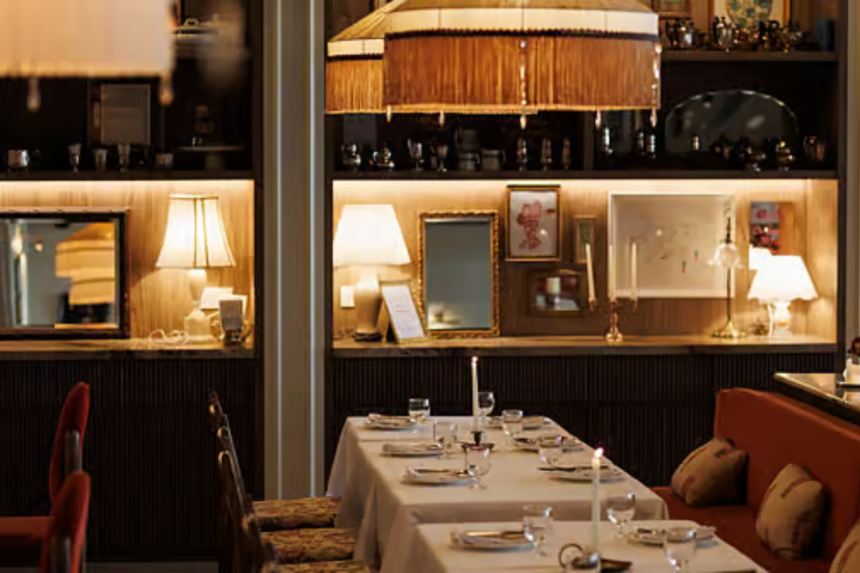
The result was Soraya, launched in Abu Dhabi in 2024 as a concept centered on communal dining and extended interaction rather than transactional service. Its early traction created enough validation to consider international expansion, with London selected as the first test of whether that identity can travel.
The Shift From Import Culture to Export Identity
The UAE’s hospitality sector has been evolving in this direction for several years, although much of the momentum has come from Dubai. Brands such as Filli, Fix Chocolatier, GOAT, and Saddle have already tested international markets through expansion and pop-ups.
Soraya represents a different layer of that trend. It positions Abu Dhabi not just as a consumer market but as a place where concepts can be developed with enough depth to scale globally.
This distinction matters. Exporting a brand is not the same as exporting a format. It requires something that holds its identity across geography without dilution.
Designing for Transferability
Soraya was not designed for London. It was designed for Abu Dhabi first.
That sequence changes how the brand behaves when it moves. Instead of adapting itself to fit a new market, it carries its original structure and translates it.
The focus remains on shared plates, long-form dining, and the social dimension of meals. These are not trends. They are behaviors rooted in regional culture. The test is whether those behaviors can resonate in a different context without being simplified or reshaped.
London becomes the proving ground for that idea.
Food as Cultural Infrastructure
The expansion strategy extends beyond a single opening. Plans already include markets such as Saudi Arabia, Bangkok, and Hong Kong.
The underlying belief is consistent. Cuisine travels faster than most forms of cultural expression. It does not require translation in the same way that art, language, or media often does. It creates familiarity before understanding.
For Narzibekov, that makes food a form of infrastructure. It carries identity across borders in a way that traditional branding cannot.
A Philosophy Rooted in Memory
The foundation of that approach traces back to his upbringing in Tajikistan, where meals were structured around connection rather than efficiency. Tables functioned as places where relationships were built and maintained.
That philosophy now shapes how Soraya operates. The emphasis is not on visual spectacle or rapid turnover. It is on how people experience time within the space, and how they leave it.
Through 971 Hospitality, Narzibekov now manages a growing global team, scaling operations while attempting to preserve that original intent.
Conclusion
Soraya’s move into London is not just another restaurant opening. It reflects a structural shift in how the UAE participates in global hospitality.
The region is beginning to export its own concepts, shaped by its own cultural logic, rather than relying on imported formats.
If the model holds, Abu Dhabi will not be defined by the brands it hosts, but by the ones it creates and sends outward.