



New trade barriers disrupt transatlantic flows, with British exporters facing sustained pressure despite partial tariff relief. The decline is not marginal. It is structural.
According to the Office for National Statistics, U.K. goods exports to the U.S., excluding precious metals, fell by £1.5 billion. That translates to a 24.7% drop following the introduction of tariffs under President Donald Trump’s “Liberation Day” policy.
The fall has not reversed. Export levels remain subdued.
The Immediate Impact on Key Sectors
The contraction is visible across categories. Car exports have declined and continue to sit below pre-tariff levels. This signals more than a temporary dip. It reflects weakened competitiveness in a cost-sensitive market.
Other goods categories have followed a similar pattern, where pricing pressure from tariffs directly affects demand.
From Free Trade to Friction
The previous environment allowed near-frictionless exchange. That structure has changed. The trade agreement introduced a 10% blanket tariff on goods entering the United States. This effectively ended the zero-tariff framework that exporters on both sides had operated within.
Products like Scotch whisky and other spirits were pulled into this shift, adding cost layers that reduce pricing flexibility in the U.S. market.
Limited Relief, Broader Pressure
The recent decision to remove tariffs on Scotch whisky offers some relief, but its impact is limited in scope. While the industry remains a major pillar of the U.K. economy, supporting around 40,000 jobs and accounting for roughly 23% of Scotland’s goods exports, this single adjustment does little to offset the broader contraction unfolding across multiple sectors. The deeper structure of transatlantic trade remains constrained.
A Widening Trade Imbalance
While exports weakened, imports moved in the opposite direction. At the start of 2026, U.K. imports from the U.S. rose, pushing Britain into a trade deficit with its largest trading partner for three consecutive months. The imbalance points to a deeper structural shift: demand remains intact, but competitiveness on the export side has steadily eroded.
The Pressure on Exporters
The challenge extends well beyond tariffs. U.K. exporters are facing compounded pressure from higher trading costs, rising domestic expenses including wages and taxes, and increasing input prices that continue to weigh on production. Together, these forces create a single outcome: margin compression. As Samuel Edwards of Ebury describes it, this “triple squeeze” is steadily eroding the ability of U.K. businesses to compete effectively in international markets.
What This Signals
The U.S. remains the U.K.’s largest export market, making a contraction of this scale far more than a trade statistic. Its impact extends across growth forecasts, industrial output, and overall trade balance stability. More than just a tariff story, it highlights how quickly trade flows can be reshaped when rising costs and new friction disrupt systems that once operated with relative openness and efficiency.
Conclusion
The sharp decline in U.K. exports to the U.S. is more than a temporary disruption; it signals a broader re-pricing of global trade. Tariffs have introduced new friction into a system long built on cost efficiency and scale, resulting in slower movement, reduced competitiveness, and a widening imbalance. Recovery is unlikely to come through isolated policy reversals; it will depend on whether exporters can adapt to a structurally reshaped trading environment.
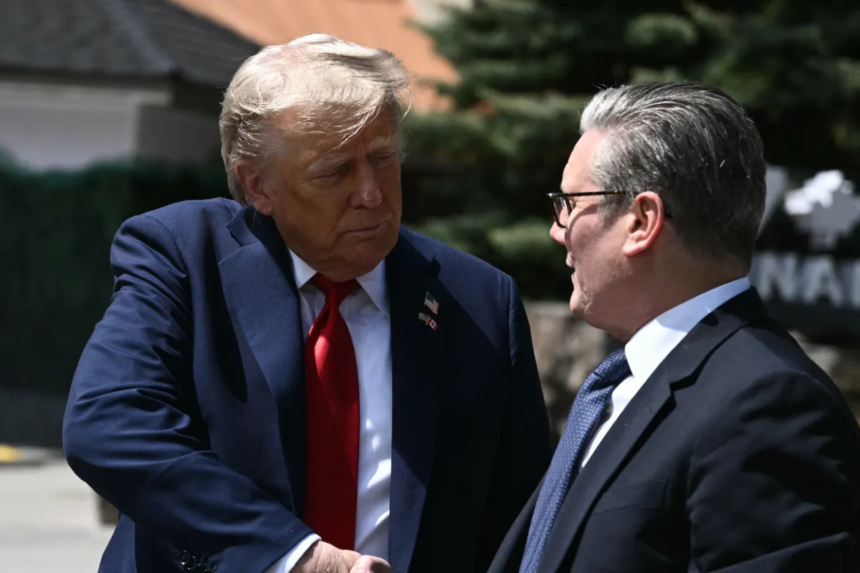
US President Donald Trump (L) shakes hands with British Prime Minister Keir Starmer as they speak to reporters after meeting during the Group of Seven (G7) Summit at the Pomeroy Kananaskis Mountain Lodge in Kananaskis, Alberta, Canada on June 16, 2025.
Brendan Smialowski | Afp | Getty Images
Source: CNBC