


Ford Motor Company is entering a decisive phase in its transformation, marked by the departure of its head of electric vehicles and software, Doug Field.
The company confirmed that Field will exit after a short transition period, closing a chapter that began in 2021 when he joined to accelerate Ford’s push into electric and digital systems.
A Structural Reset, Not Just an Exit
Field’s departure is tied directly to a broader reorganization.
Ford is consolidating its EV, software, and design functions into a new “Product Creation and Industrialization” unit. This structure will operate as an end-to-end system, integrating product development with manufacturing execution.
The unit will be led by Kumar Galhotra, reflecting a shift toward tighter operational alignment rather than siloed innovation.
The Logic Behind the Change
Under CEO Jim Farley, Ford is pursuing its “Ford+” strategy, which prioritizes efficiency, speed, and profitability alongside innovation.
The company is targeting an 8 percent adjusted EBIT margin by 2029, a goal that demands disciplined execution, not just ambitious product development.
Integrating EV and software teams into core industrial operations signals a clear intent. Build faster. Reduce complexity. Deliver at scale.
EV Ambitions Remain Intact
Despite the leadership shift, Ford’s electric roadmap remains unchanged.
A new midsize electric pickup based on the Universal Electric Vehicle platform is scheduled for launch next year. The company views this product cycle as foundational, comparable in strategic weight to historic milestones like the Model T.
Field himself indicated that the team and product pipeline are ready to move forward without disruption.
A Broader Transformation Underway
The restructuring sits within a larger overhaul of Ford’s portfolio and technology stack.
By 2029, the company plans to refresh the majority of its vehicle lineup, introduce new powertrain options, and expand software integration across its products.
By 2030, Ford expects 90 percent of its vehicles to offer electrified powertrains and advanced digital architectures, including over-the-air updates and enhanced driver-assistance systems such as BlueCruise.
No Direct Replacement Signals Intent
Ford has chosen not to appoint a direct successor to Field.
This decision reinforces the shift away from individual leadership silos toward integrated execution teams. The focus moves from visionary roles to coordinated delivery across engineering, manufacturing, and software.
Concluding View
Ford is not stepping back from electric vehicles. It is tightening control over how they are built.
The departure of Doug Field marks a transition from experimentation to execution, where success will depend less on vision and more on the ability to deliver complex products at scale, on time, and profitably.
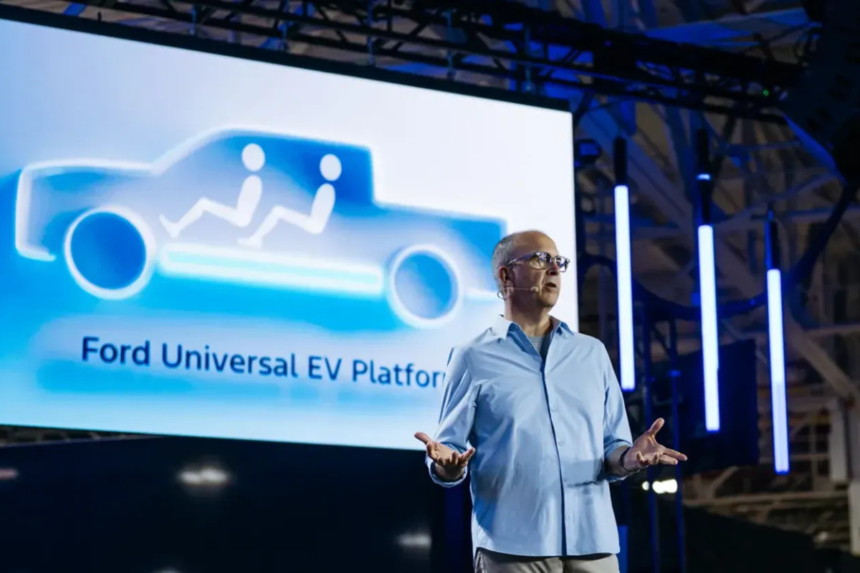
Doug Field, the chief EV, digital, and design officer at Ford Motor, speaks at Louisville Assembly Plant as Ford shares its plans to design and assemble its “Universal Electric Vehicle” platform on Aug. 11, 2025.
Courtesy: Ford
Source: CNBC