


Competitors advance while Uber deals with the long-term effects of its decision.
More than a decade ago, Uber was not just participating in the autonomous vehicle race, it was one of the frontrunners.
Under former CEO Travis Kalanick, the company launched its driverless program in 2015, positioning itself alongside early leaders like Waymo and Tesla.
That trajectory changed abruptly in 2018 after a fatal accident during testing in Arizona, an event that forced the company to reassess both its risk appetite and public image.
The Decision to Pull Back
When Dara Khosrowshahi took over, Uber made a deliberate shift.
The autonomous vehicle division was scaled back and eventually sold, as the company focused on stabilizing its business ahead of its 2019 IPO. The decision brought short-term clarity, improved margins, and helped Uber strengthen its dominance in ride-hailing.
For several years, that strategy appeared to work.
Competitors Stayed the Course
While Uber stepped away, competitors continued investing.
Waymo steadily refined its robotaxi operations, particularly in cities like San Francisco, while Tesla pushed forward with its Full Self-Driving software, improving real-world performance over time.
What once felt like experimental technology has now reached a level of maturity where autonomous vehicles are no longer theoretical; they are operational and increasingly competitive.
The Cost of Losing Time
This is where Uber’s earlier decision begins to show its long-term cost.
By exiting early, the company gave up years of compounding progress in one of the most complex technological races. Autonomous driving rewards persistence, data accumulation, and iteration.
Uber now finds itself not leading, but reacting.
A Rapid Catch-Up Strategy
Recent months show a clear shift in direction. Uber is aggressively rebuilding its position through partnerships and investments rather than internal development.
Key moves include collaborations with Rivian, Zoox, Nvidia, and multiple AI-driven autonomous platforms.
The scale and speed of these deals reflect urgency. Uber is attempting to plug a strategic gap that has widened over years.
From Platform to Dependency Risk
There is a deeper strategic concern.
If companies like Waymo and Tesla fully control autonomous ride networks, Uber risks becoming a secondary platform rather than the primary interface for mobility.
The very infrastructure Uber helped build, a global ride-hailing network, could be bypassed by vertically integrated competitors who own both the technology and the service layer.
The Lesson Behind the Shift
Uber’s situation illustrates a broader pattern in technology cycles.
Early-stage bets often look uncertain, expensive, and risky. But in foundational technologies like autonomy, stepping away too early can mean forfeiting future dominance.
Today, Uber is not abandoning the space. It is re-entering it, at a higher cost, with less control, and against competitors that never left.
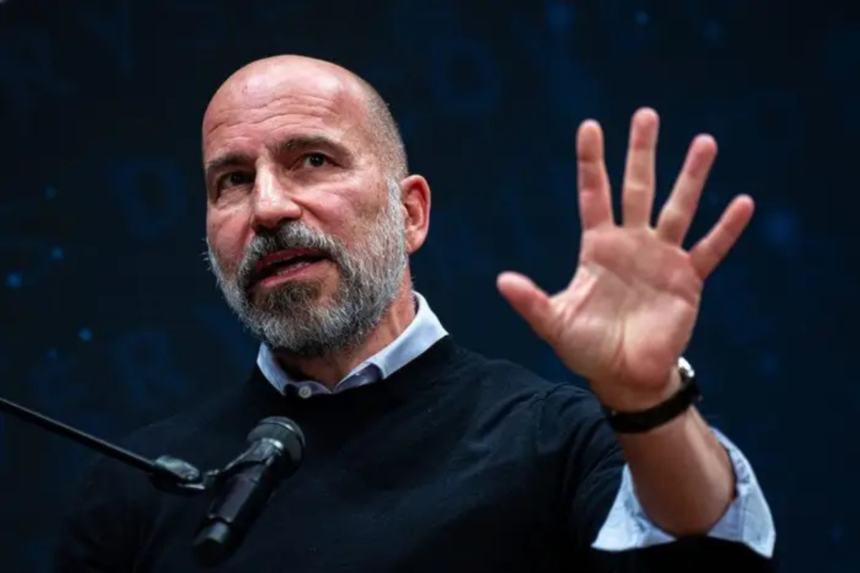
Uber CEO Dara Khosrowshahi Bloomberg / Contributor / Getty Images/Reuters