


Building AI Where Healthcare Is Hardest.
In rural India, healthcare faces challenges that go beyond distance. Clinics struggle with doctor shortages, language diversity, and unreliable internet connectivity.
In Jammu and Kashmir, the situation can become even more complex. Border tensions and security-related internet shutdowns add another layer of difficulty for healthcare delivery.
These conditions became the testing ground for O-Health, an 18-month-old clinical AI startup that built its platform to function in the most difficult environments first.
The company operates on a simple premise. If a clinical AI system works reliably in remote Himalayan regions, it can work anywhere in India.
Solving a Practical Problem in Clinical Care
Much of the global conversation around artificial intelligence in healthcare focuses on advanced diagnostics or surgical robotics.
O-Health is addressing a more immediate problem. How care is delivered during everyday consultations.
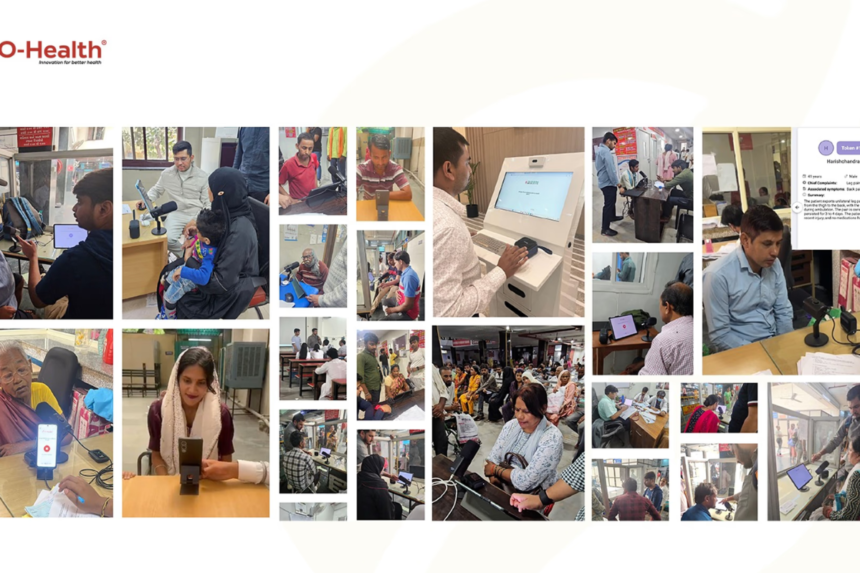
The company has developed a voice-first clinical AI platform that converts real doctor-patient conversations into structured clinical information in real time. Instead of forcing doctors to type notes during consultations, the system captures and organizes clinical data automatically.
This approach allows clinicians to focus on patients rather than screens.
Moving Beyond Data-Entry Medicine
Digital health systems have often failed in high-volume hospitals because they increase administrative workload. Doctors spend more time clicking through software interfaces than interacting with patients.
O-Health designed its platform to remove that burden.
Doctors conduct consultations exactly as they normally would. The AI system listens and converts the conversation into structured clinical records in the background. The process preserves the natural flow of medical interaction while generating documentation instantly.
Founders Built the Platform as Infrastructure
The startup was founded by Arunoday Singh and Akshar KR, whose complementary backgrounds shaped the product’s direction.
Singh, originally from Jammu and Kashmir, studied health economics at the London School of Economics. His work focuses on healthcare delivery in underserved regions. Akshar KR, a mechatronics engineer and national science awardee, leads the technical architecture behind the platform.
Together, they designed O-Health as operational infrastructure rather than a standalone software product. The company works directly with hospitals during deployment. Its team installs edge hardware, maps clinical workflows, integrates with hospital systems, and trains clinicians to use the platform effectively.
Independent AI Architecture
O-Health made a deliberate architectural decision. The company does not rely on large external AI models or foreign cloud APIs.
Instead, it built its own medical automatic speech recognition system and uses an ensemble of smaller language models designed for clinical tasks.
The platform runs on an edge-first architecture inside hospitals. This design reduces latency, protects patient data, and ensures the system continues to function even when internet connectivity fails.
For healthcare environments where reliability is critical, this architecture offers a practical advantage.
Turning Conversations Into Clinical Intelligence
The platform breaks down a medical consultation into several structured intelligence layers.
The Capture layer records doctor-patient conversations using medical-grade speech recognition designed for multilingual and noisy clinical environments.
The Understand layer structures symptoms, vitals, and clinical context into organized medical information.
If key clinical details are missing, the system generates subtle prompts that guide doctors to ask follow-up questions.
Next, the Document layer produces structured clinical notes tailored to the provider’s preferred format.
Finally, the Act and Integrate layer sends the structured information to hospital systems and national digital health infrastructure such as ABHA. The system also generates insights that support clinical and operational analysis.
Early Results Show Strong Adoption
O-Health has already completed more than 50,000 clinical consultations across its deployments.
The startup has secured over $500,000 in work orders and deployed its platform in several hospitals, including Yashoda Medicity in Delhi NCR. It is also working with state health authorities to test public healthcare deployments.
International interest is growing as well. Hospitals in the United Kingdom and Germany have expressed deployment interest, and the company plans to begin implementation in the United States.
Clinical Validation in Rural Settings
AIIMS New Delhi conducted clinical evaluations of the system in primary health centers and community health centers.
The assessment found strong similarity between O-Health’s structured outputs and documentation produced by major medical institutions. The findings indicate that the platform can deliver high-quality clinical records even in resource-constrained environments.
Toward a National Healthcare Intelligence Layer
O-Health’s long-term goal extends beyond documentation automation.
The company plans to build a national-scale clinical intelligence layer by capturing structured voice data from consultations across India’s healthcare system.
Future development will expand language coverage, improve accuracy in noisy environments, and deepen integration with hospital and public health infrastructure.
If successful, the platform could help connect data from rural clinics and major hospitals into a unified system of clinical insight.
Source: YourStory