

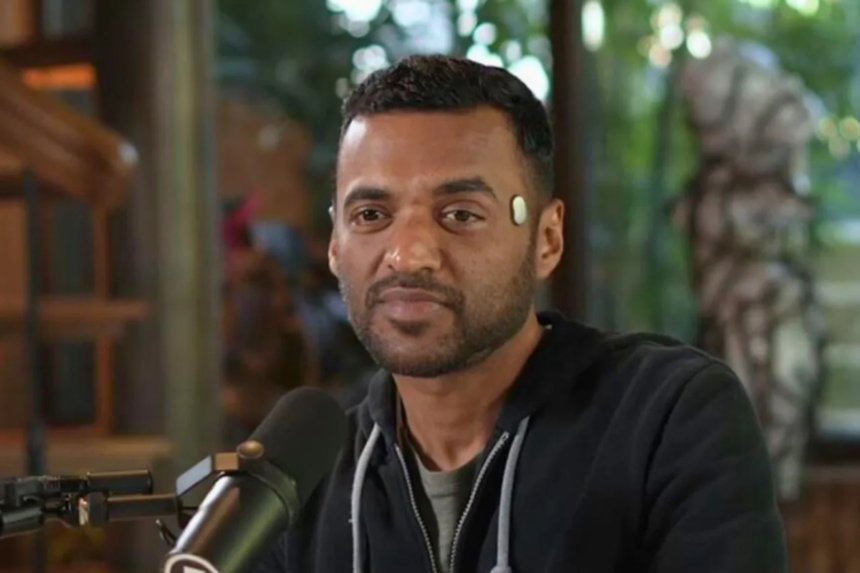
Weeks after stepping down as Group CEO of Zomato and its parent Eternal, Deepinder Goyal has launched a new venture in wearable technology.
His startup, Temple, has raised $54 million in a friends-and-family funding round at a post-money valuation of approximately $190 million.
Founder-Led Capital
In a post on X, Goyal said the round attracted founder friends and early Zomato backers willing to support the venture regardless of future listing plans.
Regulatory filings show Temple’s board approved the issuance of 234,799 compulsorily convertible cumulative preference shares at Rs 21,000 per share, totaling roughly Rs 493 crore.
Goyal led the round with an investment of Rs 104.07 crore. Steadview Capital committed Rs 90.49 crore, followed by Peak XV Partners at Rs 54.30 crore, Dharana Fund at Rs 49.77 crore, and Aaroh Fund at Rs 18.10 crore.
The round also includes participation from InfoEdge Ventures and Dharana Capital. Angel investors include Vijay Shekhar Sharma, Kunal Shah, and Nithin Kamath alongside Nikhil Kamath. Several current and former Eternal executives also invested.
More than 30 Temple employees contributed personal capital at the same valuation as external investors, without preferential pricing.
Stealth Mode, Deep-Tech Focus
Temple operates in stealth mode. Goyal has described it as a long-term initiative independent of Zomato’s food delivery and quick commerce businesses.
Hiring activity offers clues about its direction. The company is recruiting across embedded systems, computational neuroscience, and brain-computer interface engineering. That signals ambitions beyond consumer fitness wearables and into neurotechnology and advanced hardware.
If executed successfully, Temple could position itself at the intersection of AI, hardware, and human-machine interaction, a domain that demands long capital cycles and deep research capability.
A Shift From Consumer Internet to Hardware
Goyal’s pivot marks a strategic shift. After building one of India’s most recognized consumer internet brands, he now enters capital-intensive deep-tech territory.
The $54 million raise suggests investor confidence in his execution track record rather than a fully revealed product roadmap. Unlike marketplace or software ventures, wearable and neurotech platforms require longer development timelines and sustained research investment.
Temple’s early funding, founder-backed structure, and employee participation indicate alignment around a long-horizon vision rather than short-term exit metrics.
For now, the company remains quiet about product specifics. The signal, however, is clear. Goyal is building again, this time in hardware.
Source: ISN