


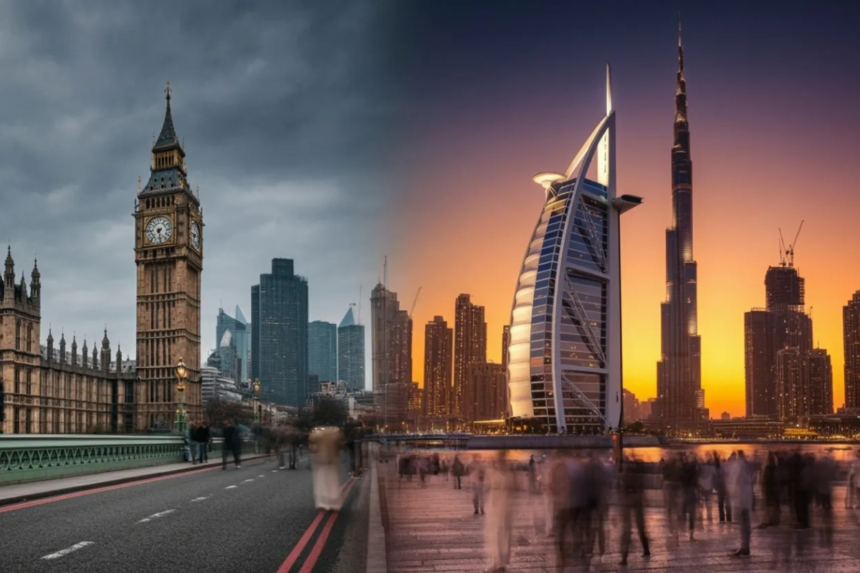
In London’s financial circles, headlines warn of a “Billionaire Flight.” Projections suggest that around 16,500 millionaires could leave the UK this year, citing tax reforms and tighter regulatory frameworks. High-profile founders such as Nik Storonsky have already shifted their base to markets perceived as more growth-aligned.
However, the narrative extends beyond capital relocation. At its core, it reflects a deeper calculation about where talent believes it can compound most effectively.
As a result, from finance to fintech, founders are increasingly looking beyond legacy ecosystems and toward jurisdictions that compress the time between idea and execution. In that shift, Dubai has emerged as one of the most prominent destinations.
Beyond Capital. A Shift in Intention
The UK built a generation of disciplined operators. Its regulatory maturity and institutional depth shaped globally competitive businesses. However, scale today demands velocity. Founders planning their next decade increasingly prioritise responsiveness, infrastructure readiness, and policy alignment with fast-moving innovation cycles.
Against this backdrop, Dubai has sharpened its ambition. Under the D33 economic agenda, the emirate aims to double its economy and rank among the world’s top three urban economies. The policy signal is clear: attract founders, retain talent, and accelerate sectors linked to technology, finance, logistics, and digital assets.
As a result, where some Western systems require entrepreneurs to navigate layers of legacy friction, Dubai structures its proposition around enablement. Streamlined licensing frameworks, specialised free zones, long-term residency pathways, and accessible capital all work to reduce structural drag.
For technology leaders accustomed to iterative speed, that difference does not just matter; it compounds quickly.
The Human Layer of Business
While macro indicators help explain movement, they do not fully explain alignment.
In many Western financial centres, commercial relationships have become increasingly transactional. By contrast, the UAE’s business culture remains deeply relational. Trust, reputation, and personal credibility often precede and shape transaction size.
For founders with multicultural identities, this environment can feel less like relocation and more like convergence. Professional ambition and cultural heritage align in ways that meaningfully reduce psychological friction.
Importantly, this is not sentimentality. It is performance architecture. In trust-driven markets, relational capital evolves into a measurable strategic asset.
The 3 Cs. Competence, Credibility, Care
Entrepreneurs who succeed in the UAE consistently demonstrate three defining attributes.
First, competence remains non-negotiable. The region attracts seasoned global operators, and performance standards are uncompromisingly high.
Second, credibility directly influences deal velocity. In tightly networked ecosystems, reputation compounds quickly — and travels even faster.
Third, care, often underestimated, determines longevity. Markets built on long-term relationships reward founders who think beyond quarterly metrics.
Together, these qualities create an environment where entrepreneurs do not merely transact. They integrate.
Move at Dubai Speed
For global founders evaluating Dubai as a base, adaptation determines trajectory.
- Trust instinct. Execute at pace.
- The UAE operates faster than many European systems. Decision cycles are compressed. Regulatory pathways move quickly. Therefore, execution discipline must match that tempo without compromising strategic clarity.
- Scale with AI. Lead with human intelligence.
- Automation enhances efficiency. However, trust closes deals. In the Middle East, durable growth rests not only on technology, but on relational depth and credibility.
- Lead with integrity. Market access follows intention.
- Founders who approach the region as a short-term arbitrage opportunity rarely sustain traction. By contrast, those who embed long-term values into their operations build platforms that endure.
From Exit Narrative to Corridor of Belonging
While the “Billionaire Flight” headline simplifies the narrative, the reality reflects a far more complex migration of expertise. In fact, a deeper pattern is emerging, one that points to the formation of a corridor linking Europe, the Gulf, and high-growth emerging markets.
Importantly, Dubai does not replace London. Instead, it complements, and in some cases accelerates, what London originally built.
For founders bridging British education with Middle Eastern heritage, the move represents more than a geographic shift. Rather, it signals a synthesis. Operational discipline meets growth-oriented policy. Global exposure aligns with regional relational depth.
As a result, talent does not simply leave one market for another. It strategically repositions itself where it believes the future compounds faster.
Today, this bridge is no longer theoretical. It has become operational.
Source: Entrepreneur
Read more news, and follow us on Instagram
Photo: Shutterstock