

NEW DELHI: More than half of the software enterprises currently rely on could soon be replaced by artificial intelligence, according to Arthur Mensch, CEO of Mistral AI.
Speaking at the India Accelerates event on the sidelines of the AI Impact Summit in New Delhi, Mensch said over 50 percent of SaaS tools purchased by IT departments may shift toward AI-driven systems in the coming years.
AI vs SaaS. A Structural Shift
Investor anxiety is already visible. Software stocks have faced pressure as generative AI tools threaten to automate workflows traditionally handled by subscription-based enterprise software.
The iShares Expanded Tech-Software Sector ETF, which includes companies such as Microsoft and Salesforce, has fallen more than 20 percent this year.
In India, major IT services players like Tata Consultancy Services and Infosys have also seen declines as markets price in AI-led disruption. Mensch framed the change as a “replatforming” moment. Instead of layering AI onto existing SaaS tools, enterprises are rebuilding workflows directly on AI systems.
He said that with proper infrastructure, companies can now create custom AI applications within days. Five years ago, similar capabilities would have required dedicated vertical SaaS solutions.
Procurement systems. Supply chain workflows. Internal task automation.
All, he argues, can now be rebuilt faster and cheaper with AI-native systems.
What Will Survive
Not all enterprise software is under threat.
Mensch clarified that “systems of record” platforms, software that manages and stores core enterprise data, are unlikely to disappear. These systems will increasingly work alongside AI rather than be replaced by it.
Other executives share this view. Bipul Sinha of Rubrik recently noted that workflow software faces disruption, while data infrastructure software may benefit from the AI surge.
India Expansion Strategy: Mistral AI is preparing to open its first office in India this year.
The company already works with multinational firms that operate in India, but is now actively exploring domestic customers in both public and private sectors.
Unlike its European strategy, where it is building data centers directly, Mistral plans to partner with Indian infrastructure providers rather than build standalone facilities.
India’s government is pushing for local AI model deployment and domestic data storage. The country’s linguistic diversity, including Hindi and Punjabi, also presents a significant opportunity. Mensch said Mistral’s large language models are designed to accommodate these needs.
The Bigger Picture
The message is clear.
Enterprise software is entering a compression phase. Legacy SaaS tools built over the last two decades may be replaced by AI-native systems built in weeks.
For AI companies, this is not an incremental change. It is a foundational shift in how businesses buy, build, and run software. For traditional software vendors, the clock is running.
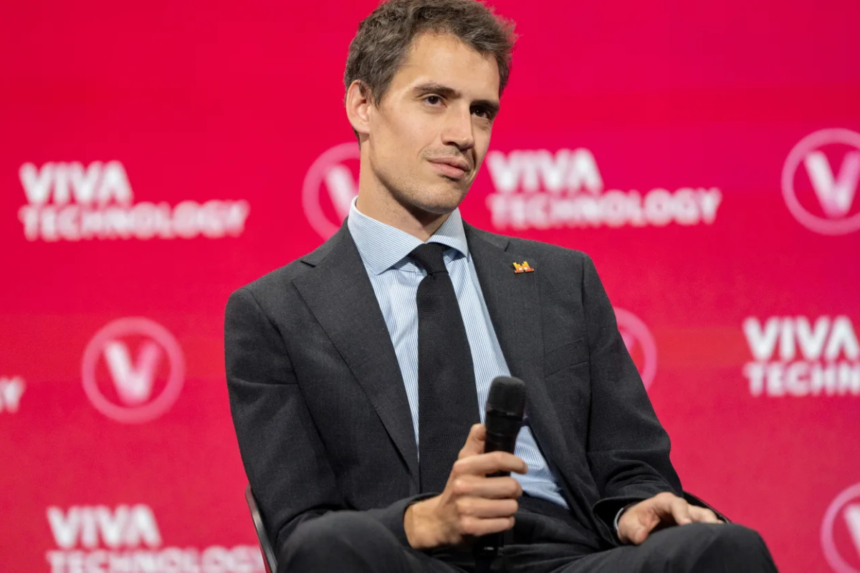
Arthur Mensch, founder of Mistral AI, during the ‘Nvidia GTC’ meeting at the 2025 VivaTech conference in Paris, France, on Wednesday, June 11, 2025.
Nathan Laine | Bloomberg | Getty Images
Source: CNBC
Read more news, and follow us on Instagram