


Today, AI startups are actively redefining how companies evaluate talent. The résumé, once the primary filter, no longer drives hiring decisions.
Instead, companies now prioritize adaptability, curiosity, and the ability to work alongside rapidly evolving technology.
This shift reflects a broader transformation. Roles are no longer fixed, and skills are no longer static.
As a result, hiring increasingly focuses on identifying individuals who can evolve as quickly as the tools they use.
Curiosity and AI Fluency Take Priority
In this context, Arvind Jain approaches hiring from a broader lens.
Rather than recruiting for narrow roles, he evaluates whether candidates can operate across changing responsibilities.
More importantly, he looks beyond experience alone and focuses on whether candidates already use AI in their daily work or personal workflows.
To assess this, applicants are often given complex tasks designed to exceed the available time.
The expectation is clear: candidates who instinctively leverage AI tools stand out.
Startups Want Builders, Not Just Specialists
Meanwhile, at Checkr, CEO Daniel Yanisse emphasizes cultural fit within a startup environment.
Specifically, the company looks for individuals who can operate without rigid structures.
In practice, adaptability, self-direction, and comfort with uncertainty serve as core requirements.
This approach reflects the nature of AI-driven businesses, as products evolve, roles evolve with them.
Therefore, employees must adapt quickly rather than rely on fixed responsibilities.
Passion Over Credentials
At the same time, Vipul Ved Prakash prioritizes a different filter: genuine interest in AI.
While technical skills still matter, they do not form the first layer of evaluation.
Instead, he focuses on intensity, a willingness to build, experiment, and engage deeply with the technology.
As a result, candidates who show energy in solving problems and exploring AI’s potential stand out over those relying solely on conventional qualifications.
Roles Are Becoming Fluid
Across these companies, one pattern remains consistent: job descriptions are becoming less rigid.
Rather than filling static roles, companies are hiring individuals who can adapt as needs shift.
Consequently, expectations have changed.
Candidates must demonstrate the ability to learn, unlearn, and quickly reapply skills, a capability that now outweighs any single area of expertise.
The New Hiring Benchmark
Ultimately, AI is not just transforming products; it is reshaping how companies build teams.
Today, employers evaluate candidates across three core dimensions:
- Their ability to use AI effectively
- Their comfort with uncertainty
- Their willingness to operate beyond defined roles
Together, these factors define the new benchmark for hiring in the AI era.
Traditional credentials still carry weight, but they are no longer sufficient.
A Redefined Entry Point Into Tech
As a result, the implication is clear: entry into AI companies is no longer restricted to conventional pathways.
Instead, what matters most is proximity to the tools shaping the future.
Those who actively engage with AI, experimenting with it and integrating it into their workflows, position themselves ahead of those who rely solely on experience.
In turn, this shift is redefining hiring priorities. Companies are moving away from evaluating what candidates have already done.
Instead, they are focusing on what candidates can do next.
Ultimately, the hiring model is evolving from proof of past achievements to evidence of future potential.
Source: BI
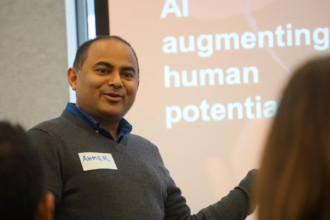
For some AI startups, a résumé is coming in second to adaptability and willingness to use AI. Shauna Clinton/Sportsfile for Web Summit Qatar via Getty Images